

Blog
History of the Dirndl? From Folk Dress to Oktoberfest Icon
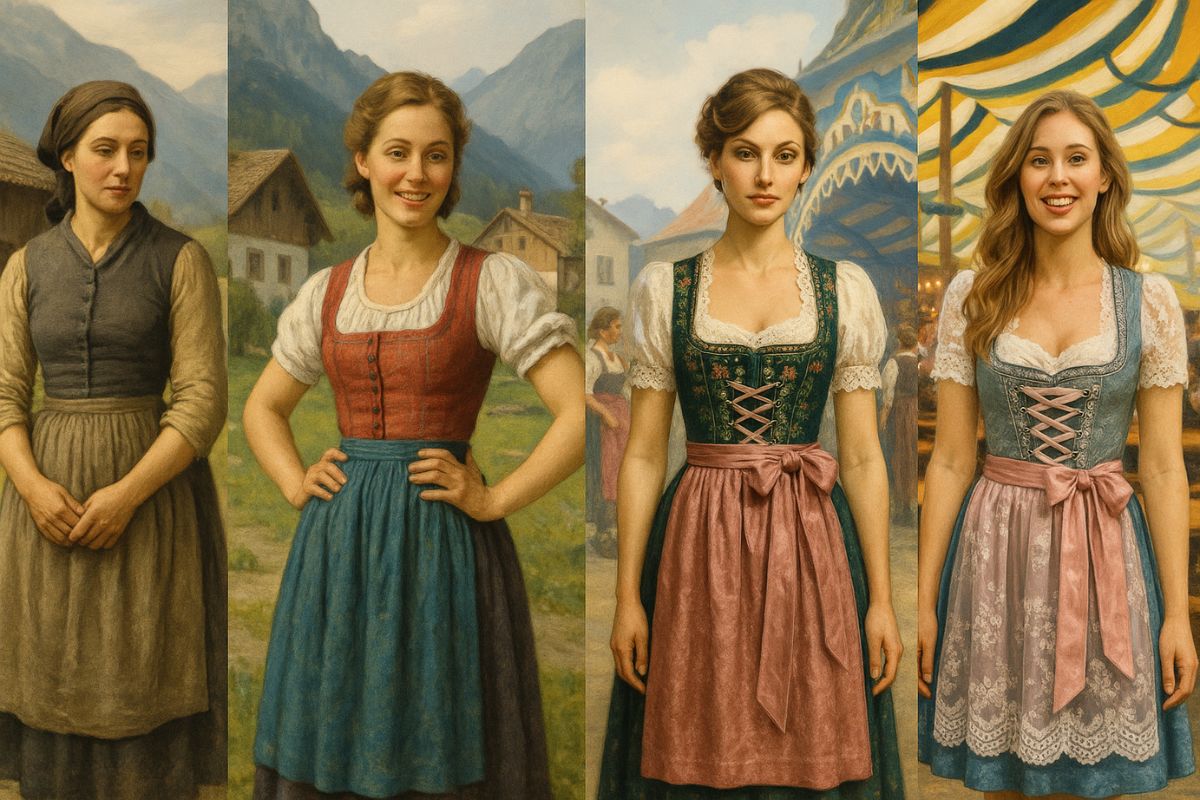
History of the Dirndl: Origins, Evolution and 2026
The dirndl has been worn by Alpine women for over two centuries — and in that time it has been peasant workwear, aristocratic fashion, Nazi propaganda tool, post-war cultural reclamation project, haute couture centrepiece, and the defining garment of the world’s largest folk festival. No other item of traditional European clothing has survived such a complicated journey and emerged more culturally vital at the end of it.
Understanding the history of the dirndl changes how you see the garment entirely. The gathered skirt, the fitted bodice, the contrasting apron, the bow tied deliberately to one side — none of these elements are arbitrary. Each one carries the weight of the specific historical moment that shaped it. This guide traces that history from its agrarian origins in the early nineteenth century through to its current position as a global symbol of Bavarian identity and authentic Trachten culture.
At German Attire, we have supplied authentic Bavarian traditional clothing to customers across the UK, US, and Australia for years. The history behind the garments we sell is inseparable from what makes them worth wearing. Read the history of Lederhosen alongside this guide for the full picture of how Bavarian Trachten evolved as a unified cultural tradition.
The Origins of the Dirndl: Alpine Working Dress Before 1800
The dirndl did not begin as fashion. It began as a solution to a practical problem faced by women working in some of the most physically demanding agricultural conditions in Europe. The Alpine regions of Bavaria, Austria, and South Tyrol presented a specific set of challenges — cold winters, wet summers, steep terrain, and work that demanded durability above all else — and the garments that evolved to meet those challenges were shaped entirely by function.
Why Alpine Women Needed a Different Kind of Dress
The standard dress forms of the early nineteenth century — corseted gowns with structured underlayers — were entirely impractical for the daily work of milkmaids, farmers’ wives, and domestic servants in the Alpine highlands. Tasks like milking, harvesting, carrying water, and tending livestock in steep pasture demanded freedom of movement, protection from cold and moisture, and fabrics tough enough to survive daily physical wear without requiring replacement.
The ensemble that evolved in response consisted of a full gathered skirt — typically wool or heavy linen — that provided warmth and allowed a wide stride. Over the skirt went a working apron, initially functional rather than decorative, protecting the skirt fabric during the most demanding tasks. A fitted bodice, laced or hooked at the front, provided torso support during physical labour. Beneath the bodice went a simple blouse with full sleeves, protecting the skin and providing an additional layer of warmth. This four-component structure — bodice, skirt, apron, blouse — is identical to the modern dirndl.
Materials and Regional Variation Before Industrialisation
The earliest dirndl-form garments were made from whatever natural fibres were locally available and locally produced. Wool — often hand-spun and home-woven — was the dominant fabric in higher-altitude communities where sheep were kept. Linen, produced from flax grown in the lower Alpine valleys, was used for blouses and lighter summer skirts. Cotton was rare and expensive before industrialisation and appeared mainly in the garments of wealthier rural households.
Regional variation was pronounced from the earliest period. The colour palettes, embroidery motifs, and specific construction details of a woman’s dress identified her village, her valley, and sometimes her family as clearly as a spoken dialect would. A woman from the Salzkammergut wore different colours and different apron proportions from a woman in the Bavarian foothills. These regional markers were not decorative choices — they were functional identity signals in communities where distinguishing between locals and outsiders carried practical social importance.
The Word “Dirndl” and What It Originally Meant
The word dirndl is itself historically significant. In Bavarian and Austrian dialect, Dirndl — diminutive of Dirn — meant simply a young woman or a girl, and by extension a maid or female servant. The dress of the Dirndl was, quite literally, the maid’s dress: the working garment of the young women who performed domestic and agricultural labour in Alpine households. That this servant’s workwear would eventually be worn by empresses, film stars, and millions of festival-goers worldwide is one of the more remarkable inversions in the history of European clothing.
The transition from purely functional working dress to something with broader cultural significance began in earnest in the first half of the nineteenth century — driven not by the women who wore the dirndl out of necessity, but by those who began to wear it out of choice.
The Nineteenth Century: From Peasant Dress to Cultural Symbol
The nineteenth century transformed the dirndl from regional working dress into something with genuine cultural and eventually political significance. Three forces drove this transformation: the Romantic movement’s idealisation of rural life, the growing interest of the European aristocracy in folk costume, and the deliberate cultural revival movements that emerged in Bavaria and Austria as responses to rapid industrialisation and urbanisation.
Romanticism and the Urban Discovery of Alpine Dress
The Romantic movement of the early to mid nineteenth century produced a powerful nostalgia among educated urban Europeans for the simplicity and authenticity they associated with rural and peasant life. Writers, painters, and poets celebrated Alpine landscapes and the people who inhabited them as representatives of an uncorrupted way of life that industrialising cities were destroying. This cultural idealisation had a direct material effect: city dwellers began visiting the Bavarian Alps and the Salzkammergut as leisure tourists, and they encountered the dirndl as part of the living culture of the regions they were romanticising.
What had been invisible as working dress became visible as a cultural artefact the moment urban observers began paying attention to it. Alpine dress was collected, copied, and adapted by visitors who wanted to bring a piece of rural authenticity back to their urban lives. The dirndl began its transformation from garment worn out of necessity into garment worn as cultural statement.
Empress Elisabeth and the Aristocratic Adoption of the Dirndl
No single figure did more to elevate the dirndl’s cultural prestige in the nineteenth century than Empress Elisabeth of Austria — known throughout Europe as Sisi. Elisabeth’s documented preference for Alpine settings, her well-publicised retreats to the Salzkammergut, and her appearances in folk-inspired clothing during her time at Ischl and her estates in the Austrian highlands carried enormous cultural weight. When an empress of the House of Habsburg chose to be associated with Alpine folk dress, the social signal was unmistakable: the dirndl was not merely acceptable in aristocratic circles — it was desirable.
The effect was a rapid adoption of stylised folk costume — Trachtmode — by the upper classes of Vienna and Munich. Tailors in both cities began producing dirndl-inspired garments in finer fabrics and with higher-quality embroidery for aristocratic and wealthy bourgeois clients. The functional working dress of Alpine maids was reborn as festive and leisure wear for the European social elite. The construction remained recognisably the same — bodice, skirt, apron, blouse — but the fabrics, embellishments, and occasion contexts shifted entirely.
The Trachtenverein Movement: 1883 and the Organised Revival
The most consequential organised effort to preserve and promote Bavarian traditional clothing began in 1883, when Joseph Vogl founded the first Trachtenverein — traditional costume association — in Bayrischzell in Upper Bavaria. Vogl’s concern was specific and urgent: industrialisation was destroying the conditions that had produced regional folk dress, and without deliberate preservation effort, the Tracht of individual Alpine communities would be lost within a generation.
The Trachtenverein movement spread rapidly across Bavaria and into Austria throughout the 1880s and 1890s. Each association worked to document the specific traditional dress of its region, to establish standards for authentic construction, and to create occasions — festivals, parades, community gatherings — at which traditional clothing would be worn collectively. This institutionalisation of folk costume was the moment at which the dirndl shifted from living practice to consciously preserved cultural heritage.
1887: The Dirndl Becomes Official Oktoberfest Attire
In 1887, Lederhosen and the dirndl were officially declared the appropriate attire for Oktoberfest — the Munich folk festival that had begun in 1810 as the celebration of Crown Prince Ludwig’s marriage to Princess Therese of Saxe-Hildburghausen. This declaration was not merely a dress code announcement: it was a formal act of cultural designation that linked two specific garments to the most important annual expression of Bavarian identity.
The effect on both garments was permanent. From 1887 onward, the dirndl was not just Alpine regional dress — it was Bavarian cultural dress, officially associated with the largest folk festival in the world and with the specific identity of Munich and the broader Bavarian state. The Theresienwiese, on which Oktoberfest is held, became the stage on which the dirndl’s cultural significance was renewed annually in front of an increasingly international audience.
| Year | Event | Significance for the Dirndl |
|---|---|---|
| Early 1800s | Alpine peasant workwear develops into recognisable form | Four-component structure established: bodice, skirt, apron, blouse |
| 1810 | First Oktoberfest — Crown Prince Ludwig marries Princess Therese | Festival founded that will become the dirndl’s most important cultural stage |
| Mid 1800s | Romantic movement drives urban interest in Alpine culture | Dirndl transitions from working dress to cultural artefact |
| 1850s–1870s | Empress Elisabeth publicly associates with Alpine folk dress | Aristocratic adoption of Trachtmode elevates the dirndl’s social status |
| 1883 | Joseph Vogl founds first Trachtenverein in Bayrischzell | Organised preservation movement begins — Tracht becomes conscious cultural heritage |
| 1887 | Dirndl and Lederhosen declared official Oktoberfest attire | Dirndl formally designated as Bavarian cultural dress at the world’s largest folk festival |
The foundations laid in the nineteenth century gave the dirndl the cultural weight it needed to survive the far more turbulent twentieth century — though that survival came at a significant cost.
The Twentieth Century: Ideology, Conflict, and Reclamation
The twentieth century subjected the dirndl to forces that no item of folk clothing had faced before. The garment’s deep association with rural Bavarian identity and its visual clarity as a symbol of traditional femininity made it useful to political movements seeking to mobilise cultural identity for ideological purposes. The story of the dirndl across the twentieth century is, in significant part, the story of how a garment can be appropriated, contaminated, and — given enough time and deliberate effort — reclaimed.
The Weimar Republic and the Dirndl Between the Wars
The 1920s and early 1930s in Germany brought the dirndl into an era of complex cultural negotiation. The Weimar Republic was a period of intense stylistic contrast — modernist fashion movements in the cities competed with conservative cultural movements in rural regions that sought to preserve traditional dress as a marker of German identity against what they perceived as cosmopolitan urban influence. The Trachtenverein movement, established in 1883, continued its preservation work throughout this period, and Oktoberfest remained the annual occasion at which Bavarian traditional dress was most publicly displayed.
The dirndl in the Weimar period was neither politically neutral nor overtly ideological — it occupied a contested space between regional pride and emerging nationalist cultural politics that would become far more explicit after 1933.
Nazi Appropriation: The Dirndl as Propaganda Tool
The National Socialist seizure of power in 1933 transformed the dirndl’s cultural context with devastating speed. The regime’s ideological framework — expressed through the slogan Blut und Boden, Blood and Soil — placed enormous symbolic value on rural German life, agricultural labour, and the folk traditions associated with both. The dirndl, as the most visible garment of traditional rural femininity in the German-speaking Alpine world, became a central element of Nazi Volkskultur propaganda.
Women at orchestrated regime events — Harvest Festivals, Nazi youth programmes, public celebrations of the agricultural calendar — were encouraged and in some contexts required to wear dirndls. The garment was deployed to represent the Nazi ideal of German womanhood: rural, fertile, rooted in soil and tradition, emphatically distinct from the cosmopolitan femininity of Weimar-era urban life. Fashion magazines published by regime-aligned organisations promoted the dirndl as the appropriate dress for German women, contrasting it explicitly with what was characterised as decadent international fashion.
The regime’s simultaneous antisemitic legislation made the dirndl’s appropriation even more charged. After the 1938 Anschluss — the annexation of Austria — Jewish women in Austria were prohibited from wearing traditional dress, including the dirndl. A garment that had evolved as the working dress of ordinary Alpine women of all backgrounds was redefined as the exclusive cultural property of those the regime classified as racially German. This deliberate exclusion gave the dirndl’s Nazi-era appropriation a specific legal and cultural dimension that extended well beyond symbolic propaganda.
Post-War Reclamation: Bavaria and Austria Rebuild the Dirndl’s Meaning
The collapse of the Nazi regime in 1945 left the dirndl in a complicated position. Its visible association with regime propaganda events meant that wearing it in the immediate post-war years carried unavoidable ideological connotations for many people, particularly in urban communities and among those who had experienced Nazi persecution directly. In some circles, the dirndl was treated as irredeemably contaminated by its wartime use.
The reclamation of the dirndl as genuine folk heritage rather than political symbol was a gradual process driven primarily by the Trachtenverein movement and by Bavarian and Austrian communities who understood the garment’s pre-Nazi history and refused to cede it permanently to its ideological appropriators. The argument was straightforward: the dirndl had existed for over a century before the Nazi regime and had served as the everyday working dress of ordinary Alpine women without political content. The regime’s appropriation was a perversion of that history, not the definition of it.
By the 1950s and 1960s, the recovery was well underway. The revival of Oktoberfest as a public celebration — the festival had been suspended during the war — gave the dirndl a new cultural stage that was explicitly post-ideological, rooted in Bavarian regional identity rather than national political projects. Each generation of Oktoberfest attendance reinforced the dirndl’s association with celebration, community, and cultural pride rather than with the ideology that had temporarily claimed it.
The Modern Dirndl: Revival, Reinvention, and Global Recognition
The twenty-first century dirndl is a different garment from its nineteenth-century ancestor in almost every respect except the one that matters most: its fundamental four-component structure. Bodice, skirt, apron, and blouse remain unchanged across two centuries of evolution. Everything else — the fabrics, the silhouettes, the occasion contexts, the global reach — has been transformed by the garment’s remarkable modern revival.
Oktoberfest and the Annual Renewal of Trachten Culture
Oktoberfest 2026 runs from 19 September to 4 October on the Theresienwiese in Munich — the same ground on which the festival has been held since 1810. What the festival does for the dirndl each year is provide the largest possible public stage for its cultural renewal. Approximately six million visitors attend Oktoberfest annually, and the majority of those who dress in traditional attire do so in the dirndl or Lederhosen. For the duration of the festival, the Wiesn is effectively the world’s largest annual demonstration of Trachten culture.
The effect of this annual visibility on the dirndl’s cultural trajectory cannot be overstated. Oktoberfest functions as a living transmission mechanism for Bavarian traditional dress — each year introducing millions of new wearers to the garment, many of whom then seek out authentic versions for subsequent festivals or cultural occasions. Our Oktoberfest Munich travel guide covers everything you need to know about attending the festival in 2026, including what to wear and where to stay.
Haute Couture and the Dirndl’s Arrival on the Runway
The dirndl’s entry into contemporary fashion at the highest level is one of the more unexpected developments in the garment’s long history. Designers including Lena Hoschek — the Austrian designer whose Trachten-influenced collections have shown internationally since the mid-2000s — and Kinga Mathe have produced dirndl versions that use silk, Swarovski crystal embellishment, hand-applied lace, and construction techniques drawn from couture tailoring rather than folk craft tradition.
These couture interpretations retain the recognisable silhouette — fitted bodice, full gathered skirt, contrasting apron — while using materials and finishing techniques that place the garment firmly in the luxury fashion category. Bridal dirndls, in particular, have become a significant sector of the premium Trachten market, with brides in Bavaria and Austria increasingly choosing a high-quality handmade dirndl over a conventional white gown for their wedding ceremony. The garment that began as a maid’s working dress is now worn at wedding altars by brides who have chosen it as the most personal and culturally meaningful expression of who they are.
Contemporary Trachten: What Authentic Looks Like in 2026
The contemporary dirndl market spans a wider range of quality, price, and cultural authenticity than at any previous point in the garment’s history. At one end sits artisan-produced traditional Trachten — garments made by specialist producers in Bavaria and Austria using regionally sourced fabrics, hand embroidery in documented regional styles, and construction techniques passed down through generations of Trachten craft. At the other end sits mass-produced festival costume — synthetic fabric imitations of the dirndl silhouette manufactured with no connection to the cultural tradition they reference.
Between these extremes, quality mid-range dirndls made from natural fibres with properly constructed and lined bodices represent the mainstream of the contemporary market. These are the garments that most Oktoberfest visitors wear — authentic enough in construction and cultural intention to be genuine Trachten, accessible enough in price to be a realistic purchase for buyers across the UK, US, and Australia. Explore our authentic Bavarian Dirndl collection to see the full range of what authentic contemporary Trachten looks like across styles, lengths, and occasions.
The Dirndl Outside Germany and Austria: Global Trachten Culture
The globalisation of Oktoberfest — now celebrated in cities from Sydney to Cincinnati to São Paulo — has carried the dirndl far beyond its Alpine origins. Oktoberfest events in the United States, Australia, and the United Kingdom attract hundreds of thousands of attendees who dress in traditional Bavarian attire, creating communities of dirndl wearers with no ancestral connection to Bavaria or Austria but with a genuine appreciation for the cultural tradition the garment represents.
This global adoption is not cultural appropriation in the meaningful sense — it is the continuation of a process that began in the nineteenth century when urban Europeans first encountered Alpine folk dress through tourism and Romantic idealisation. The dirndl has always been worn by people who were not born into the culture that produced it. What matters is the intention: wearing the garment with genuine appreciation for its history and construction, rather than as a costume stripped of cultural content.
The Cultural Meaning of the Dirndl Today
The dirndl carries more layered cultural meaning in 2026 than at perhaps any previous point in its history. For Bavarians and Austrians, it represents a direct connection to regional identity and family tradition — many families pass dirndls between generations, and the garment worn by a grandmother at Oktoberfest decades ago may be the same one her granddaughter wears today. For international visitors to the Wiesn, it represents an act of cultural participation — a tangible way of engaging with a tradition rather than simply observing it from outside.
For a complete guide to wearing a dirndl correctly — including bow placement, blouse positioning, and accessory conventions — our post on how to wear a dirndl correctly today covers every practical detail.
The Dirndl and Questions of Cultural Authenticity
The dirndl’s complex twentieth-century history — particularly its Nazi-era appropriation — continues to inform some discussions about what it means to wear the garment today. For most people in Bavaria and Austria, the post-war reclamation was successful and complete: the dirndl is understood as folk heritage that predates and survives its ideological misuse, and wearing it is an act of cultural affirmation rather than political statement. This is the mainstream view within the communities that produced the garment and continue to wear it as living tradition.
The question of authenticity in the contemporary market is a separate and more practically relevant concern for most buyers. An authentic dirndl — one with natural fibre fabric, a properly constructed and lined bodice, and finishing details applied with genuine craft — carries the history of the garment’s construction tradition in its physical structure. A cheap synthetic festival costume does not. The difference between buying authentic Trachten and buying a costume imitation is not merely a matter of price: it is a matter of engaging genuinely with the cultural tradition the garment represents or extracting only its surface appearance.
The Dirndl as Living Tradition
What makes the dirndl remarkable across its entire history is its capacity for adaptation without loss of identity. It has been peasant workwear and aristocratic fashion. It has been cultural revival and political propaganda. It has been post-war reclamation project and haute couture inspiration. Through all of these transformations, the four-component structure — bodice, skirt, apron, blouse — has remained unchanged. The silhouette that a milkmaid in the Salzkammergut wore to work in 1820 is recognisably the same silhouette that a visitor to Oktoberfest 2026 will wear on the Theresienwiese in September.
That continuity across two centuries of political upheaval, social transformation, and cultural change is not an accident. It is the result of the deliberate choices made by the Trachtenverein movement in 1883, by Bavarian and Austrian communities in the post-war decades, and by contemporary Trachten producers who understand that the dirndl’s value lies precisely in its connection to its own history. If you want to sew your own version and engage with that construction tradition directly, our guide on how to make a dirndl dress from scratch walks through every stage of the process.
Frequently Asked Questions: History of the Dirndl
When was the dirndl first worn?
The dirndl in its recognisable four-component form — bodice, skirt, apron, and blouse — developed in the Alpine regions of Bavaria, Austria, and South Tyrol in the early nineteenth century. It evolved from the working dress of rural women performing agricultural and domestic labour rather than being designed by a single individual. By the mid-1800s, it had begun its transition from working dress to culturally significant folk costume.
Who invented the dirndl?
No single person invented the dirndl. It evolved organically from the working wardrobes of Alpine women over several generations. The organised effort to preserve and standardise it as cultural heritage began in 1883, when Joseph Vogl founded the first Trachtenverein in Bayrischzell, Upper Bavaria. This preservation movement established the dirndl as conscious cultural heritage rather than simply functional clothing.
Why did Empress Elisabeth wear a dirndl?
Empress Elisabeth of Austria — Sisi — was documented wearing folk-inspired Alpine dress during her frequent retreats to the Salzkammergut and Bavarian highlands. Her affinity for Alpine settings and rural simplicity was genuine rather than purely performative, and her appearances in Trachtmode-style clothing carried enormous cultural weight. Her example helped drive the aristocratic and upper-class adoption of stylised folk dress in Vienna and Munich during the mid to late nineteenth century.
What is the difference between a dirndl and Tracht?
Tracht is the broader term for all regional traditional clothing in German-speaking Alpine communities, encompassing both women’s and men’s garments including Lederhosen. A dirndl is a specific type of Tracht — the traditional women’s dress consisting of bodice, skirt, apron, and blouse. All dirndls are Tracht, but not all Tracht is a dirndl. The Trachtenverein movement from 1883 onward worked to preserve both categories as documented cultural heritage.
How did the Nazis use the dirndl?
The Nazi regime incorporated the dirndl into its Volkskultur propaganda framework after 1933, using it as a visual symbol of idealised rural German femininity and the Blut und Boden ideology. Women were encouraged or required to wear dirndls at orchestrated regime events including Harvest Festivals and youth programme gatherings. After the 1938 Anschluss, Jewish women in Austria were legally prohibited from wearing traditional dress. Post-war reclamation efforts by Bavarian and Austrian communities gradually restored the dirndl’s pre-ideological folk heritage meaning.
When did the dirndl become official Oktoberfest attire?
The dirndl and Lederhosen were officially declared the appropriate attire for Oktoberfest in 1887. Oktoberfest itself was founded in 1810 to celebrate the marriage of Crown Prince Ludwig of Bavaria to Princess Therese of Saxe-Hildburghausen. The 1887 designation formally linked the dirndl to the festival’s cultural identity and established the connection between Bavarian traditional dress and the Theresienwiese celebrations that continues today.
What does the dirndl apron bow mean?
The apron bow placement communicates the wearer’s relationship status by Bavarian convention. A bow tied on the left signals the wearer is single. A bow on the right signals she is in a relationship or married. A bow tied at the centre back is the traditional mark of a Bedienung — a waitress working at the festival — and in some regional traditions indicates a working or neutral position. This convention is still actively observed at Oktoberfest on the Theresienwiese.
Is it appropriate to wear a dirndl if you are not German or Austrian?
Wearing a dirndl respectfully is widely accepted and encouraged at Oktoberfest and Bavarian cultural events regardless of background. The dirndl has been adopted by international visitors since the nineteenth century, when urban Europeans first encountered Alpine folk dress through tourism. What matters is wearing it with genuine appreciation for its cultural significance — choosing authentic construction over festival costume, observing established conventions like the apron bow rule, and approaching the tradition with respect rather than treating it as fancy dress.
Explore Authentic Bavarian Dirndls at German Attire
Two centuries of history are woven into the structure of every authentic dirndl. The fitted bodice, the full gathered skirt, the contrasting apron — each element connects back to the Alpine women who first wore this form of dress out of necessity and to the cultural movements that preserved it as heritage. Wearing an authentic dirndl is a way of participating in that history rather than simply referencing it.
For Oktoberfest 2026, running from 19 September to 4 October on the Theresienwiese in Munich, explore our authentic Bavarian Dirndl collection — every piece ships worldwide to the UK, US, and Australia. When you are ready to make your purchase decision, our complete guide to buying a dirndl covers everything from size and fabric to occasion-matching and accessories.
German Attire supplies authentic Bavarian traditional clothing to customers across the UK, US, and Australia. Visit our store at 27 Victoria Street, London SW1H 0EX, or browse our complete collection online at germanattire.com.

Anna Bauer is a seasoned Bavarian fashion expert, cultural consultant, and heritage stylist with over a decade of hands-on experience in traditional German clothing. Born in Munich, the heart of Bavaria, Anna grew up surrounded by the rich traditions of Trachten fashion. Her passion for cultural attire led her to pursue a degree in Fashion and Textile Design at the prestigious University of the Arts Berlin, where she specialized in European folkwear.
Over the past 12+ years, Anna has collaborated with renowned Trachten designers, styled outfits for Oktoberfest events across Germany, and contributed articles to top fashion and culture magazines across Europe. Her work focuses on preserving the authenticity of Lederhosen and Dirndl wear while helping modern audiences style them with confidence and flair.
As the lead content contributor for German Attire, Anna combines her academic background, professional styling experience, and deep cultural roots to provide readers with valuable insights into traditional German fashion. Her blog posts cover everything from historical origins and styling guides to care tips and festival outfit planning—making her a trusted voice for anyone looking to embrace Bavarian heritage in a stylish, modern way.