

Blog
What Is a German Beer Girl Called? The Real Answer
What Is a German Beer Girl Called? The Real Answer
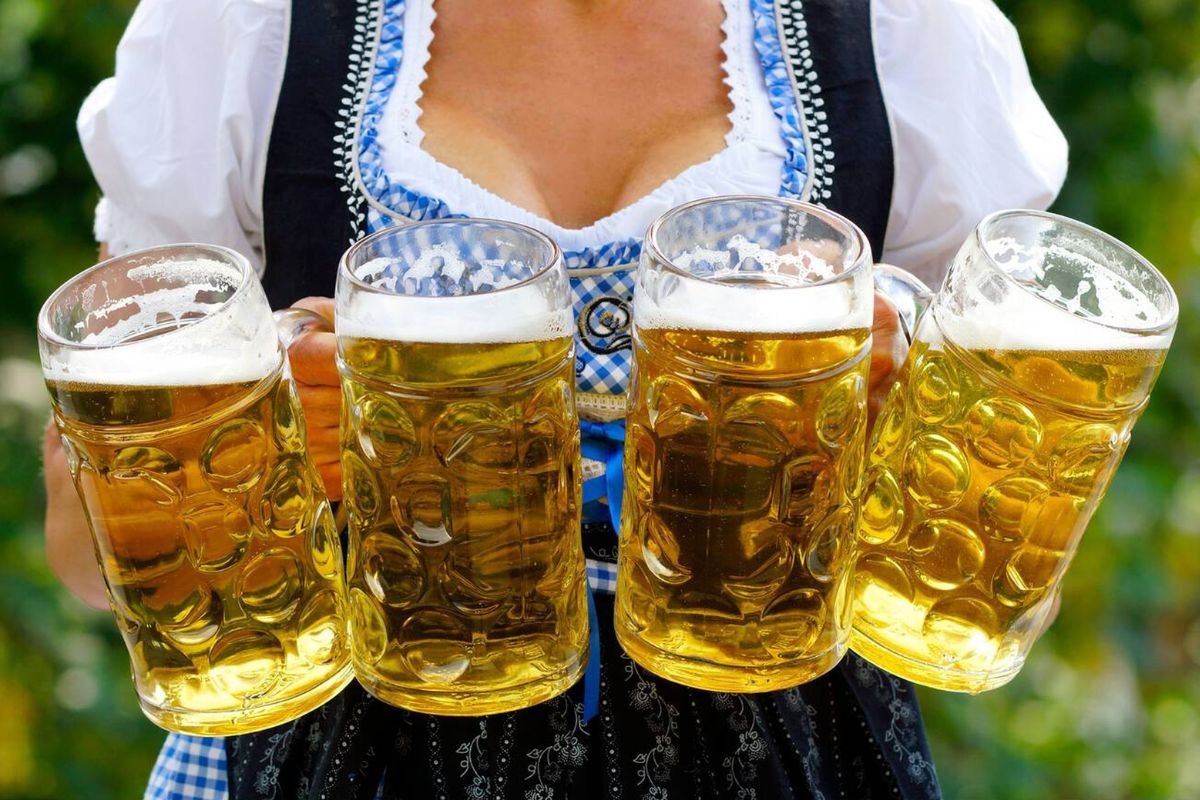
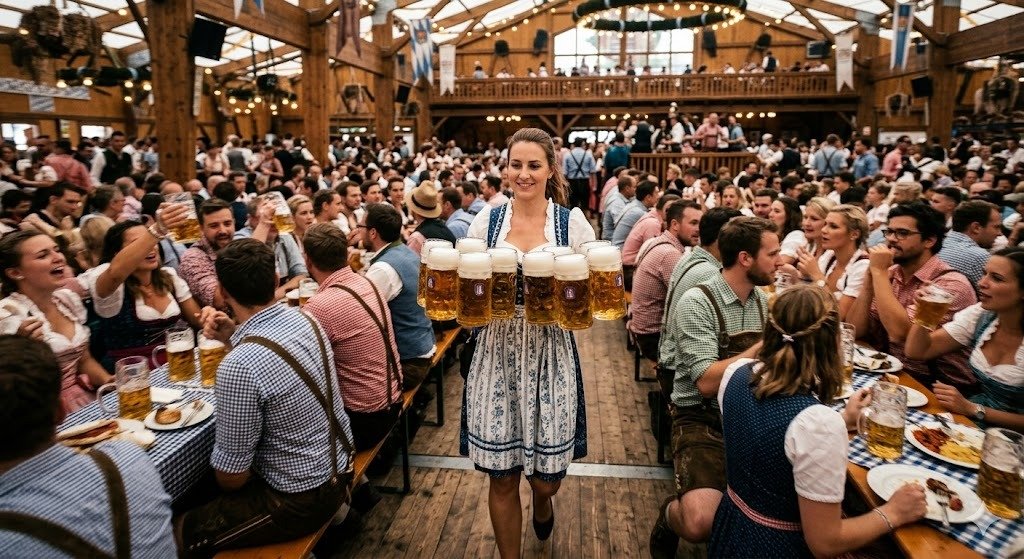
Every September, one image dominates global media coverage of the Munich festival: a woman in a Dirndl, both arms extended, carrying what looks like an impossible number of one-litre beer mugs through a packed tent. Internationally, she gets called a German beer girl. In Bavaria, nobody calls her that. Understanding what she is actually called — and what the correct terms reveal about Bavarian culture — is the first step toward understanding the real tradition behind the image.
The gap between the international phrase and the German reality matters. The women working in Munich’s beer tents are not symbolic figures or festival decorations. They are highly skilled professionals who work 10 to 12-hour shifts on their feet, carry up to 28 kilograms of beer in a single trip, navigate packed aisles of thousands of revellers, and in many cases return to the same tent year after year building a professional reputation that regular visitors recognise. The correct terminology reflects this professional reality. The tourist phrase does not.
This guide covers every German term used to describe these women, what each reveals about how Bavarians understand the role, the physical and professional demands of the work, the Dirndl uniform that defines their visual identity, and how the global image developed from its Bavarian origins into one of the most recognisable cultural exports in the world.
The Correct German Terms: What Bavarians Actually Say
Kellnerin — The Professional Title
The correct German word for a female waitress or server is Kellnerin. This is the term used in a professional context at Oktoberfest and in every other German-speaking setting where a woman serves food and drink. Its male equivalent is Kellner. The plural — referring to multiple female servers — is Kellnerinnen.
The authentic answer to what a German beer girl is called is Kellnerin — a professional waitress who exemplifies Bavarian hospitality while wearing traditional Dirndl attire that communicates cultural identity and personal status through centuries-old customs. When a Munich local refers to the server who just brought their Masskrug, they say “die Kellnerin” — not “beer girl”, not Biermädel, not any of the English-language phrases that circulate internationally. The word emphasises professionalism and skill, which is exactly how Bavarians understand the role.
Wiesn Kellnerin — The Festival-Specific Term
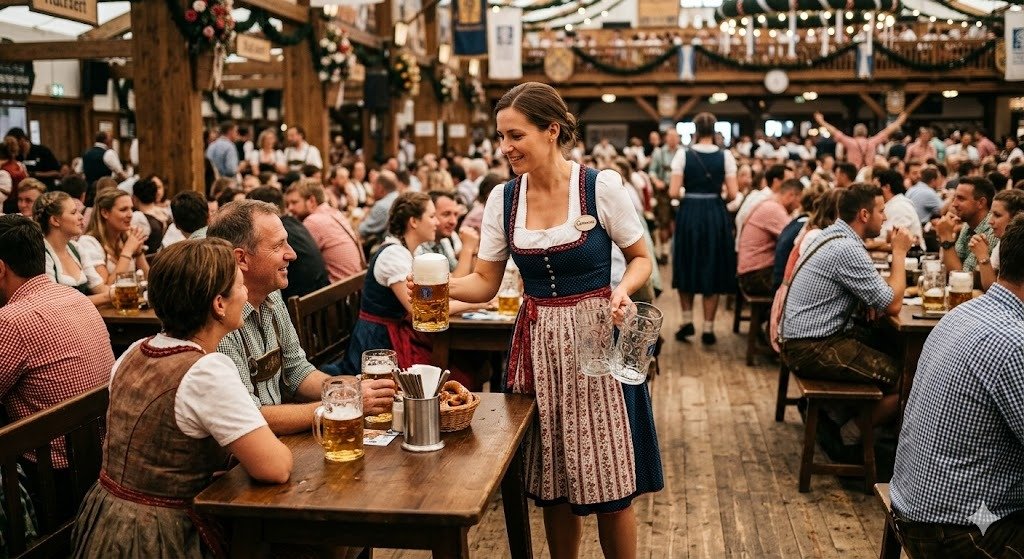
Within the context of the Munich festival specifically, the more precise term is Wiesn Kellnerin. Wiesn is the Bavarian dialect name for the festival — derived from the word for meadow, reflecting the Theresienwiese location — and attaching it to Kellnerin creates a title that is specific to the festival environment. A Wiesn Kellnerin is not simply a waitress who happens to be working at a beer festival. She is a specialist in festival service: managing the particular demands of a beer tent holding 8,000 to 10,000 people, working within the specific protocols of a tent that has its own established culture and regulars, and maintaining the standard of Bavarian hospitality under conditions that no regular restaurant approaches.
This term appears most commonly in the professional language of the festival — in employment listings, in the discussions between tent operators and their staff, and in the increasingly visible social media presence of Munich festival servers who document their work. It is the term most likely to be used by the servers themselves when describing what they do.
Bedienung — What the Tents Call Their Staff
A third term worth knowing is Bedienung — the German word for “service” used as a noun to describe a server of either gender. In the beer tent context, Bedienung refers specifically to the serving staff rather than the management or kitchen teams. Regular festival visitors and the servers themselves use this word most naturally — on social media, in conversation, and in the day-to-day language of the Wiesn. It carries no gender specification, applying equally to male servers in Lederhosen and female servers in Dirndl.
Bierkeller-Madl and Biermädel — The Colloquial Versions
Bierkeller-Madl is what locals say when referring to the servers at beer festivals like Oktoberfest — literally meaning “beer cellar girl,” rooted in the tradition of Bavarian beer hall and beer garden culture that predates the festival in its current form. This term is warmer and more colloquial than the professional Kellnerin, used in casual conversation and festive contexts rather than formal employment or media descriptions.
Biermädel — literally “beer girl” — is a similarly playful term, used in the lighthearted atmosphere of the festival itself rather than as any kind of official designation. It is closer in register to the English “beer girl” than any of the other German terms, which is probably why it surfaces in conversations between German speakers and international visitors. Neither term diminishes the professional reality of the role — they are simply the informal, festive versions of a more substantial professional identity.
Bavarian Madln — The Regional Plural
In Bavarian dialect, Madl means girl or young woman — equivalent to the standard German Mädchen. The term Bavarian Madln is also commonly used in Bavaria to refer to traditional servers in a festive context. It appears most naturally in the plural, referring to the group of servers working a tent collectively. Like Bierkeller-Madl, it is regional and colloquial rather than professional — the language of belonging to a community rather than holding a job title.
Why the Tourist Phrase Misses the Point
The phrase “German beer girl” is an English-language construct that emerged from tourism, advertising, and the global spread of Oktoberfest imagery through travel media and beer marketing. In everyday German life, the term “beer girl” is simply not something Germans use. The women who serve drinks are called Kellnerinnen or Servicekräfte — professional roles respected in the same way as restaurant and café servers anywhere in the world.
The distinction matters not just for linguistic accuracy but for cultural respect. When you call the person carrying your Masskrug a “beer girl,” you are using a tourist invention. When you call her a Wiesn Kellnerin, you are using the language she would use to describe herself. The second choice communicates that you understand something genuine about the tradition you are participating in — and in a festival that takes its cultural authenticity seriously, that distinction is felt.
The Physical Reality: What the Work Actually Demands
The Weight of a Single Round
Each Masskrug — the one-litre glass stein used exclusively at the Munich festival — weighs approximately 1.3 kilograms empty and 2.3 kilograms when filled with Festbier. It is not unusual for a skilled server to carry 10 to 12 at a time, requiring not only strength but incredible balance to weave through tightly packed beer tents without spilling a drop. Ten full steins weigh 23 kilograms — approximately the weight of a large carry-on suitcase. Twelve weigh 27.6 kilograms. These are not carried with both hands resting on a tray. They are gripped between the fingers of both hands, interlocked, with the weight distributed along the forearms, and carried at waist height through aisles between benches of seated guests who are themselves unpredictable in their movements.
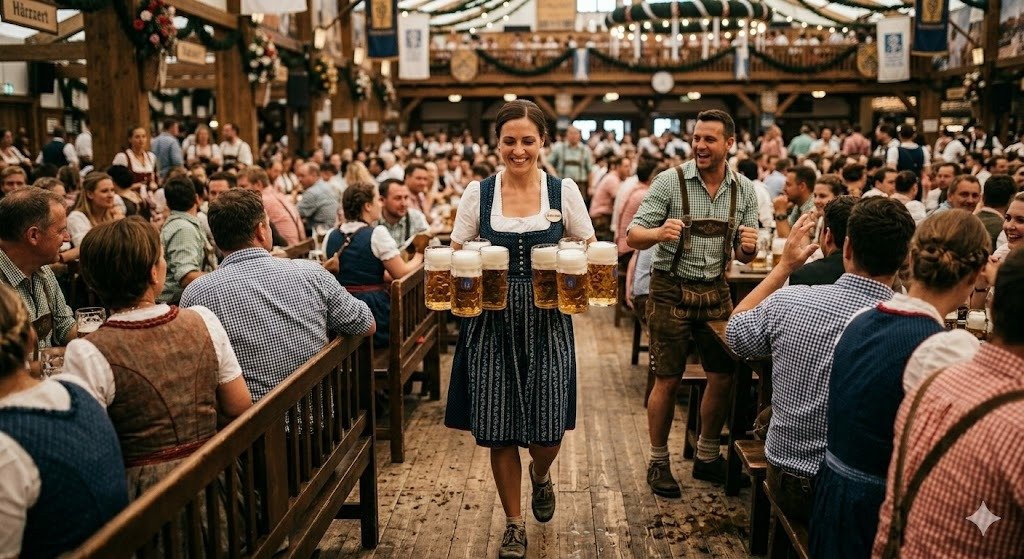
The technique for holding multiple steins is specific and learned. The handle of the first stein goes between the thumb and index finger. The second handle goes between the index and middle finger. Each subsequent stein occupies the next finger gap. The structural integrity of the entire load depends on the grip remaining consistent throughout the walk from the serving area to the table. Developing the hand strength and technique to do this reliably, session after session, across a 10-hour shift, takes months of preparation rather than days.
The Shift Reality: 10 to 12 Hours, Every Day
During the festival, a Wiesn Kellnerin works shifts of 10 to 12 hours. The tents open at 9am on weekends and 10am on weekdays, with the last service at 10:30pm. Between opening and close, a server on a busy Saturday might walk 20 to 25 kilometres within the confines of the tent — weaving through benches, returning to the service area, carrying orders, managing requests, handling payments, and maintaining the warmth and efficiency of Bavarian hospitality throughout. The festival runs for 16 days. Most servers work every day.
The physical preparation begins well before September. Many Wiesn Kellnerinnen work year-round in Munich beer halls — the Hofbräuhaus, the Augustinerkeller, the Paulaner am Nockherberg — building the specific forearm and shoulder strength that festival carrying demands. Some undertake specific training programmes in the months before the festival. The physical conditioning required is comparable to athletic preparation, not casual workplace fitness.
The Guinness Record That Defines the Extreme
The most famous demonstration of what Oktoberfest servers are physically capable of is the world record held by German server Anita Schwarz. In 2008, she carried 19 full Masskrug — approximately 43 kilograms of beer — over a distance of 40 metres without spilling. The weight she managed in that single carry represents roughly the body mass of a ten-year-old child, held at arm’s length between her fingers. The record stands as a demonstration of what years of professional festival service develops in terms of raw physical capability.
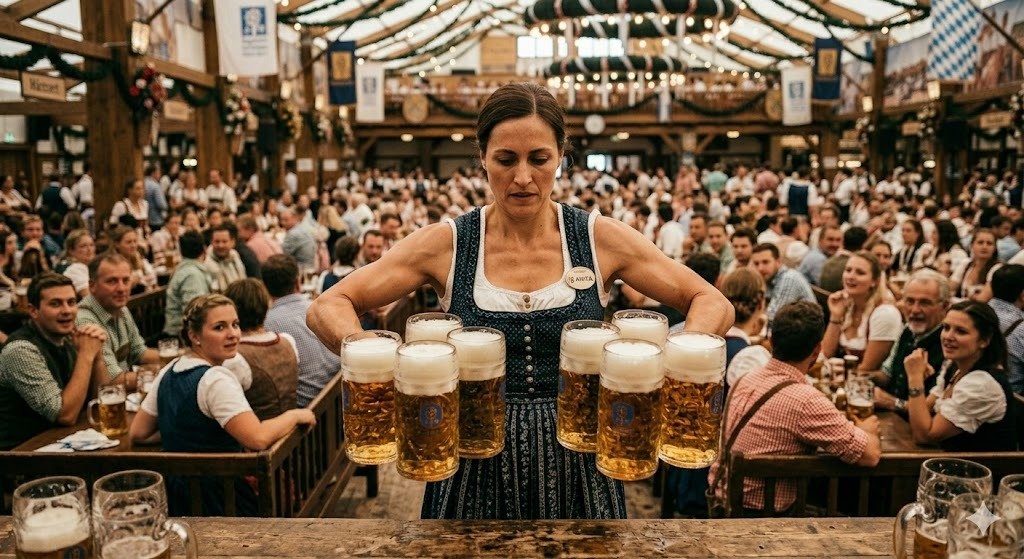
Annual stein-carrying competitions are held in Bavaria outside the festival context, testing strength and balance in a format that celebrates the professional skill rather than the cultural image. These competitions attract serious participants, not novelty acts — the distinction reflecting how genuinely the professional community regards the physical demands of the work.
The Dirndl Uniform: What Servers Wear vs What Guests Wear
The Professional Server’s Dirndl
The Dirndl worn by Wiesn Kellnerinnen is visually similar to the Dirndl worn by guests but functionally and traditionally distinct in several specific ways. Servers within the same tent wear identical Dirndl designs and colours — the tent operates as a visual unit, and the uniformity of the servers’ dress is part of the tent’s identity. Guests wear whatever Dirndl they have chosen. The server’s Dirndl marks her as belonging to the tent.
The server’s Dirndl replicates the traditional Bavarian silhouette with a white Carmen blouse and laced bodice accentuating the bust, and uses a functional apron specifically designed to protect the dress from beer spills rather than purely decorative ones. The bodice of the traditional server Dirndl retains the metal eyelet lacing system — the cord threaded through eyelets — that pre-dates the modern zip and button closures found on contemporary guest Dirndl styles. This lacing system, combined with the rich tones of the vintage colour palette, connects the server’s uniform to the 19th-century origins of the Dirndl more directly than most contemporary guest versions do.
For the complete breakdown of what guests wear and how to dress for the Wiesn, our complete women’s Oktoberfest outfit guide covers every component from blouse to shoes. Browse our Bavarian traditional Dirndl collection and Dirndl blouses for authentic options that reflect the same tradition the servers represent. For guidance on wearing a Dirndl correctly — including what the apron bow position communicates — our guide on how to wear a Dirndl correctly covers every detail.
The Apron: Functional and Symbolic
The server’s apron differs from the guest’s in one important functional way: it is designed to absorb beer spills. A server carrying 12 steins of Festbier through a crowded tent will inevitably lose some to sloshing. The apron’s material and construction account for this reality. It is replaced between shifts when necessary rather than worn for a full two-week festival from opening day to closing night.
The symbolic dimension of the apron — the bow position that communicates relationship status — applies to servers as well as guests. A server’s apron tied at the centre back traditionally signals that she is working — the back bow being the convention for waitresses and widows. This is one of the details that knowledgeable festival visitors read automatically and that first-time guests discover with genuine surprise. The apron is not merely decorative. It is a communication system that has been part of Dirndl culture for generations.
Our ladies’ Oktoberfest dress collection includes traditional styles whose apron bow placement follows exactly these conventions — the cultural vocabulary of the Dirndl preserved in every piece.
The Hofbräuhaus and Beer Hall Culture: Where the Image Originates
The Hofbräuhaus as the Global Template
When it comes to experiencing genuine German beer hall culture, the Hofbräuhaus in Munich stands apart as a historic institution dating back to 1589. Renowned for its lively atmosphere and traditional Bavarian charm, the venue features waitresses in classic Dirndls who add to the festive ambiance that locals and visitors seek out specifically. The Hofbräuhaus is not simply the most famous beer hall — it is the establishment that defined the global template for what a German beer hall looks like, feels like, and is served by.
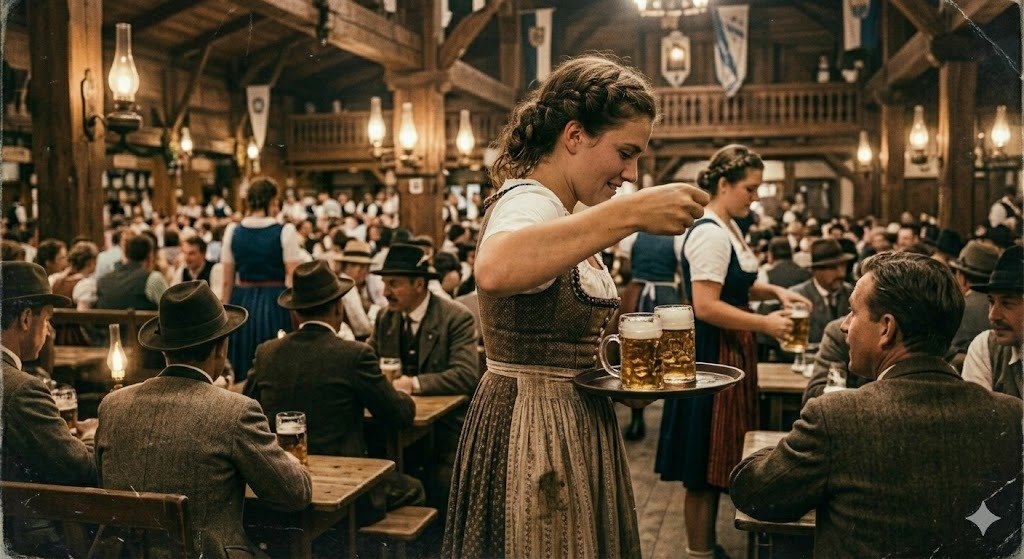
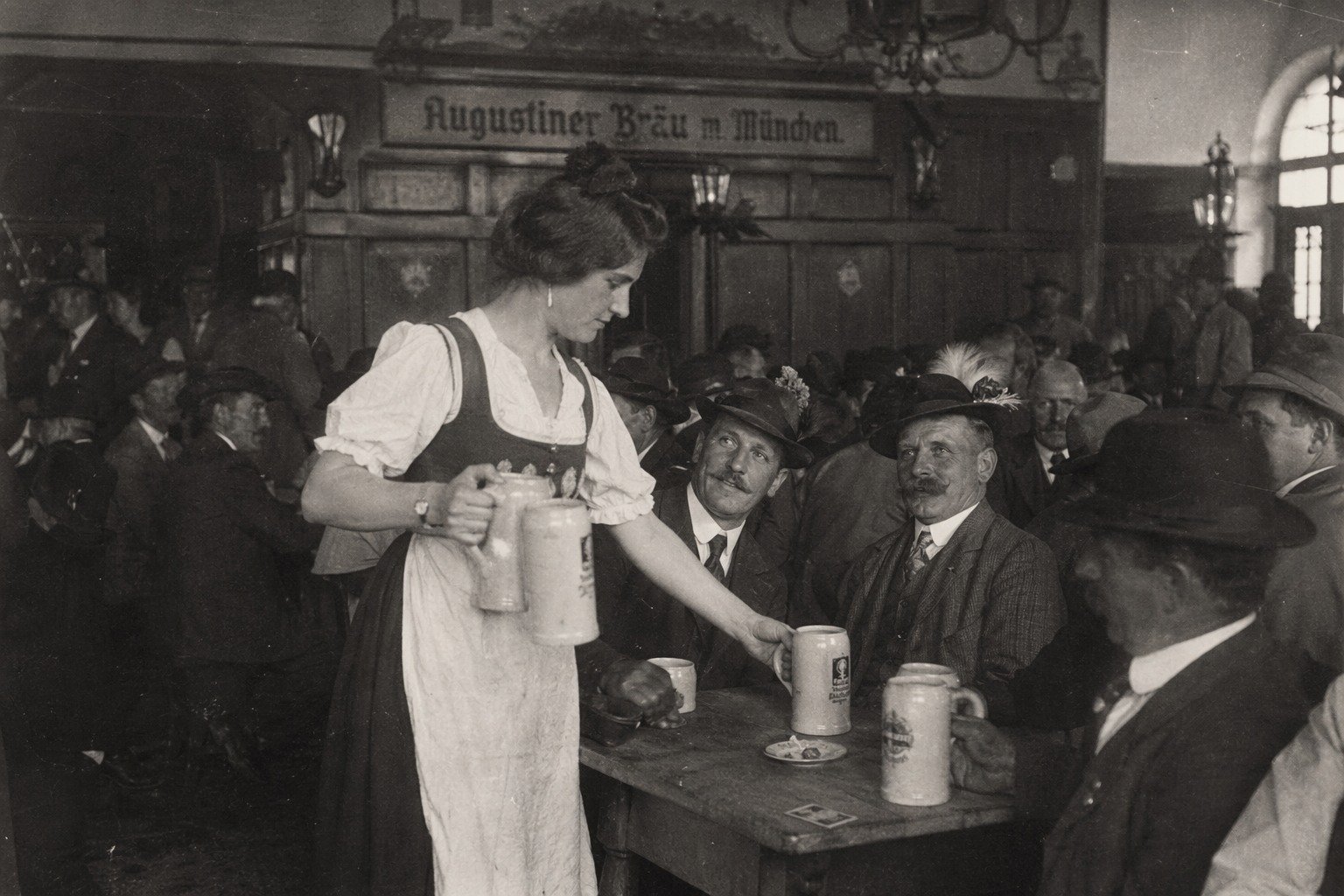
The image that became the internationally recognisable “German beer girl” — the smiling woman in Dirndl carrying multiple steins — originated in the working reality of establishments like the Hofbräuhaus and spread globally through the Munich festival’s growing international reach in the 20th century. Travel posters from the 1920s and 1930s, beer advertising from the post-war American market, and eventually film and television all reproduced the same image until it became synonymous with German culture itself in the international imagination.
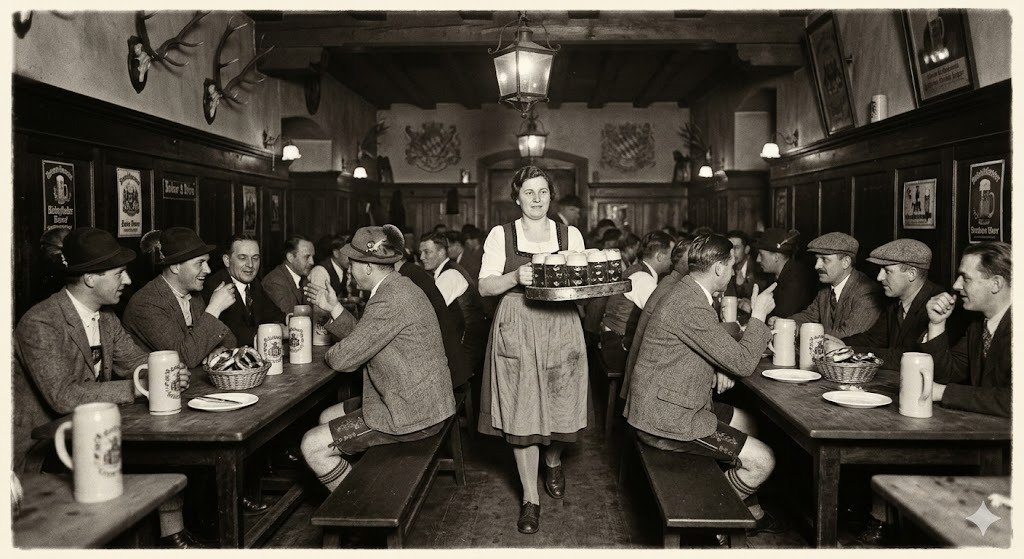
The festival grounds at the Theresienwiese festival grounds expanded this visibility to its current scale. Six million annual visitors from every country in the world encounter the Wiesn Kellnerin in her natural environment and carry that image home with them — to Australia, to the United States, to Japan, to Brazil. The image replicates itself globally through millions of personal photographs and social media posts every September, which is why it has become perhaps the most widely reproduced single image of German cultural identity.
The Reinheitsgebot Connection
German beer culture has deep historical roots guided by the Reinheitsgebot — the beer purity law established in 1516 — which stipulates that beer may only be brewed from water, malt, hops, and yeast. The servers at Munich festival tents are not pouring mass-produced generic lager. They are pouring Festbier brewed by Munich’s six licensed breweries — Augustiner, Paulaner, Hofbräu, Spaten, Hacker-Pschorr, and Löwenbräu — each of which has brewed to Reinheitsgebot standards for centuries. The beer in the Masskrug is itself a product of one of the world’s oldest and most specific food quality laws.
Understanding this connection shifts the perception of the server’s role. She is not simply delivering an alcoholic beverage. She is delivering a product that represents 500 years of German brewing tradition, in a vessel that has not changed in design for over a century, at a festival that has been continuous for over 200 years. The cultural weight of each Masskrug carried across the tent floor is considerably heavier than its physical 2.3 kilograms.
The Professional Reality: How Servers Are Hired and What They Earn
Qualifications and the Path to the Festival
Working as a Wiesn Kellnerin is not an entry-level casual job available to anyone who applies. The festival tents employ thousands of servers, but the selection process is competitive and experienced candidates have significant advantages over first-time applicants. Working at Oktoberfest requires special qualifications and training. Famous beer girls Munich must navigate crowded tent environments, manage large orders efficiently, and maintain traditional customs while dealing with international visitors. Many Oktoberfest servers return year after year, developing regular customers and becoming part of the festival’s extended family.
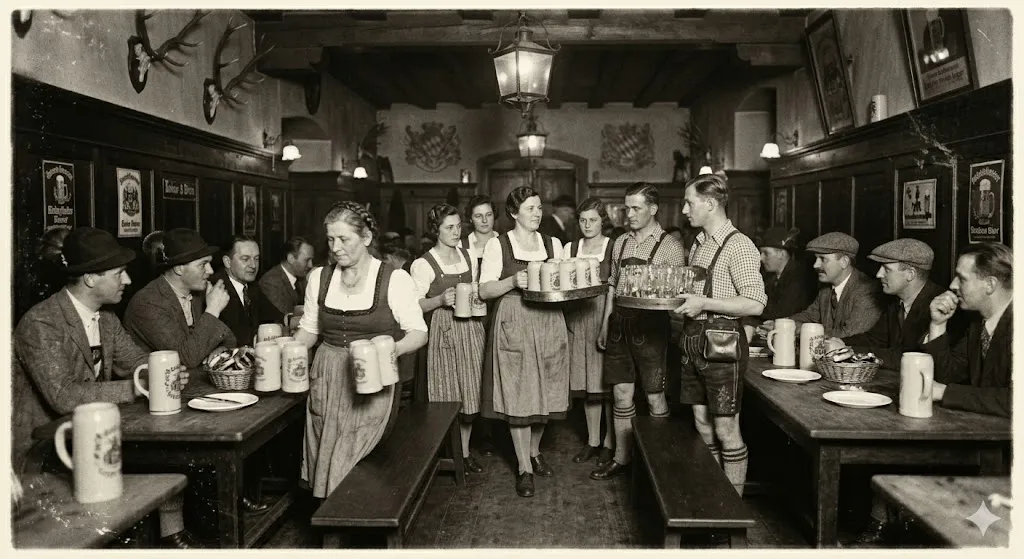
The most reliable path to festival employment is working year-round in Munich’s established beer halls and gardens. Employers at the festival tents draw heavily from the pool of staff already working in Bavarian hospitality who understand the physical demands, the cultural protocols, and the service standards expected at a Wiesn-level establishment. Language skills are an advantage — many of the six million annual visitors speak English, Italian, Spanish, Japanese, or Portuguese rather than German, and a server who can communicate naturally across language barriers is more valuable than one who cannot.
Earnings and the Economics of Festival Service
The economics of Wiesn Kellnerin work are specific and significant. Servers at the festival keep their tips, and tipping at a Munich beer tent is standard practice among both German and international visitors. The convention is to round up or add approximately 10% on top of the bill. Across a full 12-hour shift serving thousands of festival-goers during peak weekend sessions, a skilled server’s tip income for a single day can be substantial.
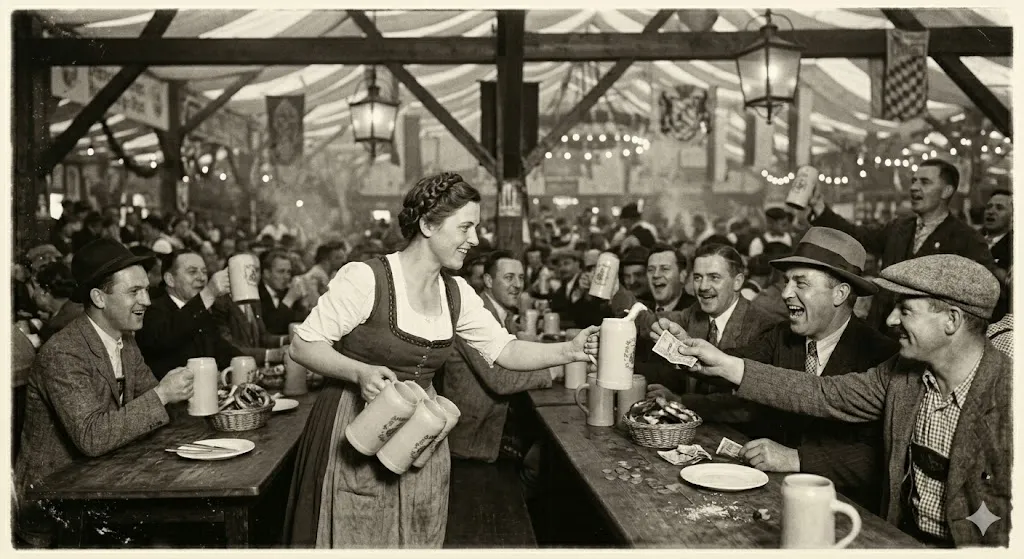
The full-time employment structure means that servers commit to the entire 16-day festival, working every day. The combination of base pay, tip income, and the concentrated duration of the festival makes October a financially significant month for experienced Wiesn Kellnerinnen — one reason so many return year after year despite the physical intensity of the work. Taking annual leave from a regular job specifically for the festival period, as many servers in full-time employment do, is entirely standard practice within the professional community.
Male Servers: The Parallel Role in Lederhosen
The global image of Oktoberfest service focuses almost entirely on female servers in Dirndl. Male servers — Kellner in Lederhosen — work alongside them in every tent and carry the same physical demands and professional requirements. The visual emphasis on the female server is a product of international tourism and advertising rather than Bavarian cultural practice. Within the tents themselves, male and female servers are equally present, equally skilled, and equally integral to the service operation.
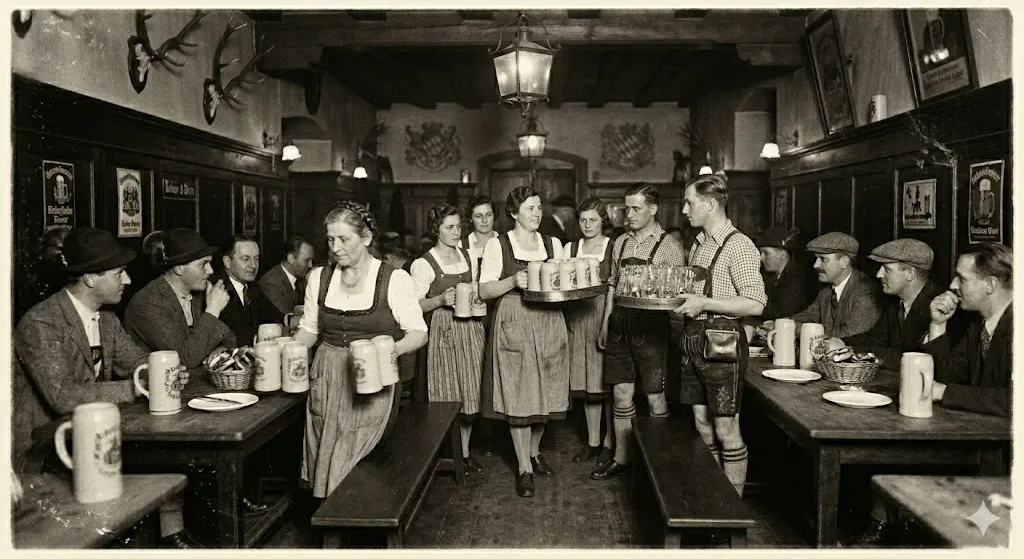
Male servers wear the traditional Trachten equivalent of the server’s uniform: Lederhosen, Trachtenhemd, and appropriate Bavarian accessories. The same cultural authenticity that defines the female server’s Dirndl defines the male server’s Lederhosen — the uniform connects the wearer to the same heritage and signals the same professionalism. The physical demands of the role are identical between genders.
How the Global Image Developed: From Bavaria to the World
Tourism, Advertising, and the 20th Century Spread
The specific image of the Dirndl-wearing server carrying multiple steins became globally recognisable through a convergence of forces in the 20th century. Munich’s tourist industry, which grew rapidly after the Second World War as international travel became accessible to middle-class audiences, used the image systematically in promotional material. American soldiers stationed in Bavaria after 1945 encountered the festival and sent photographs home. Travel magazines featured the Wiesn server as the iconic visual shorthand for Bavaria — a single image communicating an entire cultural identity.
The beer industry amplified this spread significantly. The global craft beer movement renewed interest in traditional brewing methods and authentic cultural experiences, creating new opportunities for genuine German beer service traditions to be appreciated and preserved worldwide. Beer brands marketing German-style lagers internationally used the Dirndl-clad server image because it instantly communicated authenticity and tradition without requiring any explanatory text. The image worked as marketing precisely because it had already become globally familiar.
The Contemporary Shift: From Symbol to Professional Recognition
The narrative around the role has evolved significantly in the social media era. Individual servers — Wiesn Kellnerinnen who document their work on platforms like TikTok under tags like #wiesnbedienung and #oktoberfestbedienung — have brought genuine professional perspective to an audience of millions that previously only saw the image without the reality behind it. Videos showing the physical preparation, the shift structure, the technique for carrying multiple steins, and the community of returning professionals among the festival staff have changed how many viewers understand what the work actually involves.
These servers act as cultural ambassadors, bridging the past with the present through their interactions with patrons. Their role goes beyond pouring pints — they carry on age-old practices like toasting with Prost and ensuring guests feel welcome and immersed in a unique experience. They embody the essence of Gemütlichkeit — the sense of warmth and coziness that characterises traditional German hospitality. This is the cultural function that no marketing image and no costume version captures: the Gemütlichkeit that the servers create through their skilled, warm, professional presence is not reproducible anywhere else.
Costume Versions and Their Relationship to the Authentic
The global recognition of the image has generated an enormous market for costume versions of the Dirndl sold for Halloween, themed parties, and casual Oktoberfest replica events worldwide. These costumes bear a surface resemblance to authentic Dirndl but are made from synthetic fabrics, feature shorter hemlines, and are designed for novelty rather than tradition. The market for them is legitimate and substantial — but it is separate from the authentic Trachten tradition that the professional servers represent.
The distinction that matters is not whether someone wears a costume or an authentic Dirndl at a themed event. It is whether the wearer understands what the authentic version represents and makes a conscious choice rather than an uninformed one. The professional servers at Munich’s tents wear authentic traditional garments that connect them to 200 years of cultural continuity. Our ladies’ Oktoberfest dress collection offers authentic options that reflect this tradition rather than the costume market — pieces that wear correctly, develop with use, and represent genuine Bavarian craftsmanship.
Frequently Asked Questions
What is the correct German word for a beer girl at Oktoberfest?
The correct professional term is Kellnerin — female waitress or server. At the Munich festival specifically, the more precise term is Wiesn Kellnerin, identifying the server’s role within the specific festival context. Bedienung — German for “service” — is used as a noun by regulars and the servers themselves in casual conversation. Colloquial terms like Bierkeller-Madl and Biermädel appear in festive contexts but are not professional titles. The English phrase “German beer girl” is a tourist construction not used by Germans.
How many steins can an Oktoberfest waitress carry at once?
A skilled Wiesn Kellnerin typically carries 10 to 12 full Masskrug in a single trip. Each one-litre stein weighs 2.3 kilograms when filled with Festbier, making a 12-stein carry approximately 27.6 kilograms of beer. The world record, set by Anita Schwarz in 2008, stands at 19 full steins — approximately 43 kilograms — carried over 40 metres without spilling. This requires specific hand and forearm technique developed through months of preparation and year-round work in Bavarian beer halls.
What do female Oktoberfest servers wear?
Festival servers wear a professional version of the traditional Bavarian Dirndl — fitted bodice with metal eyelet lacing, white Carmen blouse, full skirt, and a functional apron designed to protect the dress from spills. Servers within the same tent wear identical Dirndl designs and colours as part of the tent’s visual identity. The server’s Dirndl follows traditional construction more closely than most contemporary guest versions, with the traditional laced bodice retained rather than replaced by modern zip or button closures.
What does the apron bow position mean on a Dirndl?
The apron bow position on a Dirndl communicates relationship status in traditional Bavarian culture. Tied on the left means single and available. On the right means in a relationship or married. Tied at the centre front is associated with young girls and is not appropriate for adult women. Tied at the centre back signals that the wearer is a working server or, historically, a widow. This system is understood and read by knowledgeable festival attendees immediately. Our guide on how to wear a Dirndl correctly covers this and every other component of the traditional outfit in full.
How do you become an Oktoberfest server?
The most reliable path is working year-round in Munich’s established beer halls and gardens — the Hofbräuhaus, Augustinerkeller, and similar venues — to build the physical conditioning, cultural knowledge, and professional reputation that festival tent operators look for. Language skills, particularly English and at least one other international language alongside German, are valuable for serving the festival’s multinational visitor base. Most experienced servers return to the same tent year after year, making first-time applications competitive. There is no formal certification — the route is practical professional experience in Bavarian hospitality.
Is the term “beer wench” offensive?
The term “beer wench” originates in historical English and carries associations that many people consider disrespectful when applied to professional servers. Bavarian servers themselves use Kellnerin, Wiesn Kellnerin, or Bedienung to describe their role — none of which carry the diminishing connotations of the English-language alternative. Using the correct German terminology shows respect for the professional reality of the work and the cultural tradition it represents. At the festival itself, addressing a server as “Kellnerin” or simply catching their eye and raising a glass is both correct and well-received.
What is Gemütlichkeit and how does it connect to Oktoberfest servers?
Gemütlichkeit is a German and Bavarian concept describing a quality of warmth, cosiness, and convivial belonging — the specific feeling generated when people gather together in comfort and goodwill. It has no direct English equivalent. Oktoberfest servers actively create Gemütlichkeit through their professional presence — the efficiency that means your Masskrug arrives before you have finished the previous one, the warmth of a Prost directed at your table, the professional ease of a server who has been doing this for years and makes a packed tent of strangers feel like a shared celebration. The Gemütlichkeit is not the beer. The Gemütlichkeit is what the skilled professional brings to the service of it.
The Wiesn Kellnerin: More Than an Image
The global recognition of the “German beer girl” image has made it one of the most universally understood visual shorthand symbols for an entire culture. But the image, inevitably, simplifies what the reality involves. The Wiesn Kellnerin carrying 12 steins through a packed Augustiner tent on the opening Saturday of the 2026 festival is not performing for photographs. She is executing a professional skill that took years to develop, in service of a tradition with over 200 years of continuous history, in a garment whose origins predate the festival itself.
Knowing what she is actually called — and what that name reflects about how Bavarians understand her role — is one of the smallest but most meaningful ways a festival visitor can demonstrate genuine respect for the culture they are participating in. Say Kellnerin rather than “beer girl.” Say Prost and mean it. Tip correctly. And if she carries 12 steins to your table without spilling a drop, recognise that you have just witnessed a professional skill that has been practised in Munich’s beer halls since before your grandfather was born.
For your complete Oktoberfest 2026 preparation — from what to wear to how to plan your Munich trip — our Munich Oktoberfest planning guide covers everything. Browse our Bavarian traditional Dirndl collection for authentic attire that reflects the same cultural tradition the servers represent — and order well before August when festival demand depletes popular sizes.
GermanAttire supplies authentic Bavarian Lederhosen, Dirndl, and traditional German Trachten to customers across the UK, US, and Australia. Visit our store at 27 Victoria Street, London SW1H 0EX, or browse our complete ladies’ Oktoberfest dress collection online — everything the Wiesn Kellnerin wears, made for the people who appreciate what it represents.

Anna Bauer is a seasoned Bavarian fashion expert, cultural consultant, and heritage stylist with over a decade of hands-on experience in traditional German clothing. Born in Munich, the heart of Bavaria, Anna grew up surrounded by the rich traditions of Trachten fashion. Her passion for cultural attire led her to pursue a degree in Fashion and Textile Design at the prestigious University of the Arts Berlin, where she specialized in European folkwear.
Over the past 12+ years, Anna has collaborated with renowned Trachten designers, styled outfits for Oktoberfest events across Germany, and contributed articles to top fashion and culture magazines across Europe. Her work focuses on preserving the authenticity of Lederhosen and Dirndl wear while helping modern audiences style them with confidence and flair.
As the lead content contributor for German Attire, Anna combines her academic background, professional styling experience, and deep cultural roots to provide readers with valuable insights into traditional German fashion. Her blog posts cover everything from historical origins and styling guides to care tips and festival outfit planning—making her a trusted voice for anyone looking to embrace Bavarian heritage in a stylish, modern way.