

Blog
Where Is Oktoberfest Held in Munich? Your 2026 Visitor’s Guide
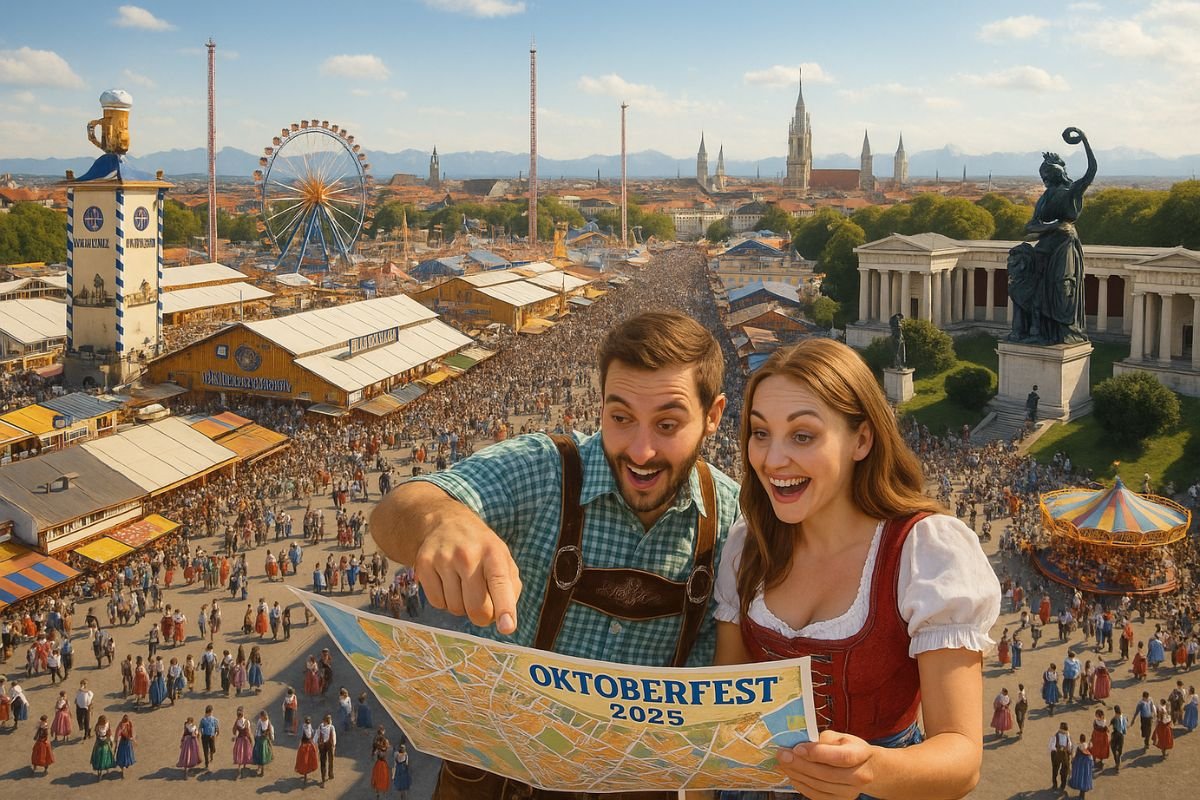
Where Is Oktoberfest Held in Munich? The Complete 2026 Ground Guide
Every September, six to seven million visitors converge on a single 40-hectare meadow in the heart of Munich. Most of them arrive knowing only the name: Theresienwiese. Fewer know what awaits inside — fourteen massive beer tents each with its own personality, a funfair that rivals any in Europe, a heritage section recreating the festival’s earliest form, and two major parades through the streets surrounding the grounds. Understanding the location, layout, and navigation of the Wiesn before you arrive transforms the experience completely.
The festival that has occupied this site continuously since 1810 is not just large — it is precisely organised in ways that reward visitors who know where things are and penalise those who do not. A visitor who knows which U-Bahn exit leads directly to the main entrance, which tent is closest to the Bavaria statue, where the Servicezentrum is, and how the grounds are divided between the beer tent zone and the funfair arrives as a confident participant. One who does not can spend an hour navigating 40 hectares without finding what they came for.
This guide covers the confirmed 2026 dates, the exact location and address, every practical route to the grounds, the complete tent-by-tent layout, the key landmarks, the opening hours, and everything specific to navigating Theresienwiese as a first-time or returning visitor. The history of Lederhosen and the full cultural background of the festival are covered in our dedicated historical guide — this one focuses entirely on the physical and practical experience of being there.
The Exact Location: Theresienwiese, Munich
Address and GPS Coordinates
Oktoberfest is held at Theresienwiese, located in the Ludwigsvorstadt-Isarvorstadt district of Munich, Bavaria, Germany. The official address for navigation purposes is Theresienwiese, 80339 München. For GPS navigation: 48.1319° N, 11.5492° E. The main entrance faces north toward the Bavaria statue. Side entrances operate on the west and east perimeters.
The name Theresienwiese — literally “Therese’s Meadow” — comes directly from Princess Therese of Saxe-Hildburghausen, who married Crown Prince Ludwig of Bavaria at a celebration on this site on October 12, 1810. The citizens of Munich were invited to watch the festivities on the fields outside the city gates. The horse racing and outdoor celebration proved so popular that the city repeated it annually. Over two centuries later, the meadow named for the bride still hosts the world’s largest Volksfest every autumn.
The 191st Oktoberfest 2026 takes place from September 19 to October 4, 2026 on the Theresienwiese. This is a 16-day run from the third Saturday of September through the first Sunday of October. Note that some sources currently circulating online list incorrect dates — the confirmed official dates from Munich’s city government are September 19 to October 4.
Where Theresienwiese Sits in the City
Theresienwiese sits southwest of Munich’s historic city centre, approximately 1.5 kilometres from the Marienplatz and 800 metres from Munich Central Station (Hauptbahnhof). The neighbourhood surrounding the grounds — Ludwigsvorstadt on the north and east sides, Isarvorstadt to the south — is primarily residential and commercial Munich, with the festival grounds representing the largest open space in the area.
The grounds are bounded roughly by Bavariaring to the south (where the Bavaria statue stands), Hansastrasse to the north, Theresienhöhe to the west, and Matthias-Pschorr-Strasse to the east. Within these boundaries, the 40-hectare space transforms entirely from empty meadow to full festival city across a construction period that begins in late July and concludes with dismantlement in late October.
Oktoberfest 2026: Dates, Hours, and the Opening Ceremony
Daily Opening Hours for 2026
The large tents at Oktoberfest open at 10am on weekdays and 9am at weekends and on the public holiday of October 3 (German Unity Day). Beer service closes at 10:30pm and the music plays until then. The tents themselves close at 11:30pm. Exceptions are the Käfer Wiesn-Schänke and Kufflers Weinzelt, which stay open until 1am.
On opening day, Saturday September 19, beer service begins at noon rather than the standard weekday time. Many visitors arrive at the grounds before 10am on opening day to secure walk-in seats before service begins. This is one of the few days when arriving before the tents officially open serves a practical purpose — the walk-in queues at the tent doors form as early as 8am on opening Saturday.
The Opening Ceremony at Schottenhamel
The official start of each festival year occurs at noon on opening day inside the Schottenhamel tent. The Lord Mayor of Munich drives the first tap into the ceremonial keg with a wooden mallet and declares “O’zapft is!” — meaning “It’s tapped!” This is the signal that beer service opens across all tents simultaneously. The Schottenhamel tent is the designated site of this ceremony by tradition and protocol — no other tent taps before the mayor’s keg is struck.
The opening ceremony is attended predominantly by invited guests and media. The public can watch from outside the tent, but being inside requires either a reservation or exceptional luck with walk-in seating that morning. For the vast majority of visitors, the significance of the ceremony is experienced indirectly — through the sound of the crowd inside when the tap goes in, and the simultaneous opening of service across the entire grounds at noon.
Key Events Within the Festival Calendar
Two major parades route through the streets around Theresienwiese during the first weekend of the festival. The Grand Entry of the Oktoberfest Hosts runs on opening Saturday morning — the tent owners, brewery representatives, and their families processing to the grounds in decorated horse-drawn carriages to formally open their tents. The Traditional Costume and Riflemen’s Parade runs on the first Sunday, September 20, 2026, with over 9,000 participants in regional Trachten and historical uniforms marching through Munich’s streets.
The ecumenical church service on the first Wednesday of Oktoberfest takes place in the Marstall festival tent. The square concert takes place at the foot of the Bavaria statue, not far from the entrance to the Schützenfest tent. These events reflect the festival’s genuine cultural depth beyond the beer-drinking core — events that locals attend specifically and that reward visitors who look for them on the official schedule.
October 3, German Unity Day, falls within the 2026 festival and generates weekend-level attendance on a weekday. Tents open at 9am rather than the standard weekday 10am. Accommodation prices rise significantly for this date, and walk-in tent seating becomes as difficult as a Saturday evening. If your visit includes October 3, treat it exactly as you would a Saturday in terms of arrival time and crowd management strategy.
The Grounds: A Complete Layout of Theresienwiese
The Three Zones of the Festival
Theresienwiese during Oktoberfest divides into three distinct functional zones. Understanding which zone contains what prevents the single most common navigational frustration — spending time in the amusement area when you intended to be in the beer tent zone, or missing the Oide Wiesn entirely because its location on the southern edge is not obvious from the main entrance.
The Beer Tent Zone occupies the central and eastern portions of the grounds. The fourteen large tents are arranged in a roughly U-shaped layout around the central avenue (Wirtsbudenstrasse) that bisects the grounds from north to south. Each tent faces either the central avenue or the parallel Schaustellerstrasse running along the funfair edge. The layout means that walking the central avenue from north to south passes the majority of the large tents on both sides.
The Funfair and Amusement Zone extends across the southern and southeastern sections of the grounds. Roller coasters, the Ferris wheel, carousels, bumper cars, and the full range of traditional Volksfest attractions occupy this area. Food stalls selling roasted almonds, gingerbread hearts (Lebkuchen), grilled fish on sticks (Steckerlfisch), and traditional Bavarian snacks are concentrated here and in the avenues between the beer tents.
The Oide Wiesn occupies the southern tip of the grounds, separated from the main festival area by a fence and a small entry charge. This heritage section recreates the historic atmosphere of the early Oktoberfest with traditional carousel rides, folk music performances, the Historische Wirtsbuden (historic taverns serving beer in traditional style), and a programme of cultural events that runs parallel to the main festival. Many Munich locals consider the Oide Wiesn the most authentic and enjoyable part of the entire grounds — quieter, more traditional, and less oriented toward international tourism.
The Fourteen Large Beer Tents: Location and Character
Each of the fourteen large tents at the festival has its own brewery partner, seating capacity, architectural style, and crowd character. Knowing which tent suits your purpose before arriving saves time and manages expectations.
Schottenhamel-Festhalle: The opening ceremony tent. Located near the main northern entrance, making it the first major tent encountered by visitors entering from the Theresienwiese U-Bahn station. The youngest audience demographic of any major tent — traditionally popular with students and first-timers. Capacity approximately 10,000.
Hofbräu-Festzelt: The most internationally famous tent and the most likely to be predominantly non-German speaking on any given day. The Hofbräuhaus brewery’s festival presence draws visitors specifically because the Hofbräuhaus name is globally recognised. The atmosphere is loud, communal, and genuinely welcoming to visitors unfamiliar with tent etiquette. Capacity approximately 10,000.
Augustiner-Festhalle: The tent most consistently cited by Munich locals as their preference. Augustiner is the oldest independent brewery still operating in Munich, and its tent carries a reputation for the most traditionally Bavarian atmosphere — less internationally oriented, more community-focused. Augustiner-Festhalle is beloved by locals for its traditional atmosphere. Capacity approximately 6,000.
Hacker-Festzelt: Known architecturally for its painted ceiling depicting a sky scene, earning it the nickname “Heaven of Bavaria.” The ceiling is one of the most photographed elements inside any tent and creates an atmosphere distinct from the more standard tent interiors. Capacity approximately 9,300.
Löwenbräu-Festzelt: Identifiable from outside by the large mechanical roaring lion sculpture mounted on the tent facade — one of the most recognisable external landmarks on the grounds. The lion roars at intervals, drawing crowds to the entrance and making the Löwenbräu tent easy to locate without a map. Capacity approximately 8,000.
Paulaner Festzelt: One of the largest tents on the grounds, associated with the Paulaner brewery whose history connects directly to the Salvator strong beer tradition. The tent facade mimics traditional Bavarian architectural forms, making it one of the more visually distinctive from the outside. Capacity approximately 8,450.
Käfer Wiesn-Schänke: The upscale tent, operated by the Munich caterer Käfer rather than a brewery. Smaller than the major tents, with a different pricing tier and atmosphere oriented toward an older, more affluent clientele. One of the two tents that stays open until 1am rather than 11:30pm. Reservation-dependent almost entirely — walk-in seating is extremely difficult here compared to the larger tents.
Kufflers Weinzelt: The wine tent — an alternative to the beer-focused programme of the other tents, serving wine alongside beer in an atmosphere oriented toward the evening and a wine-drinking rather than Festbier-drinking crowd. Also open until 1am. Smaller capacity and a distinctly different character from the large brewery tents.
The remaining six large tents — Marstall, Fischer-Vroni, Bräurosl, Armbrustschützen-Festzelt, Winzerer Fähndl, and Ochsenbraterei — each have specific character and regular following. The Marstall tent hosts the festival’s ecumenical church service. Fischer-Vroni specialises in grilled fish. The Armbrustschützen-Festzelt hosts the crossbow shooting competition that runs as one of the festival’s formal sporting events. Full details on each tent’s reservation system and booking process are covered in our dedicated guide on how to book a beer tent table.
The Bavaria Statue and the Ruhmeshalle
The Bavaria statue — a 18.5-metre bronze figure of a woman representing the Bavarian state — stands at the southwestern edge of the grounds on an elevated terrace, presiding over the festival from a height that makes her visible from most of the grounds. She was cast in 1850 and represents the oldest permanent feature of the site, predating most of the festival’s current structure by over a century.
The statue is hollow. A spiral staircase inside the bronze shell leads to a viewing platform inside the head, from which the entire festival panorama is visible — the arrangement of tents across the grounds, the funfair to the south, and the Munich city skyline to the north and east. The entrance to the statue’s interior is through the Ruhmeshalle — the Hall of Fame — the colonnaded arcade that forms the pedestal structure around the statue’s base. Opening hours during the festival are limited; check the official Munich city website for 2026 access times.
The square at the foot of the Bavaria statue serves as the venue for the square concert that is part of the official Wiesn programme. The Schützenfest tent entrance sits nearby, and the western section of the grounds — home to several smaller tents and quieter food stalls — is most easily accessed from this end of the grounds.
Key Services: Servicezentrum, Lost Property, and First Aid
The Servicezentrum is the main services hub for the festival grounds. Lost and found is typically located near the Servicezentrum behind the Schottenhamel tent. This is the location to go to if anything is lost during the visit — a wallet, a phone, a travelling companion. The Servicezentrum also handles general visitor enquiries and can contact the medical teams if needed.
First aid stations are positioned at multiple points across the grounds and clearly marked on the official festival map at every entrance. For any medical situation that requires urgent attention, the staff inside every beer tent know the location of the nearest first aid point and will direct visitors immediately. Police units are stationed both at fixed posts near the main entrance and mobile across the grounds throughout all operating hours.
Luggage storage is available at the Hauptbahnhof (Munich Central Station) and at some U-Bahn stations. The festival grounds do not have general luggage storage for visitors — come to the Wiesn with what you need for the day and nothing more. ATMs are present on the grounds but develop long queues during peak hours on weekday evenings and throughout weekends. Drawing cash before arriving is the more practical approach.
Getting to Theresienwiese: Every Transport Route
The U-Bahn: Fastest and Most Direct
U-Bahn lines U4 and U5 stop directly at the Theresienwiese station, which is the closest access point to the festival grounds. Schwanthalerhöhe station (also U4/U5) is one stop further and often has shorter queues than the main festival station during peak exit times.
During the festival, the U4 and U5 lines operate at increased frequency — typically every 3-5 minutes during peak festival hours rather than the standard schedule. The platform at Theresienwiese station exits directly toward the northern main entrance of the grounds, making it the most efficient single connection from central Munich. Schwanthalerhöhe is a useful alternative when exiting after evening sessions, when the Theresienwiese platform becomes very crowded with departing visitors simultaneously.
From Munich Central Station (Hauptbahnhof): take the U4 or U5 one stop to Theresienwiese. Journey time approximately 4 minutes. The Hauptbahnhof is also served by the U1, U2, U3, U6, U7, U8, and S-Bahn lines, making it the central interchange point for visitors arriving from any direction in Munich or from the wider Bavarian rail network.
S-Bahn Routes Including from the Airport
S-Bahn lines S1 and S8 connect Munich Airport directly to Hackerbrücke station, which is a 10-minute walk from the festival entrance. For visitors arriving directly from the airport without wanting to first connect to the city centre, the S1 or S8 to Hackerbrücke is a single-connection route from the terminal to within walking distance of the grounds.
The Hackerbrücke route follows the Bavariaring south from the station, passing under the bridge and turning into the grounds from the western approach. This arrival path brings visitors past the Löwenbräu-Festzelt entrance area — useful orientation for first-time visitors to establish their position relative to the tent layout.
Tram and Bus Options
Tram lines 18 and 19 stop at Holzapfelstraße or Hermann-Lingg-Straße, both within walking distance of Theresienwiese. Bus MetroBus line 53 stops at Schwanthalerhöhe. CityBus line 134 stops directly at Theresienwiese. CityBus line 58 stops at Georg-Hirth-Platz or Goetheplatz near the festival grounds.
Trams are less frequently used by festival visitors than the U-Bahn because journey times are longer and surface congestion around the grounds during peak festival hours can delay trams significantly. For visitors already in transit on a tram route that passes close to the grounds, however, these stops provide useful access without requiring a change to the underground system.
Cycling: Munich’s Most Underused Festival Option
Munich is one of Europe’s most cycle-friendly cities, and arriving at the Wiesn by bicycle is genuinely practical for visitors staying within 5-10 kilometres of the grounds. Dedicated cycle paths connect the city centre and most residential neighbourhoods to Theresienwiese, and bicycle parking is available on the perimeter of the grounds. This is the transport option that most international visitors overlook and that most Munich locals who live reasonably close use without thinking twice.
The practical consideration: after an evening in the beer tent, cycling home requires honest self-assessment. Munich police enforce drunk-driving laws with equal application to cyclists — do not cycle if you have consumed more than is safe to do so. Munich’s public transport network runs until after midnight, with extended night service during the festival, providing a reliable return option for visitors who arrive by bike but prefer to leave by public transport.
Driving and Parking: Why It Makes No Sense
Driving to the Wiesn is genuinely impractical during the festival. The streets immediately around Theresienwiese are closed or severely restricted during operating hours. No public parking is available at the grounds themselves. Street parking in the surrounding neighbourhoods fills hours before the tents open on busy days. Munich police actively enforce traffic restrictions throughout the festival period.
If driving to Munich is unavoidable — for visitors from outside the city with no other practical option — Park and Ride facilities on the city outskirts connect via U-Bahn and S-Bahn to central Munich, from which the Theresienwiese connection is straightforward. Check the MVV (Munich public transport) website for current Park and Ride locations and the correct onward connections for 2026.
The Accommodation Decision: Where to Stay in Munich
Accommodation for Oktoberfest 2026 should be booked immediately. This is not a general travel recommendation — it is a specific factual warning. Hotels within walking distance of Theresienwiese begin filling for the festival weekend from the previous January onwards. Hotels anywhere in Munich for the opening and closing weekends typically have no availability at reasonable prices by the time most visitors start planning in spring.
The Best Neighbourhoods for Festival Visitors
Ludwigsvorstadt-Isarvorstadt is the closest neighbourhood to Theresienwiese and the most convenient for walking directly to the grounds. Altstadt-Lehel is central, historic, and well-connected to sightseeing alongside the festival. Maxvorstadt offers museums, cafés, and excellent transport links at slightly lower prices than the Theresienwiese-adjacent neighbourhoods.
Hotels within 0.5 km of the festival cost more but save transportation time. Expect to pay €150-300+ per night for basic 3-star hotels during Oktoberfest. Staying 2-3 U-Bahn stops away on the U4 or U5 lines saves 30-50% on accommodation while maintaining a quick, direct connection to Theresienwiese.
The U4/U5 corridor — Giesing and Sendling to the south, Arabellapark and Bogenhausen to the north — offers the best balance between price, availability, and connection quality. Stations along this line have a direct journey to Theresienwiese station of under 15 minutes from most points. For full accommodation guidance alongside package options and travel logistics, our Munich travel and packages guide covers all options in detail.
How Many Days to Spend at the Wiesn
The Single-Day Visit
One full day at the festival delivers a genuine, memorable experience for most visitors. A single day allows time for two to three tent sessions — a lunchtime session in one tent, an afternoon session in another, and an early evening in a third — alongside time in the funfair and the Oide Wiesn. This is sufficient to understand what the festival is and why six million people attend it annually.
The limitation of a single day is that it forces choices. The Traditional Costume Parade is only on the first Sunday. The opening ceremony is only on opening day. The church service is only on the first Wednesday. A visitor with only one day will always miss the specific event that falls on a different day. Multiple days solve this — a second day can be targeted specifically at an event missed on the first.
The Multi-Day Strategy
Two to three days allows a more deliberate approach to the grounds. Day one: orientation — the main tents, the central avenue, the Oide Wiesn, the Bavaria statue area. N two: a specific targeted objective — the parade, the Hammerschlagen competition, a different tent cluster, or the funfair in daylight rather than after dark when the Ferris wheel and illuminated rides create a different atmosphere. Day three: a more relaxed, personal approach — returning to the tent that felt most comfortable, finding the food stalls that produced the best meals, and experiencing the late-afternoon shift in tent atmosphere as the day session crowd transitions to the evening crowd.
Mixing weekday and weekend visits within a multi-day stay is the approach most experienced visitors recommend. A weekday morning combined with a weekend evening shows both ends of the festival’s atmospheric range: the calm, accessible, almost meditative quality of a Tuesday morning in a half-full Augustiner tent, and the full-volume communal energy of a Saturday evening when 10,000 people are simultaneously singing.
Festival Etiquette: The Rules That Actually Matter
The Dancing Rule That Gets Visitors Ejected
The single most frequently broken rule at the festival grounds — and the one that results in genuine ejection from tents — is standing on tables. The rule at Oktoberfest is: dance on benches, never on tables. Bench dancing is not only permitted but encouraged — it is a defining visual of the festival experience, and the wooden benches are designed to accommodate it. Table dancing is explicitly prohibited and enforced by tent security. This distinction is not intuitive to visitors who arrive without knowing it, and it costs several visitors their place in the tent every busy evening.
Smoking is prohibited inside all beer tents. Each tent has a designated smoking area on the outside perimeter. The no-smoking policy is strictly enforced and has been in place since the early 2000s. Visitors who wish to smoke must leave the tent, use the designated area, and return — which, during a packed evening session when re-entry may be restricted, carries a real risk of losing their seat.
Tent Capacity Closures
When a tent reaches capacity, security closes the entrance and allows no further entry until seated guests leave. This happens regularly on Friday and Saturday evenings from approximately 6pm-7pm onwards. Visitors who arrive after 6pm on a weekend evening without a reservation may find their preferred tent closed entirely for the remainder of the evening. Arrive before 10am on weekdays — this is the difference between a great experience and a frustrating one. On weekends, arriving before noon for lunchtime sessions gives the most reliable access to walk-in seats before the tents fill.
What to Wear on the Grounds
Traditional Trachten — Lederhosen for men, Dirndl for women — is the majority dress choice at the festival. Wearing it is not mandatory but wearing it correctly signals genuine respect for the tradition. A poorly fitted Dirndl with a synthetic fabric bought from a souvenir shop reads differently to a well-made authentic piece, and the people around you will notice the difference.
For men, the complete traditional outfit — Lederhosen, checked Trachtenhemd tucked in, Haferlschuhe, and knee socks — is covered fully in our complete traditional outfit guide. For women, the Dirndl components and how to wear them correctly are covered in our guide on what women wear at the Wiesn. Browse our men’s Lederhosen collection and ladies’ Oktoberfest dress collection for authentic options — and order well before August, when festival demand depletes popular sizes.
Comfortable shoes are not optional. The festival grounds are 40 hectares. A full day involves hours of walking on uneven surfaces, standing on wooden slatted floors, and occasional cobblestone paths between venues. The most elegant Dirndl does not compensate for feet that stopped functioning at 4pm because of inappropriate footwear. Haferlschuhe and sturdy Mary Janes for women, Haferlschuhe for men — both designed specifically for the kind of wear the Wiesn demands.
Frequently Asked Questions
What U-Bahn line goes to Oktoberfest?
Lines U4 and U5 both stop at Theresienwiese station, which exits directly toward the main festival entrance. Schwanthalerhöhe station — one stop further on the same lines — is less crowded and useful as an alternative exit point after evening sessions when the Theresienwiese platform becomes very busy with departing visitors simultaneously. Journey from Munich Hauptbahnhof to Theresienwiese is approximately 4 minutes on either line.
Can you walk to Oktoberfest from Munich Central Station?
Yes — Munich Central Station (Hauptbahnhof) is approximately 800 metres from the northern entrance to Theresienwiese. The walk takes 10-15 minutes at a normal pace, heading south-southwest from the station along Bayerstrasse and turning onto the Bavariaring. This is a practical option for visitors staying near the Hauptbahnhof who prefer to walk rather than take the one-stop U-Bahn connection.
What time do the beer tents open at Oktoberfest 2026?
On weekdays, the large beer tents open at 10am. On weekends and on October 3 (German Unity Day), they open at 9am. Beer service ends at 10:30pm across all tents. Tents close at 11:30pm. The Käfer Wiesn-Schänke and Kufflers Weinzelt are exceptions, staying open until 1am. On opening day, September 19, beer service begins at noon regardless of the early morning opening of the grounds.
What is the Oide Wiesn?
The Oide Wiesn — meaning “old festival meadow” — is the heritage section at the southern end of Theresienwiese, separated from the main grounds by an entry charge of approximately €4. It recreates the early Oktoberfest atmosphere with traditional carousel rides dating from the 19th century, historic taverns serving beer in period-appropriate style, and a cultural programme of folk music, dance performances, and craft demonstrations. Many Munich locals consider it the most authentic part of the entire festival and attend it specifically rather than the main grounds.
Is it better to stay near Theresienwiese or in central Munich?
Staying within walking distance of Theresienwiese (Ludwigsvorstadt or Isarvorstadt neighbourhoods) offers the obvious advantage of walking home rather than navigating public transport after an evening in the tents. The disadvantage is price — hotels here are the most expensive during the festival. Staying 2-3 stops away on the U4 or U5 line reduces accommodation costs by 30-50% while maintaining a direct, quick connection to the grounds. For visitors who plan only one day at the festival, walking distance is worth the premium. For multi-day visitors, the U-Bahn-adjacent option is more economical.
Does Oktoberfest have a map?
Yes — the official Theresienwiese map is available from the city of Munich at muenchen.de, within the official Oktoberfest app, and in printed form at every entrance to the grounds. The map shows the location of all 14 large tents, all 21 small tents, the rides and amusement zones, the Oide Wiesn, toilet facilities, ATMs, first aid stations, the Servicezentrum, and key access paths. Download the map before arriving rather than trying to navigate the grounds without one — 40 hectares of festival is significantly larger than it appears on a printed overview.
What is “O’zapft is!” at Oktoberfest?
O’zapft is is the Bavarian dialect phrase meaning “It is tapped” — the announcement made by the Lord Mayor of Munich at noon on opening day when he drives the first tap into the ceremonial keg in the Schottenhamel tent. It is the official signal that beer service opens simultaneously across all tents. The phrase has been used since at least 1950 and is now considered the defining verbal marker of the festival’s opening. The mayor typically completes the tapping in two strikes — achieving it in one is considered remarkable and is mentioned in the press when it occurs.
Arriving Prepared
The Wiesn rewards preparation and punishes assumptions. The visitor who arrives knowing that their tent of choice closes at capacity by 7pm on a Saturday, that the U4 from Hauptbahnhof takes four minutes, that walk-in seats exist in the morning but not the evening, and that bench dancing is fine while table dancing results in ejection — that visitor has a genuinely excellent day. The visitor who arrives expecting to figure things out as they go spends the first three hours in the wrong place at the wrong time.
Theresienwiese on a full festival day is one of the most simultaneously welcoming and overwhelming experiences in European travel. The scale is larger than most people imagine from photographs. The warmth of the communal atmosphere — strangers raising steins together, the brass band playing Ein Prosit and 10,000 people singing along simultaneously — is more genuine than most people expect from a tourist event. Getting there correctly, knowing the layout, and understanding how the day unfolds turns that experience from chaotic into unforgettable.
German Attire supplies authentic Bavarian Lederhosen, Dirndl, and traditional German Trachten to customers across the UK, US, and Australia. Visit our physical store at 27 Victoria Street, London SW1H 0EX, or browse our complete men’s Lederhosen collection and ladies’ Oktoberfest dress collection online — and order by August 2026 to guarantee your size is available before the September festival.

Anna Bauer is a seasoned Bavarian fashion expert, cultural consultant, and heritage stylist with over a decade of hands-on experience in traditional German clothing. Born in Munich, the heart of Bavaria, Anna grew up surrounded by the rich traditions of Trachten fashion. Her passion for cultural attire led her to pursue a degree in Fashion and Textile Design at the prestigious University of the Arts Berlin, where she specialized in European folkwear.
Over the past 12+ years, Anna has collaborated with renowned Trachten designers, styled outfits for Oktoberfest events across Germany, and contributed articles to top fashion and culture magazines across Europe. Her work focuses on preserving the authenticity of Lederhosen and Dirndl wear while helping modern audiences style them with confidence and flair.
As the lead content contributor for German Attire, Anna combines her academic background, professional styling experience, and deep cultural roots to provide readers with valuable insights into traditional German fashion. Her blog posts cover everything from historical origins and styling guides to care tips and festival outfit planning—making her a trusted voice for anyone looking to embrace Bavarian heritage in a stylish, modern way.