

Blog
Complete German Braids Style Guide for Every Hair Type
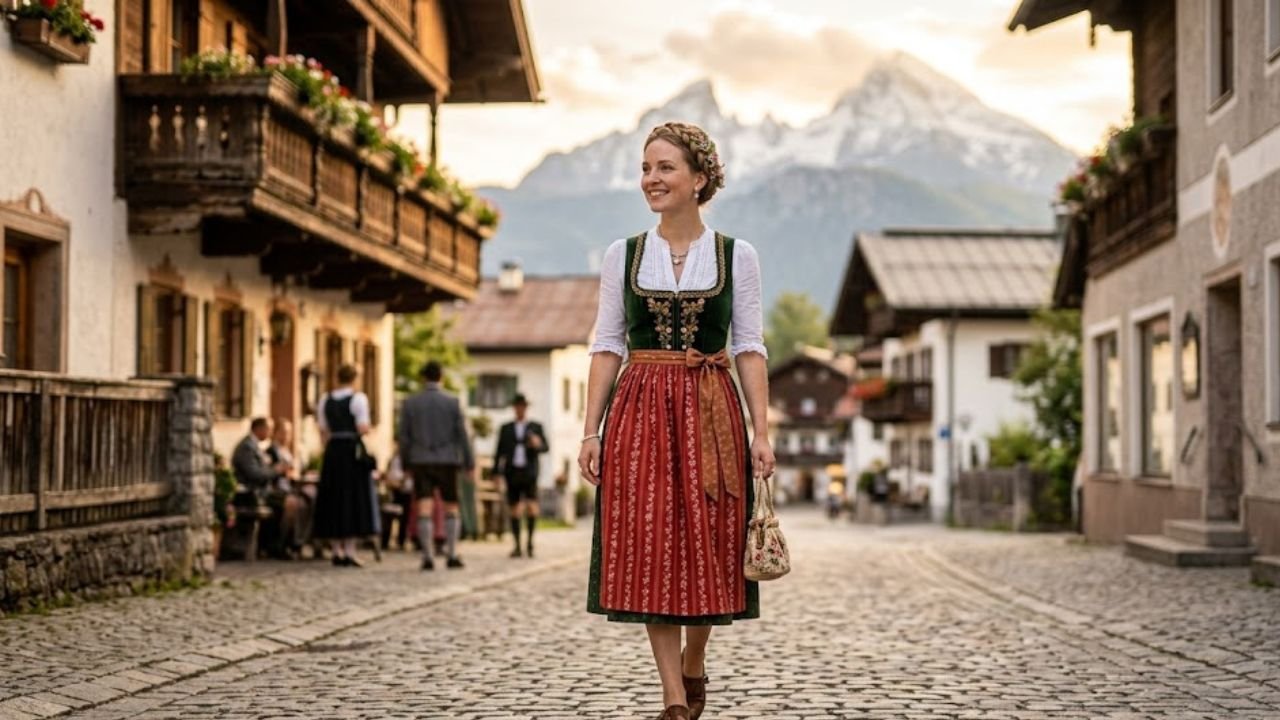
German Braids for Dirndls: The Complete Style Guide for Every Hair Type, Occasion & Skill Level
The Cultural Roots — Why Braids and Dirndls Belong Together
The Real History of German Braids
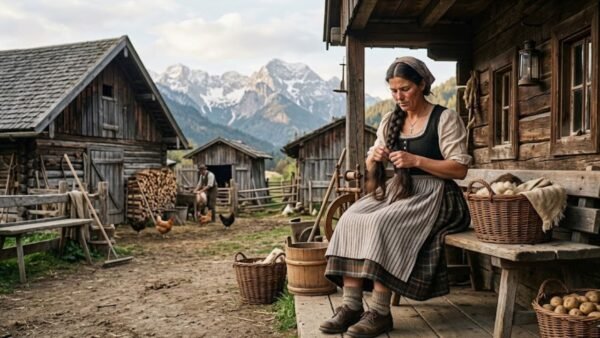
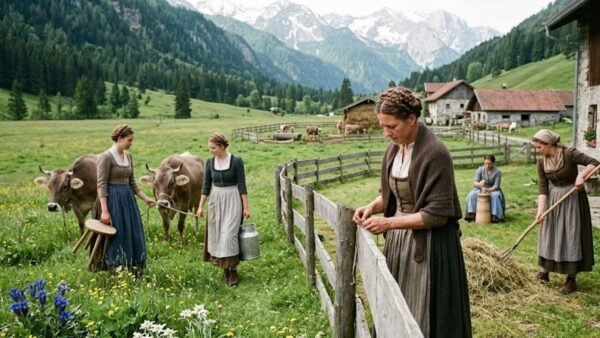
Before braids became a festival fashion statement, they were a solution to a practical problem. In Alpine Bavaria and Austria — the cultural heartland of dirndl and Tracht tradition — women working in agriculture, dairy farming, and domestic labor needed their hair entirely out of the way. Long hair braided and pinned close to the head stayed clean in the barn, safe near open flames in the kitchen, and manageable during the physically demanding rhythms of rural Alpine life. The braid was not an aesthetic choice first. It was a functional one, born from necessity and refined by daily repetition until it became second nature. The variety of braiding techniques across different Alpine valleys and regions reflects local solutions to the same problem, and those regional variations in braid style became, over generations, markers of geographic and cultural identity.
The shift from purely functional to culturally symbolic accelerated during the 19th-century German folk revival movement, when Romantic-era intellectuals and artists began documenting, celebrating, and idealizing rural German and Austrian peasant culture. Traditional dress — Tracht — was elevated from everyday working clothing to a symbol of authentic national identity, and with it came renewed attention to the hairstyles, accessories, and grooming customs that completed the traditional look. Braids that had simply kept hair out of farm work became celebrated as expressions of a specifically German and Bavarian cultural identity. Festivals, civic events, and eventually the Munich Oktoberfest (which began in 1810 as a royal wedding celebration and gradually became a public festival) provided new occasions where traditional dress and braided hair appeared in public celebration rather than private labor.
It is honest and necessary to acknowledge that braid symbolism in Germany carries a shadow period. During the Nazi era of the 1930s and 1940s, the image of a German woman with braids — typically the crown braid or two-plait style — was aggressively co-opted as a propaganda symbol of the idealized “German maiden.” This historical association caused real discomfort with traditional braided hairstyles among subsequent generations of German women. The meaningful cultural response, however, was not to abandon the tradition but to consciously reclaim it — to restore braids to their actual origins as practical, regional, and personal expressions of a living folk culture that predated and extended far beyond that era by centuries. Today’s German braid culture is, in the words of younger Bavarian women who wear it freely, relaxed, personal, and fashion-forward. It belongs to nobody’s ideology. It belongs to the women who wear it. For those building a deeper understanding of the full history of the dirndl, this reclamation of traditional aesthetics on their own terms is one of the most interesting chapters in German cultural history.
What Makes a Hairstyle Work With a Dirndl
A dirndl is a structurally specific garment. It has a defined bodice that creates visual shape at the chest and waist, a blouse that frames the neckline and shoulders, an apron that adds another layer of color and pattern at the front, and a full skirt that grounds the entire look with weight and movement. Each of these elements creates visual information — and your hairstyle needs to complete that composition rather than compete with it. The design logic is essentially the same as any fashion styling decision: proportion, balance, and focal point. If your dirndl’s bodice has intricate embroidery and your blouse has a high lace collar, a very elaborate updo creates too much density at the top and competes with the collar detail. If your dirndl has a low sweetheart neckline and relatively simple bodice, a crown braid fills the space above the neckline and creates a more finished look than hair worn completely down.
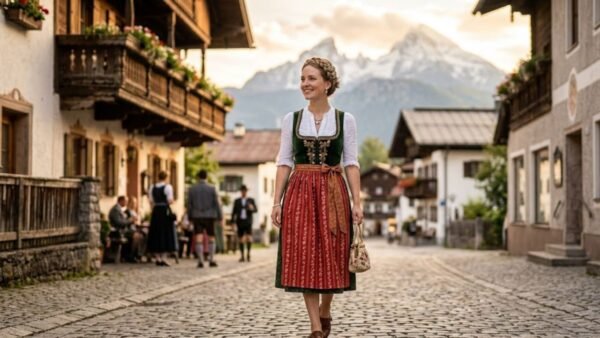
There are three broad zones of dirndl occasion that should guide your hairstyle decision. Casual Tracht — worn to Christmas markets, village Fests, Sunday afternoons — allows the most latitude: simple half-ups, rope braids, and even lightly accessorized loose hair all work. Festive Oktoberfest styling demands greater durability and presence: braids that will stay intact through hours of standing, dancing, and the inevitable exposure to humidity require proper preparation and fixative. Formal and wedding dirndl occasions call for elevated versions of traditional styles — a more sculpted crown braid with Tracht pins and fresh flowers rather than a casual half-up. Understanding which zone your occasion occupies before you touch a hairbrush saves significant time and frustration. For those curious about the full scope of what to wear with a dirndl beyond the hair, the detailed guide on dirndl accessories for Oktoberfest covers jewelry, footwear, and bag choices that work in harmony with different braid styles.
Classic German Braid Styles — The Foundation Every Dirndl Wearer Should Know
French Braid Intermediate
The French braid is the most widely recognized braiding technique in Western styling, and it forms the technical foundation from which many dirndl-appropriate styles are built. Beginning at the crown of the head, the French braid incorporates sections of hair from either side into a three-strand plait as it travels down the scalp, eventually becoming a standard braid where the hair runs out of new sections to incorporate. The result sits smooth and close against the head, creating a sleek, sculpted line from crown to nape. For dirndl styling, a single French braid works best with dirndls that have relatively plain bodices and necklines, where the braid’s clean line adds visual interest without competing with surface detail. It suits medium to long hair lengths and takes roughly ten to fifteen minutes to complete on yourself — longer if your hair is very thick or layered. The French braid’s main limitation at long festivals is its smoothness: on clean, fine hair it can begin to loosen by mid-afternoon without adequate product and pinning at the base.
Dutch Braid (Reverse French Braid) Intermediate
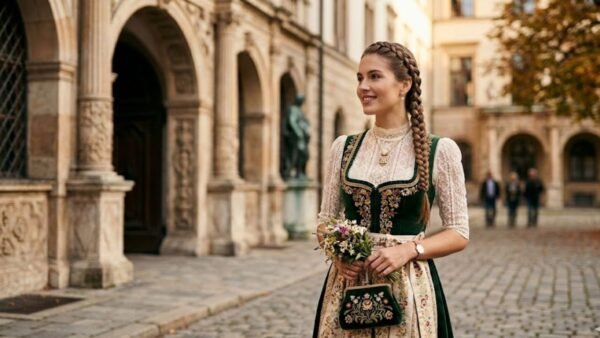
The Dutch braid is the French braid’s bolder sibling, and for dirndl styling — particularly at Oktoberfest — it is currently the more popular of the two. The mechanical difference is straightforward: where a French braid crosses sections over the center, a Dutch braid crosses sections under, which forces the braid to sit raised above the scalp in three dimensions rather than lying flat against it. The effect is a braid that appears sculptural, textured, and visually dramatic even when executed in a simple single-braid style. This raised quality photographs exceptionally well, which is one reason the Dutch braid has become dominant in festival styling content across social media. For dirndl pairings, the Dutch braid works with almost any neckline: a single Dutch braid down the back of the head suits structured, formal dirndls; two Dutch braids worn as modern pigtails update the classic two-plait look into something genuinely contemporary. It requires the same skill level as the French braid but the learning curve is slightly steeper because the under-crossing motion feels counterintuitive for the first several attempts.
Classic Two Pigtail Braids — The Stereotype, Rehabilitated Beginner
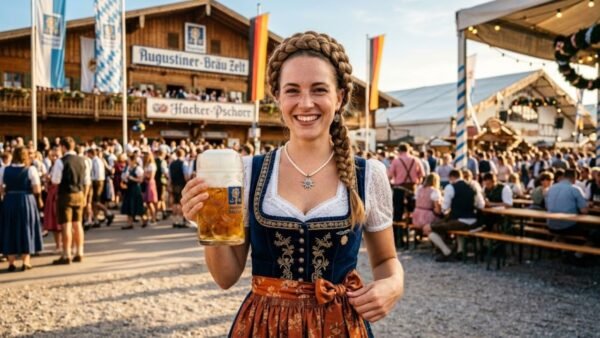
Two pigtail braids have such strong costume associations that many experienced dirndl wearers avoid them entirely — and in their tight, shiny, perfectly symmetrical form pulled close to either side of the head, that avoidance is justified. That version of the style reads as fancy dress, not fashion. But the underlying structure of two braids worn on either side of the head is not inherently problematic; the problem is execution. The modern adult interpretation of two pigtail braids loosens everything: the braids are worn lower, starting behind the ears rather than at the crown; the tension is relaxed so the braids have organic texture rather than tight uniformity; and the two braids are typically Dutch-braided for dimension rather than simple three-strand plaited. Finished with dried flower pins or Tracht ribbons at each elastic, this version of the style reads as deliberately styled rather than costumey. It works best with casual dirndls in softer fabrics and floral prints, and on hair that is naturally wavy or textured, where the looseness appears intentional rather than messy. The key distinguishing principle: if someone would mistake it for a children’s hairstyle, tighten nothing — loosen everything instead.
Modern German Braid Styles — Elevated, Wearable, and Festival-Proven
Crown Braid (Kronenzopf / Milkmaid Braid) Advanced
If any single hairstyle can claim the title of most authentically German among all dirndl braid options, it is the crown braid — known in German as the Kronenzopf, and in English sometimes called the milkmaid braid. The style wraps two braids (usually Dutch-braided for dimension) around the circumference of the head from each side, meeting and pinning at the opposite temple or at the back of the crown to create a halo or wreath of braided hair. Its origins are straightforwardly practical: Alpine women needed all their hair secured and away from their faces and necks during physical work, and the crown braid is the most comprehensively secure way to accomplish this on long hair without any external covering. The halo it creates has obvious visual echoes of the floral wreaths worn at spring and harvest festivals throughout the Alpine region, which may explain why the style migrated so naturally into ceremonial and festive contexts as Tracht culture evolved.
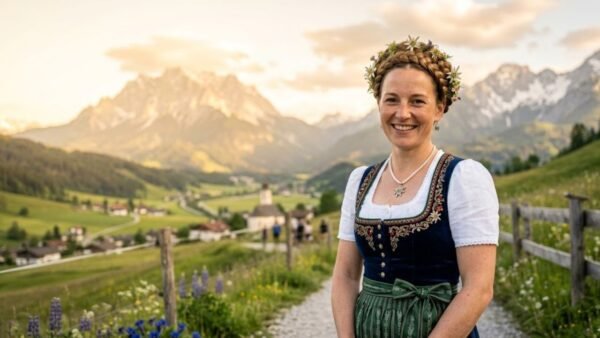
Achieving a crown braid on your own hair is one of the more technically demanding self-styling tasks, and the honest advice is to practice it at least twice before your event day. The challenge is that you are braiding upward and laterally across the back of your head — a direction that requires both arms raised for extended periods and a spatial understanding of your own hair that is difficult to develop from photographs alone. Two mirrors help significantly. For a romantic crown braid, slightly pull apart each section of the braid after completing it to widen and soften the plait before pinning. For a more structured version, keep tension consistent throughout. Fresh flowers, Tracht ribbon, or small decorative pins tucked into the crown at intervals transform the basic style into something that suits formal and wedding occasions as elegantly as it suits casual Fests. On shoulder-length hair, a partial crown using two smaller braids pinned to meet at the back creates most of the visual impact with considerably less technical difficulty. Those looking to understand how the crown braid connects to broader complete dirndl styling will find the accessory choices particularly relevant to making this style work at its best.
Side Dutch Braid Intermediate
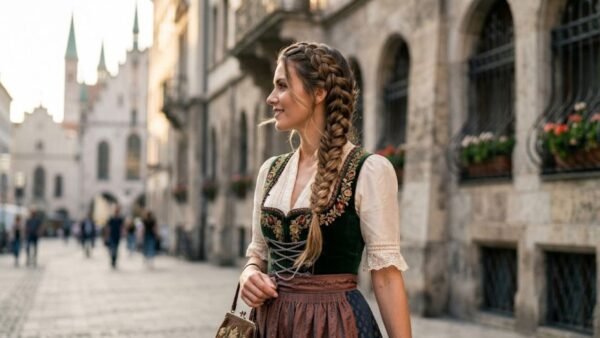
Currently the most popular modern dirndl braid across German and Austrian festival culture, the side Dutch braid starts at the temple on one side of the head and travels across the scalp at a diagonal angle before transitioning into a conventional braid that falls over one shoulder. This diagonal angle is the key to making the style flattering for a wide range of face shapes: angling the braid toward the opposite side of the face from which it starts creates an elongating, asymmetrical line that flatters rounder or wider face shapes by drawing the eye diagonally. For longer, narrower faces, a shallower angle that travels more horizontally softens the overall proportions. The side Dutch braid photographs beautifully in profile and three-quarter view, which makes it a particularly practical choice for festivals where photographs are inevitable. It pairs well with dirndls that have interesting neckline details — because the braid falls to one side, the opposite side of the neck and chest remains visible, allowing a decorated blouse collar or neckline embroidery to remain unobscured. Finish with the end of the braid tucked and pinned for an updo variation, or left loose over the shoulder for a more relaxed effect.
Braided Half-Up / Half-Down Beginner
The braided half-up, half-down is the single most versatile hairstyle in dirndl styling, and it is the style most likely to produce a genuinely flattering result on a first attempt with minimal preparation. The principle is straightforward: the top section of the hair — from temples to crown — is gathered, braided, and pinned or secured at the back of the head, while the remaining hair falls loose below. The braid can be a French braid, Dutch braid, simple three-strand plait, or rope braid depending on preference and skill level. Three meaningful variations exist within this framework. A single center braid pulled back from the crown creates a clean, symmetrical look that suits structured and formal dirndls. Two smaller braids gathered from each temple and joined at the back — creating a double braid crown effect — adds more visual interest and frames the face beautifully. A twisted half-up using two sections of hair twisted together rather than braided produces a softer, more romantic texture that works especially well with floral print dirndls or lace-collar blouses. The style works on almost all hair lengths above the chin and holds well throughout the day because only the secured upper section needs to maintain its structure — the lower hair, worn loose, can absorb minor dishevelment without the look appearing undone.
Waterfall Braid Intermediate
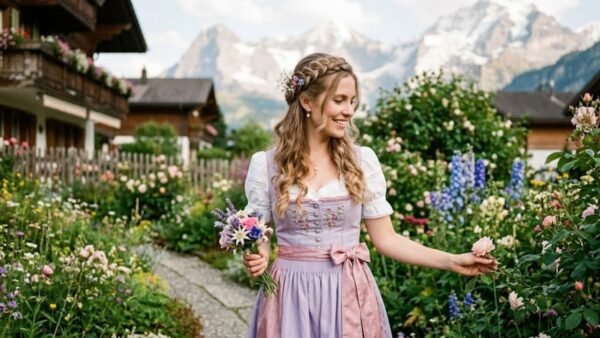
The waterfall braid is one of the most visually distinctive braiding techniques available for dirndl styling, and one of the most chronically underused. Unlike a French or Dutch braid that incorporates hair into the plait and keeps it there, the waterfall braid works by releasing the bottom strand of each crossed section rather than retaining it, allowing that strand to cascade freely downward while new hair from above is picked up to replace it. The result is a braid that appears to have strands of hair flowing through it from above — like water falling through the weave — while the braid itself travels horizontally across the head. This horizontal line, running from one temple across to the opposite side where it is pinned, creates a delicate, ethereal effect that suits romantic and feminine dirndl styles particularly well. Summer Fests and outdoor weddings are its natural habitat. On curly or wavy hair, the released cascade strands spring into ringlets that add further visual interest. The waterfall braid requires intermediate skill and benefits considerably from a second person to maintain tension while the main braid travels across the head.
Rope Braid Beginner
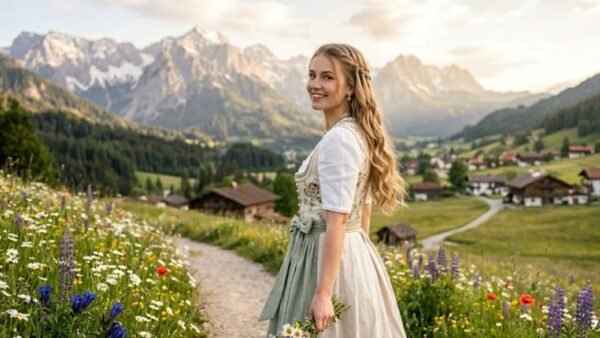
The rope braid is the most practically useful braid in any dirndl wearer’s repertoire for one specific reason: it takes under two minutes and produces a result that looks polished and intentional rather than rushed. The technique involves splitting the hair into two sections, twisting each section in the same direction (both clockwise, for example), then winding those two twisted sections around each other in the opposite direction. The opposing twists lock together and hold without any additional structure. The finished rope braid has a defined, spiral texture that differs visually from a standard plait and pairs particularly well with fitted, structured dirndls where a cleaner, more modern aesthetic is appropriate. Worn down the back, over one shoulder, or doubled up and pinned as a loose updo, the rope braid is the answer to the question of what to do when you have fifteen minutes, a full dirndl, and no patience for complicated technique. Finish with a decorative elastic, Tracht ribbon, or a narrow velvet band for a result that reads as deliberate rather than default.
Fishtail Braid Intermediate
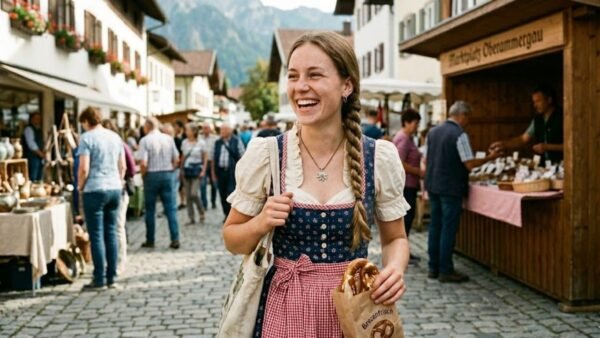
The fishtail braid is the most visually impressive technique on this list in terms of the complexity it appears to demonstrate — and the gap between how intricate it looks and how straightforward it actually is, once learned, is satisfyingly wide. Rather than working with three strands, the fishtail uses two sections. Small pieces are alternately pulled from the outer edge of one section and crossed to join the opposite section. The result is a tight, herringbone-patterned weave that looks hand-crafted and detailed even from several feet away. For dirndl styling, a side fishtail braid worn over one shoulder is typically more flattering than a center fishtail worn down the back, as the diagonal fall creates visual asymmetry that suits the layered design of most dirndls better than a perfectly centered line. On fine or thin hair, slightly pulling each section apart after braiding creates an illusion of thickness and fullness that a tightly executed fishtail doesn’t provide. Texture spray applied before braiding gives fine hair the grip it needs to hold each small crossover without slipping.
Pull-Apart / Messy Braid Beginner
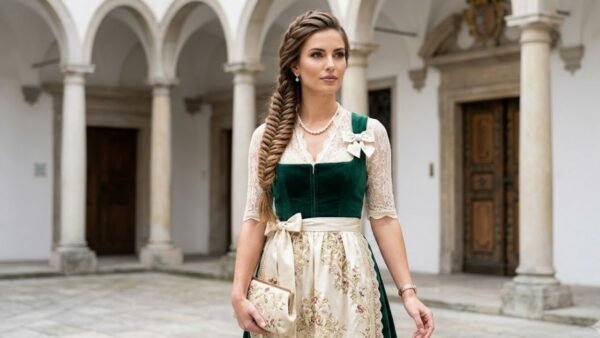
The pull-apart braid is not a separate braiding technique — it is a finishing method applied to any completed braid, and it produces what has become arguably the most photographed dirndl hairstyle of the current decade. Once a standard Dutch or French braid is complete, you work back from the end toward the root, gently pinching the outer edges of each plait section and pulling them apart sideways. This widens each looped section of the braid, creating a voluminous, textured result that appears organic, relaxed, and effortless while still being clearly a deliberate and considered style choice. The messy braid occupies a specific cultural position in modern Tracht styling: it communicates that the wearer understands tradition deeply enough to wear it loosely, which is considerably more sophisticated than either avoiding braids or executing them with anxious precision. Volume in the pull-apart braid is partially an optical illusion — wider plait loops photograph as fullness — which makes it an excellent option for those with finer hair who struggle to achieve substantial-looking braids by other means.
Double Dutch / Boxing Braids Intermediate
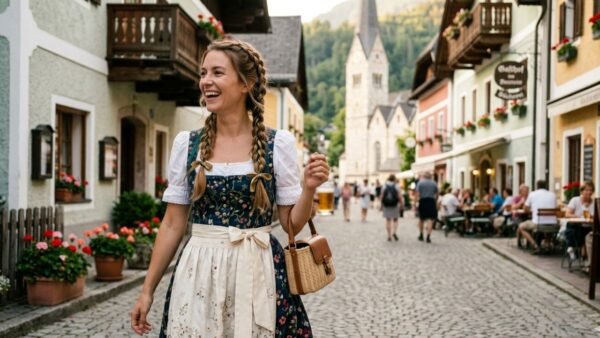
Double Dutch braids — two Dutch braids running parallel from front to back on either side of a center part — represent the contemporary, confident evolution of the classic two-pigtail braid. The raised, three-dimensional quality of the Dutch technique gives this style genuine sculptural presence on the head that reads as intentional and fashion-conscious rather than folksy. For dirndl styling, keeping the double Dutch braids from reading as sportswear requires two key decisions: the parting should follow natural hair texture rather than being ruler-precise (a slightly irregular center part reads as styled, not athletic), and the accessories must bridge traditional and contemporary codes — Tracht-colored ribbons at the elastics, small floral pins at the crown, or a single narrow velvet headband along the part all accomplish this effectively. Bold Tracht accessories complete the look in a way that anchors the style firmly in the dirndl universe. This pairing works best with structured Bavarian dirndls in stronger colorways — navy, forest green, burgundy — where the boldness of the hairstyle and the richness of the fabric reinforce each other.
Statement and Festival Braids — For Those Who Want to Stand Out
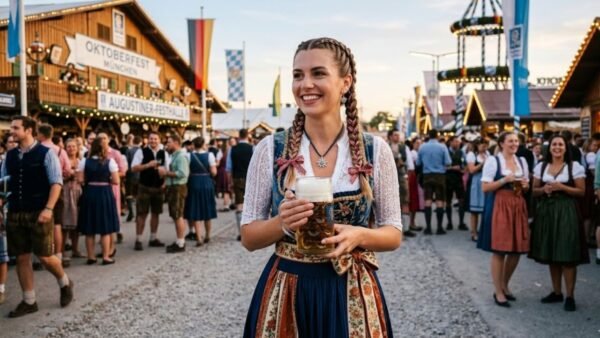
Some occasions call for more than a functional braid. Major Oktoberfest events, dirndl-specific fashion evenings, photoshoots, and competitive Tracht gatherings reward hairstyles that demonstrate genuine investment and technical ambition. The following styles are at the more demanding end of the spectrum — most require a skilled second pair of hands or a professional styling session — but the visual payoff is significant for occasions that warrant it.
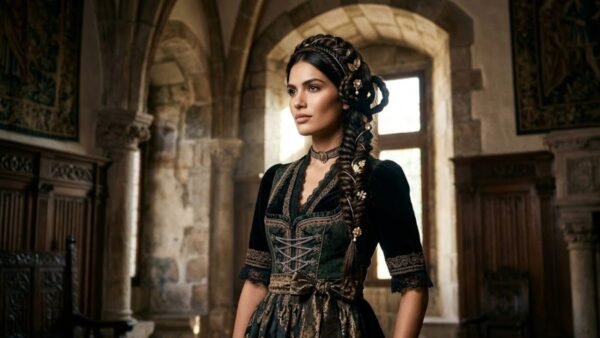
The faux mohawk braid centers multiple braids along the top of the head to create a dramatic raised crest from front to nape, flanked by flatter gathered sections or undone waves. It suits darker, more dramatically colored dirndls — deep burgundy, forest green, black — and benefits from strong, architectural Tracht accessories rather than delicate floral ones. The Viking and multi-strand statement braids have gained genuine traction in dirndl styling culture, particularly among younger German and Austrian women who see no contradiction between a 15th-century garment and a hairstyle inspired by contemporary fantasy aesthetics. Multiple small braids woven into a larger structure, with leather cord, gold pins, or braided Tracht ribbon threaded through, creates a look that is simultaneously rooted in Northern European folk tradition and entirely modern in its attitude. These styles work best with darker or more dramatic dirndl designs and require either a professional or a very practiced friend. Space buns with braids — two high buns with braided sections framing the face — occupy the more playful end of the statement spectrum and suit younger wearers at casual Fests with lighter, more summery dirndl styles. The key to keeping them from looking like a Halloween costume is everything around them: a well-fitted dirndl in a quality fabric, proper accessories, and a confident wearing of the whole ensemble signals intention rather than accident.
German Braids by Hair Type — Honest Guidance for Every Head
Braids for Long Hair
Long hair — roughly past mid-back — offers the widest range of dirndl braid options and the most room for customization, but it comes with a specific set of challenges that shorter hair avoids entirely. Weight is the primary one: very long, thick hair creates gravitational pull that works against the structural integrity of braids over the course of a long festival day. The solution is not more hairspray but better preparation. Texturizing spray applied from mid-shaft to ends before braiding creates friction that makes each crossover grip the next one rather than sliding. For crown braids and updos, securing the braid foundation with a discreet elastic before beginning the wrapping pass prevents the heavy fall of long hair from pulling the entire structure downward by mid-afternoon. The best styles for long hair in terms of both visual impact and all-day durability include the crown braid, fishtail braid, double Dutch, and any variation of the pull-apart braid — all of which use the hair’s length as a feature rather than a liability. Long-haired wearers attending full-day Oktoberfest events should carry a small flat pin kit and a travel-size firm-hold spray for structural reinforcement at the midpoint of the day.
Braids for Medium Hair
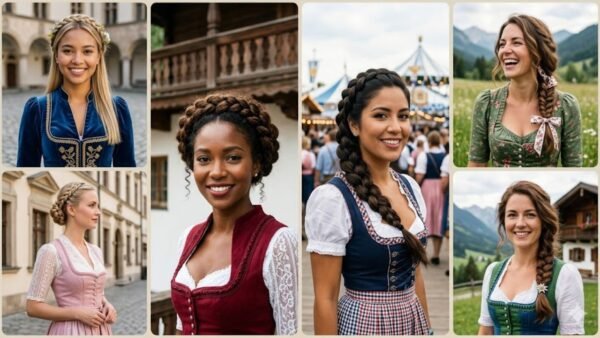
Medium hair — roughly between the chin and the shoulder blades — occupies what is actually the most practical position for dirndl braiding. It is long enough for the full range of styles including a partial crown braid, side Dutch, rope braid, half-up variations, and fishtail, and short enough that weight and management are rarely serious problems. Where medium hair has a genuine advantage over long hair is in the half-up, half-down style: the loose lower section, rather than falling as a heavy curtain down the back, sits in a more contained and naturally flattering way at the shoulders and collarbone. For styles that require additional length — a full crown braid that fully encircles the head, or a very long fishtail — clip-in braid extensions offer a straightforward solution. Modern clip-in extensions are available in a wide range of textures and colors, and their seam is easily concealed within the braid structure itself. When using extensions for a dirndl event, match not just the color but the texture: a smooth extension in wavy hair will be visible as a foreign element where a matched texture will blend naturally.
Braids for Short Hair
Short hair and braids is a topic surrounded by more discouragement than it deserves, and the honest truth is more nuanced than either “it works for everything” or “it doesn’t work at all.” Genuinely very short hair — cropped at the neck or above — cannot support a full crown braid or side Dutch without extensions, and attempting to force these styles on insufficient length produces results that look strained rather than styled. That is the honest limit. Within that boundary, however, the options are more creative and interesting than most style guides acknowledge. Small accent braids near the temples — two or three narrow French braids running back from the hairline and secured with decorative pins — create braid detail on short hair without requiring overall length. A partial crown using two small braids that meet and pin at the back of the head works on hair that reaches the chin. Braided bangs incorporated into an otherwise short and textured style add a traditional element that reads as intentional Tracht styling. The broader principle is this: short hair paired with a dirndl does not require braids to look correct. A well-styled, confident short cut with appropriate accessories — a Tracht headband, floral pin, decorative comb — is entirely appropriate and often more elegant than an underpowered attempt at a braid that the hair cannot support. Those exploring the complete dirndl styling picture will find that confidence in every detail of the look, hair included, is the element that unifies everything.
Braids for Curly and Wavy Hair
Curly and wavy hair produces dirndl braids that straight-haired wearers spend considerable product budget trying to replicate. Natural texture in a braid creates organic dimension, visual depth, and a sense of artisan craftsmanship that is genuinely, not superficially, beautiful. The styling approach for curly hair in a dirndl context focuses on working with the curl pattern rather than suppressing it. Braid sections while the hair is slightly damp with a curl-defining cream applied through each section — this sets the curl pattern within the braid and substantially reduces frizz throughout the day. Dutch braids work particularly well with curly hair because the raised structure accommodates more volume than a flat French braid and keeps the curl contained within a defined shape. For very coily or tightly textured hair, sectioning with a wide-tooth comb and smoothing each section once (rather than repeatedly) before incorporating it into the braid prevents the over-manipulation that causes frizz. The pull-apart braid on naturally wavy hair produces one of the most aesthetically successful dirndl hairstyles across all hair types — the organic spring of slightly loosened wave sections creates exactly the effortless volume that the style is designed to suggest.
Braids for Fine or Thin Hair
Fine hair presents a specific challenge in braid styling that no product fully solves but several techniques significantly mitigate. The core problem is that fine hair has less friction between strands, which means braids slip, loosen, and lose their structure faster than thick hair under the same conditions. The preparation approach for fine-haired dirndl braiding begins the night before: washing hair the evening before your event and sleeping on it produces just enough natural oil and minor texture to give braids meaningful grip. On the day of the event, apply dry shampoo at the roots and a texturizing spray from mid-shaft through ends. Work the products in fully before braiding — the residue is more useful than the spray. Choose styles that create the illusion of volume rather than requiring it: the pull-apart braid, Dutch braid (whose raised structure appears thicker than it is), and half-up styles where the loose lower section adds apparent volume all serve fine hair better than styles that depend on mass to look substantial. Avoid heavy serums or oils before braiding — they eliminate friction entirely and make fine hair essentially impossible to secure. Holding spray applied at the scalp after braiding, rather than over the finished braid (which flattens it), extends the style’s life through a full festival day.
German Braids by Occasion — From the Wiesn to the Wedding
Oktoberfest Braids — When Your Hair Needs to Survive the Day
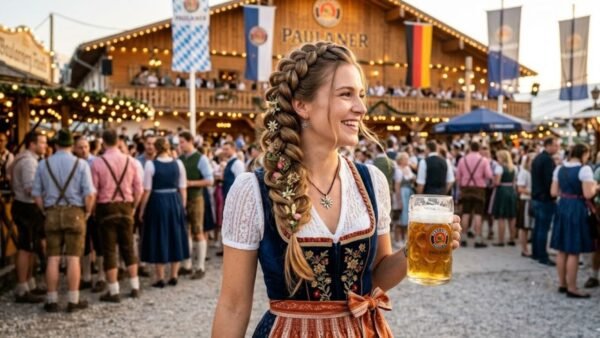
The Munich Wiesn runs from early morning until midnight, and any hairstyle worn through that span will be tested by standing crowds, outdoor humidity, the warmth of festival tents, dancing, and the general entropy that festival environments impose on careful morning preparations. Durability is, without exaggeration, the primary criterion for Oktoberfest braid selection — significantly more important than visual complexity or theoretical elegance. The styles that consistently perform over a full festival day share certain structural characteristics: they are braided on textured rather than clean hair, they use multiple anchor points (not a single elastic at the bottom), and they are finished with a firm-hold rather than flexible hairspray. Crown braids, double Dutch braids, and Dutch braids with pinned ends are the most reliable choices for longevity. The morning-to-evening transition matters too: a style that begins as a clean crown braid in the morning will develop organic looseness by afternoon that can be refreshed in under three minutes with two pins and a pocket mirror. Plan for this rather than fighting it.
Contrary to the stereotype, the actual most popular hairstyles worn by German women at the Wiesn are not the elaborate pigtails of the St. Pauli Girl. Real Wiesn hair leans toward natural texture, half-up styles with braided sections, loose crown braids, and the ever-present Blumenkranz worn over simply gathered or loosely braided hair. Many German women prioritize looking genuinely good over looking stereotypically “German” at the festival, which produces a range of hairstyles that reflects contemporary fashion sensibility as much as Tracht tradition. Tracht accessories — ribbons, flower pins, and the Blumenkranz — are the markers of intentional festive styling, not necessarily the braids themselves.
Wedding and Formal Dirndl Braids
What separates a formal dirndl braid from a casual one is not the complexity of the technique — it is the precision of the execution, the quality of the accessories, and the degree to which the hairstyle communicates deliberate investment. A crown braid at a village Fest can be loosely pulled-apart and pinned with wildflowers. The same crown braid at a wedding needs to be executed with consistent tension, smoothed sections, and finished with genuine Tracht silver pins, fresh flowers from a florist, and the structural integrity to last through a full ceremony and reception. For formal occasions where a professional hairstylist is available, providing them with images of the specific braid style and the dirndl itself — particularly the neckline and bodice detail — allows them to calibrate the hairstyle’s volume, height, and accessory placement to complement the specific garment rather than styling in isolation. For DIY formal braids, the most important investment is a single full practice run at least one week before the event, performed with the actual dress, accessories, and lighting so that problems can be identified and solved without the pressure of a timeline.
Casual and Everyday Dirndl Braids
The Christmas market, the Sunday afternoon village walk, the casual regional Fest — these occasions call for hairstyles that are intentional without being effortful, that suggest “I dressed up a little” rather than “I spent an hour on this.” The rope braid, the simple half-up with a small Dutch braid section, and the pull-apart braid worn over one shoulder are the workhorses of everyday dirndl styling. A Tracht ribbon tied at the end of a simple three-strand plait takes a basic braid from utilitarian to festive in ten seconds. A single decorative pin placed above a temple braid adds Tracht character to what would otherwise be a generic half-up. The consistent principle for casual dirndl hair is to add one traditional element — one accessory, one braid section, one ribbon — to whatever you were already planning to do with your hair. This principle produces better results, more reliably, than attempting a full formal braid style under time pressure. Those seeking inspiration for the complete casual dirndl look, from hair to footwear, will find the guide on how to wear a dirndl a useful complement to the hairstyle choices covered here.
Seasonal Dirndl Braid Reference
| Season / Occasion | Best Braid Styles | Key Accessories | Special Considerations |
|---|---|---|---|
| Summer / Oktoberfest (Sept–Oct) | Crown braid, side Dutch, double Dutch, pull-apart | Blumenkranz, Tracht ribbon, floral pins | Prioritize hold and durability; texturize before braiding; carry pins |
| Winter / Christmas Markets | Half-up Dutch, rope braid, braided half-up under hat | Velvet ribbon, pearl pins, Tracht headband | Style must work under a hat; loose lower sections stay warm at the neck |
| Spring / Easter & May Fests | Waterfall braid, soft crown, loose half-up with flowers | Fresh or silk spring flowers, pastel ribbons | Romantic texture suits spring dirndl prints; real flowers for outdoors |
| Formal / Wedding | Crown braid, structured half-up, side fishtail updo | Silver Tracht pins, fresh florals, fine hair combs | Consider a professional; practice run essential; photograph the braid in dress |
| Casual / Everyday | Rope braid, simple half-up, pull-apart, two loose pigtails | Single decorative pin, Tracht ribbon at elastic | One traditional element transforms any basic style into dirndl-appropriate |
The Complete Dirndl Braid Styling Toolkit
What You Actually Need — No Unnecessary Products
The styling industry has a financial interest in convincing you that a specific braid result requires a specific product, but the honest toolkit for dirndl braid preparation is considerably shorter than any commercial guide will suggest. The genuinely necessary tools are a tail comb for precise sectioning, a paddle brush for detangling before braiding, small clear elastics (not fabric-covered ones that snag), and a supply of bobby pins. Products that make a real functional difference: a texturizing or salt spray applied to dry hair before braiding to create grip, dry shampoo at the roots if your hair was washed the same morning, a light braiding cream worked through sections of very smooth or fine hair to add friction, and a firm-hold hairspray for the finished style. Everything beyond this list is optional and situation-specific. Heavy serums, conditioning oils, and glossing sprays should be applied after braiding if at all — applied before, they eliminate the friction your braids need to hold. The temptation to add shine to a braid is understandable but counterproductive to durability, particularly for long festival days outdoors.
Dirndl Braid Accessories — Traditional and Modern
The accessories woven into or placed atop a dirndl braid do a significant portion of the cultural signaling work that makes a hairstyle read as Tracht rather than generic. Traditional Bavarian and Alpine accessories include the Trachtenband (woven or velvet ribbon in regional colors), the Blumenkranz (flower wreath worn as a headband), Edelweiss pins — the small white flower of the Alpine meadow that carries deep symbolic resonance in Bavarian culture — and decorative silver or gold hair combs with traditional motifs. The Blumenkranz deserves particular attention because its origins run deeper than festival fashion: flower wreaths in Alpine culture were worn at May Day celebrations, harvest festivals, and weddings as symbols of youth, fertility, and seasonal joy long before they became Oktoberfest accessories. Wearing one at a dirndl occasion is therefore not a superficial styling choice but a connection to a living folk tradition.
Modern accessories that bridge traditional and contemporary aesthetics include gold or silver bar pins with minimal design, subtle braided leather cord threaded through braid sections, fine pearl-tipped pins placed at intervals along a crown braid, and narrow velvet headbands in dirndl-coordinating colors. When selecting accessories, match to the dominant accent color in your dirndl’s apron or bodice embroidery rather than the base color of the dress — this creates a cohesive look that appears considered without being matchy. For a complete understanding of how accessories function across the full dirndl look beyond the hair, the detailed reference on accessories to wear with a dirndl covers jewelry, bags, and footwear choices that work in harmony with different braid and hair accessory combinations.
Braid + Dirndl Pairing Guide — Match Your Style to Your Dress
| Dirndl Style | Best Braid Choices | Styles to Avoid | Ideal Accessory |
|---|---|---|---|
| Low sweetheart / square neckline | Crown braid, half-up Dutch, high-positioned braids | High ponytail braid (neckline needs upward visual fill) | Tracht ribbon, small floral pins at crown |
| High neck / lace collar | Side fishtail, loose rope braid over shoulder, low half-up | Crown braid (competes with collar detail at top of neck) | Single Edelweiss pin, minimal accessories |
| Floral / romantic print | Waterfall braid, soft pull-apart crown, loose half-up | Tight structured boxing braids (too sporty for romantic fabric) | Blumenkranz, fresh or silk flowers, pastel ribbon |
| Dark / dramatic dirndl (burgundy, black, navy) | Double Dutch, Viking multi-strand, side Dutch with volume | Delicate waterfall (visual weight mismatch) | Gold pins, leather cord, bold Tracht accessories |
| Casual cotton / summer dirndl | Rope braid, simple half-up, loose two-strand plaits | Full formal crown braid (overdressed for the garment) | Lightweight ribbon, simple daisy or wildflower pins |
| Off-shoulder or cold-shoulder | Crown braid, full updo with braided elements | Side braid over bare shoulder (draws attention away from neckline) | Decorative comb, silver Tracht pins at crown |
The Real Secret to a Perfect Dirndl Braid
There is no objectively correct German braid for a dirndl. There is only the braid that suits your hair, your face, your garment, your occasion, and your level of patience on the morning of your event. The entire history of Tracht styling — from the practical Alpine farm braid to the artful festival Kronenzopf — is a history of women adapting available materials and techniques to immediate context, not following a fixed rulebook. The folk revival of the 19th century gave braid culture symbolic weight. The 20th century gave it unwanted political baggage. The 21st century is giving it back to the women who wear it, on their own terms, with their own variations, in their own time.
What genuine Tracht culture rewards is not perfection — it is intention. A loosely pulled-apart Dutch braid worn with a Blumenkranz and a genuine smile communicates more fluency in the tradition than a technically flawless style assembled from a tutorial without feeling or context. Learn the foundation styles. Understand the cultural history behind them. Match your choices to your specific dirndl and occasion. And then — trust your own eye and your own instincts. Tradition is a starting point, never a cage. The braid you feel most like yourself in is the right one. Wear it with confidence, and the dirndl will do the rest.
To complete your dirndl preparation from the inside out, explore the dirndl blouse sizing guide for the foundation layer, and the complete dirndl wearing guide for everything from apron bow placement to footwear. For those just beginning their dirndl journey, the how to buy a dirndl guide covers fit, quality markers, and budget considerations that inform the entire look — hair included. Browse the full collection of authentic Bavarian dirndl dresses to find the garment your next braid deserves.
Find the Dirndl Your Braid Deserves
Every great hairstyle starts with a great dirndl underneath it. Explore our handcrafted collection of authentic Bavarian and traditional German dirndls — from casual summer Fests to formal occasions.
Shop Bavarian Dirndl Dresses
Shop Dirndl Blouses
Full Women’s Collection
Frequently Asked Questions — German Braids for Dirndls
What is the difference between a Dutch braid and a French braid?
A French braid crosses each side section over the center strand, causing the plait to sit flat against the scalp. A Dutch braid crosses each section under the center strand instead, which pushes the braid up and away from the scalp — creating a raised, three-dimensional effect. For dirndl styling at festivals, Dutch braids tend to photograph more dramatically and hold their visual structure better over long days outdoors. If you have only learned one braiding technique, the Dutch braid delivers more visual reward for the same effort level once you overcome the initial learning curve of the reversed crossing direction.
What do German women actually wear their hair like at Oktoberfest?
The reality at Munich’s Wiesn is considerably more varied than any stereotype suggests. Most German women wear half-up half-down styles with braided sections, loose crown braids with organic texture, side Dutch braids, or simply well-accessorized natural hair. The Blumenkranz flower wreath is genuinely widespread. Perfectly tight pigtail braids — the St. Pauli Girl version — are far less common than tourist-facing media implies. The consistent thread across German Wiesn hairstyles is accessory intentionality: Tracht ribbons, decorative pins, and flower elements appear even on simple styles, marking the wearer as deliberately dressed for the occasion.
How do you do a crown braid on short hair?
A full crown braid that circles the entire head requires at least shoulder-length hair. For shorter hair, a partial crown achieved by braiding from one temple, sweeping the braid across the back, and pinning at the opposite side creates the same visual impression with less length requirement. Hair that reaches the chin works for this technique. For very short hair, accent braids near the temples pinned back with Tracht pins add braid detail without requiring length, and clip-in braid extensions specifically designed for crown styling provide a seamless full-crown result for any hair length.
What accessories are traditional with dirndl braids?
Traditional dirndl braid accessories include velvet or woven Trachtenband ribbon (woven through braids or tied at ends), the Blumenkranz flower wreath worn as a headband, Edelweiss pins, and decorative silver or gold hair combs with regional motifs. In Bavarian and Austrian tradition, ribbon colors historically indicated regional origin and marital status. Today the focus is primarily aesthetic: match your ribbon or accessory color to the accent colors in your dirndl apron or bodice embroidery for a cohesive, styled result. Avoid mixing gold and silver metal tones in the same hairstyle.
How do you keep braids from falling out at Oktoberfest?
Start with second-day hair or apply texturizing spray to freshly washed hair — clean hair is too slippery to hold braids through a full festival day. Use small clear elastics at every anchor point. Apply braiding cream or a light pomade through each section before braiding to add friction between strands. Secure with bobby pins placed horizontally across the braid for stronger hold. Finish with firm-hold (not flexible-hold) hairspray. Keep three spare bobby pins and a travel hairspray in your bag for a mid-day refresh that takes under three minutes.
What is a Blumenkranz and when do you wear one?
A Blumenkranz is a flower wreath worn in the hair — a Bavarian and Alpine folk accessory with roots in pre-Christian harvest and May Day rituals. At Oktoberfest and regional Fests, Blumenkränze made from real or high-quality silk flowers are worn over loose or braided hair. They suit any dirndl occasion and communicate festive rather than formal intent. For formal occasions and weddings, real flowers from a florist create a more elevated effect. When choosing a Blumenkranz, match the dominant flower color to an accent color in your dirndl’s apron or embroidery for visual coherence.
Can you braid natural or curly hair for a dirndl?
Absolutely — and curly hair often produces the most visually striking dirndl braids because natural texture creates dimension and depth that straight hair requires significant product investment to replicate. Braid on slightly damp hair with a curl-defining cream applied through each section. Dutch braids and rope braids work particularly well with natural curl patterns. Smooth each section once before incorporating it rather than over-manipulating, which causes frizz. The pull-apart braid on wavy hair is particularly beautiful — the organic spring of the loosened waves creates exactly the effortless volume the style is designed to suggest.
What length of hair do you need for a crown braid?
A full crown braid that wraps around the entire head generally requires at least 12 inches of hair — roughly shoulder length. Longer hair creates a fuller, more substantial crown with more braided material visible at the top. For hair between chin and shoulder length, a partial crown achieves most of the visual impact. Those with shorter hair can use clip-in braid extensions specifically designed for crown styles, which blend naturally when color and texture are matched carefully.
What is the most flattering dirndl braid for a round face?
Styles that create vertical height or asymmetrical diagonal lines work best with round face shapes. A high crown braid or any braid positioned to add volume above the crown draws the eye upward and creates visual length. A side Dutch braid pulled diagonally across the head adds elongating asymmetry. Avoid styles that add horizontal width at the sides — low, full pigtail braids worn out to the sides accentuate roundness rather than balancing it.
How do I match my braid style to my dirndl neckline?
A low sweetheart or square neckline has visual space above it that benefits from upward hairstyle volume — crown braids and half-up styles fill this space naturally. A high neck or lace collar already concentrates detail at the throat, so a side braid or loose style that moves away from the neck keeps the look balanced. Off-shoulder dirndls benefit from a full updo or crown braid that keeps hair off the exposed shoulders. The guiding question: should the neckline or the hairstyle be the focal point? Choose one, then style everything else to support it.
Should you braid your hair wet or dry for a dirndl?
For most braid styles, dry hair with texturizing product applied is the optimal starting point. Completely clean, wet hair lacks grip and produces braids that loosen quickly. For curly or coily hair, braiding on slightly damp hair with curl-defining cream applied gives the best results. For straight or fine hair, apply dry shampoo at roots and a texturizing spray through lengths, work both products in thoroughly, and braid immediately for maximum grip and hold throughout a long festival day.
What is a Tracht ribbon and how do you use it in dirndl braids?
A Trachtenband is a traditional woven or velvet ribbon used decoratively in Bavarian and Alpine Tracht styling. Historically, specific ribbon colors and patterns indicated regional origin and marital or social status. Today they are used to tie at the end of a braid in place of a plain elastic, to weave through the length of a braid as a running color accent, or to wear as a narrow headband over an updo. Match the ribbon color to your dirndl’s apron or blouse accent color for a cohesive, pulled-together result.
How long does a crown braid take to do?
A crown braid takes 20 to 45 minutes depending on skill level, hair thickness, and whether you have help. Self-styling a crown braid is technically demanding because you are working above and behind your own head — practice at least twice before your event. With a skilled second person, the same braid takes 15 to 25 minutes. Lay out all tools (tail comb, elastics, bobby pins, hairspray) before starting to avoid mid-braid interruptions that lose tension.
Can you wear a ponytail with a dirndl?
A plain high ponytail reads as casual or athletic rather than festive alongside a dirndl. However, a braided ponytail, a low ponytail wrapped with a Tracht ribbon, or a textured ponytail with braided temple sections pulled back can work well for casual and everyday dirndl occasions. The key is adding one traditional Tracht element — a braid section, a ribbon, or a decorative pin — that bridges the modern hairstyle choice and the traditional garment.
What is the easiest braid to do on yourself for a dirndl?
The rope braid is the easiest self-styled dirndl braid — it requires splitting the hair into two sections, twisting each in the same direction, then winding them around each other in the opposite direction. The opposing twist locks and holds without additional structure. It takes under two minutes, looks polished, and pairs well with structured or fitted dirndls. For slightly more visual impact with still-manageable technique, a side Dutch braid worn over one shoulder is achievable solo with a moderate amount of practice.
Explore More German Attire & Festival Styling
German braid and dirndl culture is part of a broader world of Tracht tradition worth exploring in depth. The following guides will help you build a complete, authentic festival look from the ground up.
- Learn how to measure for a dirndl so that the garment your braid crowns actually fits the way it should — a poorly fitting bodice undermines even the most carefully chosen hairstyle.
- Read the complete guide to accessories to wear with a dirndl at Oktoberfest, covering everything from jewelry and bags to footwear that works with different braid and dress combinations.
- Understand how to care for your dirndl so it remains the backdrop your braid deserves across many seasons of wear.
- For the full picture of what a polished Oktoberfest look entails, the guide on what women wear at Oktoberfest provides context on how hair, dress, and accessories work together as a complete ensemble.
- Browse our complete Bavarian dirndl collection and our full range of dirndl blouses to find the pieces that will make your next braid truly shine.

Anna Bauer is a seasoned Bavarian fashion expert, cultural consultant, and heritage stylist with over a decade of hands-on experience in traditional German clothing. Born in Munich, the heart of Bavaria, Anna grew up surrounded by the rich traditions of Trachten fashion. Her passion for cultural attire led her to pursue a degree in Fashion and Textile Design at the prestigious University of the Arts Berlin, where she specialized in European folkwear.
Over the past 12+ years, Anna has collaborated with renowned Trachten designers, styled outfits for Oktoberfest events across Germany, and contributed articles to top fashion and culture magazines across Europe. Her work focuses on preserving the authenticity of Lederhosen and Dirndl wear while helping modern audiences style them with confidence and flair.
As the lead content contributor for German Attire, Anna combines her academic background, professional styling experience, and deep cultural roots to provide readers with valuable insights into traditional German fashion. Her blog posts cover everything from historical origins and styling guides to care tips and festival outfit planning—making her a trusted voice for anyone looking to embrace Bavarian heritage in a stylish, modern way.