

Blog
7 Dirndl Accessories for Oktoberfest 2026 You Shouldn’t Skip
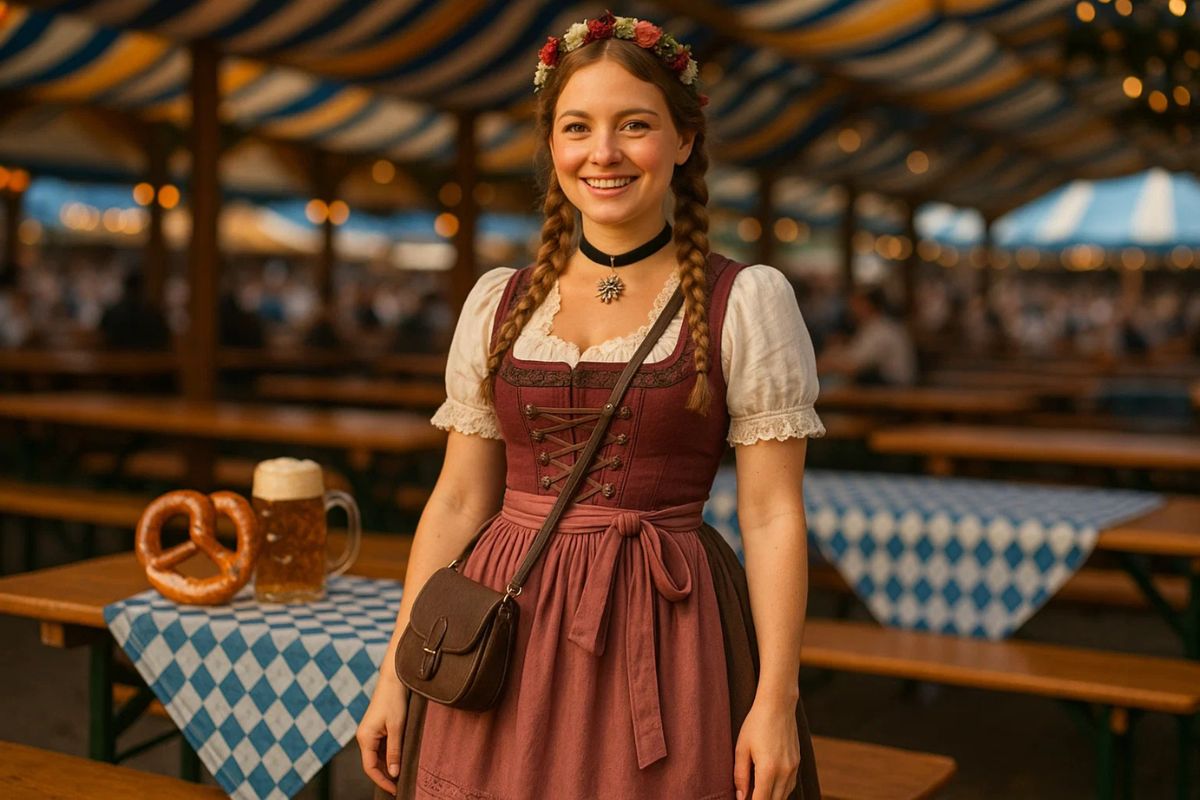
Dirndl Accessories for Oktoberfest — The Complete 2026 Guide
Most women attending the Munich festival spend considerable time choosing the right Dirndl and relatively little time thinking about the accessories that complete it. In this post we are going to talk about 7 Stylish Accessories Wear with Dirndl at Oktoberfest 2026. The result is a well-chosen dress paired with generic jewellery, an impractical bag, and shoes that fail before the afternoon session ends. The accessories are not an afterthought — they are the layer that distinguishes a carefully assembled Trachten outfit from a dress worn to a themed party.
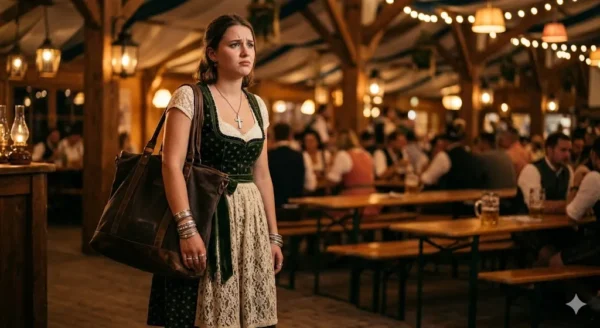
The authentic Dirndl accessory tradition is genuinely rich. Each piece — the Charivari chain, the Kropfband choker, the Trachtentasche purse, the Gamsbart-decorated hat, the Lebkuchenherz given by a partner — carries specific cultural meaning. Understanding what each accessory is and where it comes from changes how you choose and wear it. And there is one completely practical rule that no amount of cultural knowledge overrides: the Munich festival allows bags with a maximum capacity of three litres and maximum dimensions of 20 x 15 x 10 cm. Getting this wrong means your bag is confiscated at the entrance.
This guide covers every accessory category for the Dirndl — from culturally significant jewellery to practical festival bags — with specific guidance on matching accessories to different Dirndl styles and the 2026 trend direction that is reshaping how Bavarian women approach accessorising. For the complete outfit picture, our complete women’s Oktoberfest outfit guide covers every component from blouse to shoes. Shoe and sock guidance specifically is covered in depth in our guide on how to wear a Dirndl correctly.
The 2026 Accessory Principle: One Statement Piece Over Many Small Ones
Before covering individual accessories, the 2026 trend direction is worth establishing as a framework. The principle shaping how fashion-conscious Bavarian women are approaching Dirndl accessories in 2026 is: less is more. The right accessories complete the look — a simple piece of jewellery, a classic traditional bag, and the right shoes. Bold contrasts give way to harmonious tone-on-tone combinations that appear timeless.
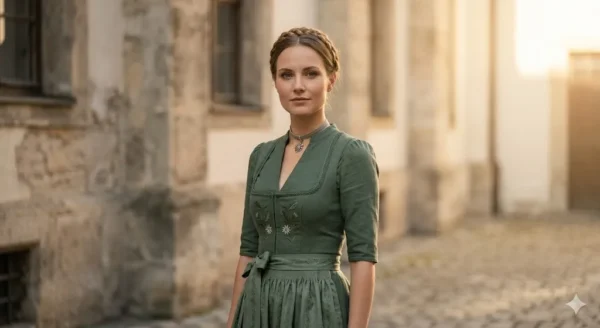
In practical terms, this means choosing one striking accessory as the centrepiece of the look — a significant Charivari chain, a well-made Kropfband, or a carefully constructed flower crown — and letting the other pieces support it rather than compete with it. The mistake most first-time festival visitors make is layering every available accessory simultaneously: flower crown, choker necklace, earrings, waist chain, brooch, and hat all at once. The result is visual noise that no individual piece can cut through. One genuine, well-chosen accessory communicates more cultural authenticity than six generic ones.
Jewellery: The Cultural Language of the Neckline
The Kropfband and Kropfkette — The Most Traditional Choice
The most culturally authentic jewellery choice for a Dirndl is the Kropfband or Kropfkette — the traditional Bavarian choker necklace worn at the throat. These two terms describe slightly different versions of the same tradition: the Kropfband is a ribbon or velvet choker with a decorative pendant, while the Kropfkette is a multi-strand chain choker with silver or pewter interlinking. Both are worn snugly at the throat, both emphasise the décolletage framed by the Dirndl bodice, and both connect the wearer directly to centuries of Bavarian folk jewellery tradition.
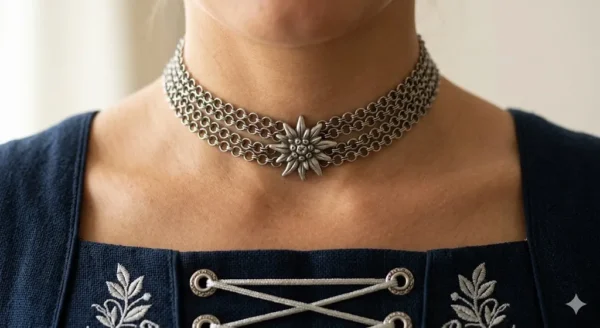
Traditional Kropfband and Kropfkette designs feature classic Alpine motifs. Edelweiss flowers — the small white Alpine bloom revered in Bavarian and Austrian folklore as a symbol of purity and courage — are the most common pendant motif. Hearts, deer, chamois, pretzels, and mountain motifs all appear across different regional and maker traditions. Silver and pewter are the traditional metals. Gold is less common in authentic Trachten jewellery — if you see a gold Dirndl necklace claiming traditional heritage, examine the quality claim carefully.
How to choose the right Kropfband for your Dirndl: match the metal tone of the necklace to the hardware elsewhere in the outfit — the bodice eyelet metal, the apron clasp, the bag hardware. Mixing silver and gold in a single Dirndl outfit is a visible styling error. A silver Kropfkette against a silver-eyelet bodice creates cohesion. The same silver necklace against bronze or gold hardware creates the visual confusion of an outfit assembled from incompatible pieces.
The Charivari — The Most Historically Significant Piece
The Charivari is the most culturally layered of all Dirndl accessories — and one of the least well understood by international visitors. Originally a men’s accessory worn hanging from a watch chain or belt across Lederhosen, the Charivari is a decorative chain or cord carrying a collection of small charms: old Bavarian coins, antler fragments, small carved animals, family crests, hunting trophies, and regional symbols. Each charm represents a specific event, achievement, or inherited tradition. A Charivari assembled over a lifetime tells the story of the person wearing it through its charms.
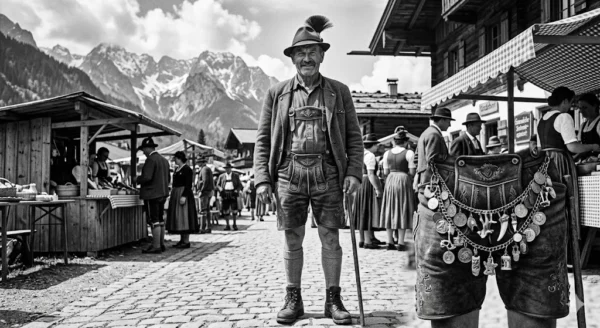
Women began wearing Charivari in the 20th century, adapted for the Dirndl bodice or apron waistband rather than the belt position used on Lederhosen. A women’s Charivari hangs across the bodice front or sits just above the apron bow, with the chain width and charm selection typically more delicate than the men’s version. The cultural significance is identical — each charm carries meaning, and a Charivari assembled over years of festival attendance becomes a wearable personal archive.
For visitors purchasing a Charivari for a first festival visit: choose a simple design with two or three meaningful charms rather than a heavily laden chain that signals no genuine accumulated history. An honest, simple Charivari communicates more authentic connection to the tradition than an overloaded one assembled entirely for appearance. The history of the Dirndl and its accessories reveals why this accumulated personal meaning is so central to Trachten culture.
Edelweiss Pendants and Alternative Necklace Styles
Beyond the Kropfband and Charivari, a single Edelweiss pendant on a fine silver chain is a clean, culturally appropriate alternative for women who prefer a simpler approach. The Edelweiss as a motif requires no explanation in the Alpine cultural context — its meaning (purity, love, Alpine connection) is understood by everyone at the festival. A well-made silver Edelweiss pendant in a size proportional to the neckline — not oversized, not so small it reads as forgettable — is elegant and unambiguously correct.
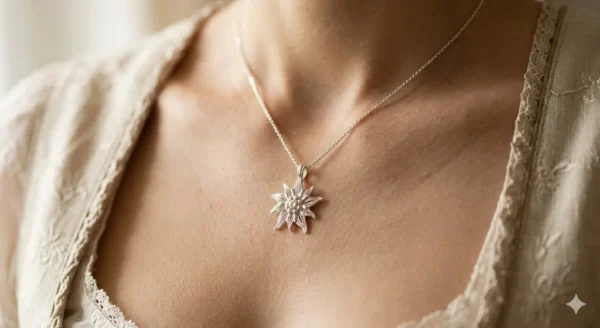
Statement pendants with non-Alpine motifs — fashion jewellery, branded pendants, contemporary minimalist geometric pieces — do not work against a Dirndl because they occupy a completely different cultural vocabulary. The Dirndl is a garment rich in specific cultural content. Accessories that come from outside that cultural vocabulary look incongruous in the way that a football jersey looks incongruous at a formal dinner — not wrong in itself, but wrong in context.
Earrings — Proportion and Restraint
Dirndl earrings follow the same Alpine motif vocabulary as necklaces: Edelweiss, hearts, antlers, chamois, pretzels, small beer steins. Dangling styles work particularly well when the hair is braided or pinned up — a hairstyle that shows the neck and ears — because they create movement and visual interest at the neckline without competing with the Dirndl itself.
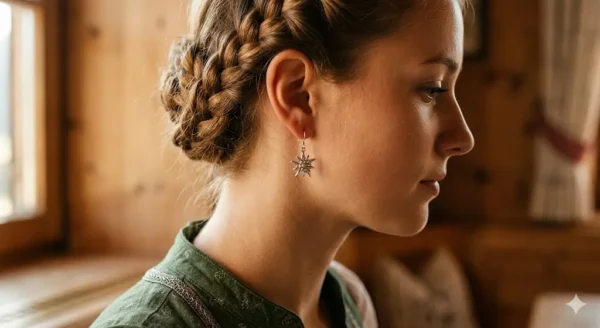
The proportion rule is important: if you are wearing a Kropfkette or Charivari, choose small stud or minimally dangling earrings. The necklace is the feature piece at the neckline — large earrings competing with a significant choker necklace creates too much simultaneous visual activity in a single area. If you are wearing no necklace, more substantial earrings serve as the focal point of the jewellery look. Choose one focal point and support it with everything else.
Bodice Pins and Brooches
A category the old post ignored entirely: bodice pins and brooches attached directly to the Dirndl bodice. These small decorative elements — typically featuring Alpine motifs in enamel, silver, or pewter — are pinned at the centre front of the bodice, just below the neckline. They add detail to plain bodices, personalise embroidered ones with an additional layer of meaning, and provide a subtle location for a family heirloom piece.
Brooches were historically the primary form of personalisation for Trachten garments before embroidered Dirndls became widely available. A brooch that has been in a family for generations — a silver Edelweiss or a small enamel chamois from a grandmother’s collection — worn on a contemporary Dirndl creates exactly the kind of living heritage connection that the Trachten tradition values most highly.
The Lebkuchenherz — The Oktoberfest Accessory Most Visitors Miss
One of the most distinctively Wiesn-specific accessories is the Lebkuchenherz — the large decorated gingerbread heart sold at stalls throughout the festival grounds. Inscribed with messages like “Ich liebe dich” (I love you), “Mein Schatz” (my darling), or “Vergiss mich nicht” (forget me not) and decorated with icing, mirrors, and ribbons, these gingerbread hearts are traditionally given by partners to wear around the neck on a ribbon throughout the festival.
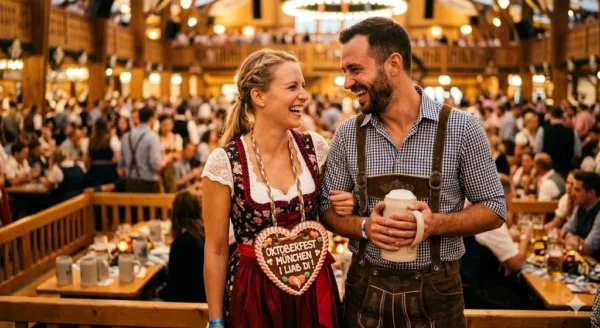
The Lebkuchenherz is not primarily a food item — it is a festival jewellery tradition. Wearing one around the neck signals that someone gave it to you, which in the Wiesn social context carries specific meaning: you are there with someone who cares enough to buy it. The tradition is old enough that it reads as genuinely cultural rather than tourist gimmick to Bavarians who know it. If you are attending with a partner, giving and wearing Lebkuchenherzen is entirely within the authentic tradition of the festival.
The Wiesn-Glügerl — The Munich-Specific Personalised Pin
The Wiesn-Glügerl is a small decorative pin or clip specific to the Munich festival, typically made at stalls within the grounds where your name or a short message is burned into the wood or metal surface. These personalised pins are attached to the Dirndl bodice, apron, or hat and serve as a festival souvenir that becomes part of the outfit for the duration of the visit. Regular Munich festival attendees often accumulate a small collection across multiple years — each pin a dated record of a particular Wiesn visit.
International visitors are less familiar with this tradition, but it is entirely accessible — the stalls are visible within the grounds and the process takes only a few minutes. A Wiesn-Glügerl with your name in traditional Bavarian script adds a specific, dated piece of festival history to the outfit.
Hair Accessories — The Flower Crown and Its Alternatives
The Flower Crown: How to Choose and Wear It Correctly
The flower crown — Blumenkranz in German — has become the most internationally recognisable Dirndl hair accessory and one of the most Instagrammed elements of the Munich festival aesthetic. Its popularity is entirely justified: a well-chosen flower crown over braided hair creates one of the most visually complete expressions of the Dirndl tradition. The combination of braided hair and flower crown is the specific aesthetic associated with authentic Alpine folk dress throughout Bavarian and Austrian culture.
The 2026 direction for flower crowns follows the overall accessory trend toward restraint and quality: a smaller, carefully constructed crown in muted natural tones outperforms an oversized wreath of artificial blooms. The colour palette that reads most naturally against Dirndl fabrics in 2026 — sage green, champagne, smoke blue, taupe, walnut brown — is served by crowns in deep red, burnt orange, forest green, cream, and burgundy. Bright, saturated primary colours in the crown compete with the subtle natural tones of the Dirndl rather than complementing them.
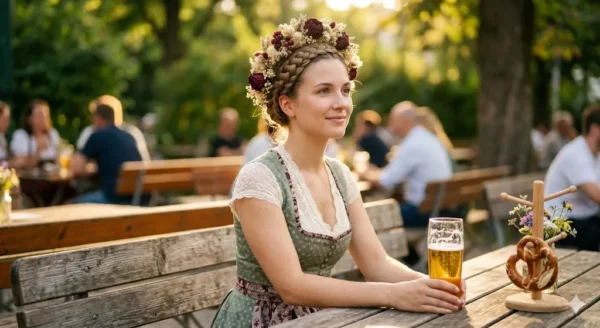
Silk and dried flowers are significantly more practical than fresh flowers for a full day of festival wear. A crown of fresh flowers looks excellent at 10am and progressively worse through the afternoon heat of a September Wiesn. A well-made silk or dried flower crown in quality materials looks correct all day without wilting or dropping petals onto the Dirndl bodice.
The crown must sit over braided or pinned hair rather than loose, unstyled hair. Against a braided updo, a flower crown looks intentional and culturally connected. Against loose hair, it slides throughout the day and looks like a shopfront display item rather than a considered part of the outfit. If you plan to wear a flower crown, plan the hairstyle at the same time.
The Tirolerhut — The Tyrolean Hat for Women
The Tirolerhut — the structured felt Alpine hat — is traditionally a men’s accessory that women have adopted with genuinely good results for the Dirndl context. A women’s Tirolerhut is typically smaller and more finely proportioned than the men’s version, with a narrower brim, a corded band, and a Gamsbart — the traditional chamois hair brush decoration that is the hat’s most culturally distinctive element. The Gamsbart is made from the neck hair of the chamois mountain goat and has been part of Alpine hat tradition for centuries, originally signalling hunting success and later evolving into a prestige accessory.
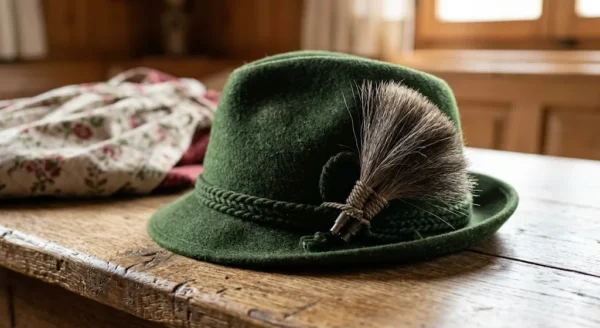
A Tirolerhut works best with ladyhosen outfits, where the combination creates a complete Alpine mountain look, and with Dirndl styles in darker, more structured fabrics where the hat’s formality suits the overall register. It works less well with light, summery Dirndl styles or with full flower crown looks where two major headpieces compete for visual dominance.
Simpler Hair Accessories for a Less Statement-Heavy Look
Not every Dirndl look needs a flower crown or hat. Hair clips with Edelweiss motifs, decorative combs with Alpine details, velvet hairbands in coordinating colours, and small floral hairpins all add character to braided or pinned hairstyles without the visual weight of a full crown. For women who prefer their hair to stay in place throughout a long festival day without elaborate styling, these smaller accessories provide the Bavarian cultural reference at a practical level.
The Trachtentasche — Your Festival Bag Has Strict Size Rules
The Munich Festival Bag Size Restriction
This is the practical detail that catches international visitors off guard every single year. The Munich Oktoberfest permits bags with a maximum capacity of three litres and maximum measurements of 20 x 15 x 10 cm. Bags exceeding these dimensions are confiscated at the entrance. Large handbags, standard crossbody bags, backpacks, and tote bags are all too large. This is a genuine security measure implemented and enforced consistently.
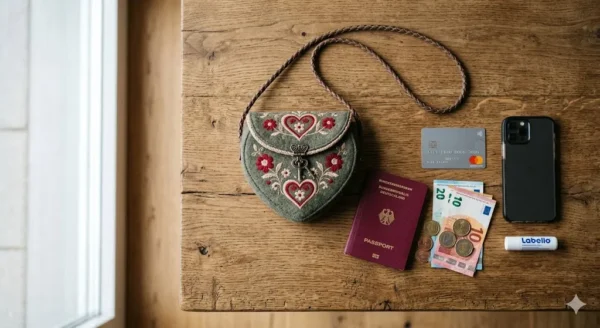
Small cross-body purses, fanny packs, or an apron purse are the correct choices for the festival specifically. Plan your essential items accordingly: ID or passport, one card, cash (ATMs have long queues inside during peak hours), phone, lip balm, and a small amount of personal items. Everything else stays at the hotel. A well-organised small bag for the festival day is better prepared than a large bag that is confiscated at the entrance.
The Trachtentasche — Authentic Design and Practical Function
The Trachtentasche is the traditional Dirndl purse — a small bag specifically designed to complement Trachten dress in both size and aesthetic. Traditional designs are made from embroidered linen, wool felt, or genuine leather, typically in heart shapes or rectangular formats decorated with Alpine motifs. The heart shape in particular is associated with the gingerbread heart (Lebkuchenherz) tradition and with the Dirndl accessory culture more broadly.
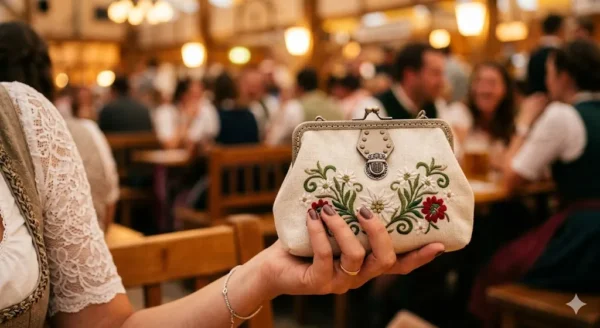
Modern Trachtentasche designs extend the traditional aesthetic into more practical formats: slim crossbody bags in leather or suede with secure zip closures, belt-attached pouches that leave both hands free for dancing and beer steins, and structured mini bags with Bavarian embroidery detail on a crossbody strap. All of these options keep within the festival’s bag size restriction while providing secure, hands-free carrying capacity appropriate for a full festival day.
Security is a genuine consideration at a festival of six million visitors. A Trachtentasche with a zip or secure clasp closure is the correct choice — open-top bags and easily accessed pockets are unnecessary risks in crowded beer tents. Choose function first within the authentic aesthetic, not appearance first with function as an afterthought.
Outerwear — The Janker and Trachten Cardigan
The Janker: What It Actually Is
Munich in late September ranges from warm afternoons (18-22°C) to cold evenings (8-12°C). Every Dirndl outfit needs outerwear for the temperature transition. The correct traditional choice is the Janker — a tailored wool jacket cut specifically for wearing over Dirndl, typically in loden cloth (a dense, water-resistant boiled wool) with horn or antique metal buttons and optional velvet trim at the collar and cuffs.
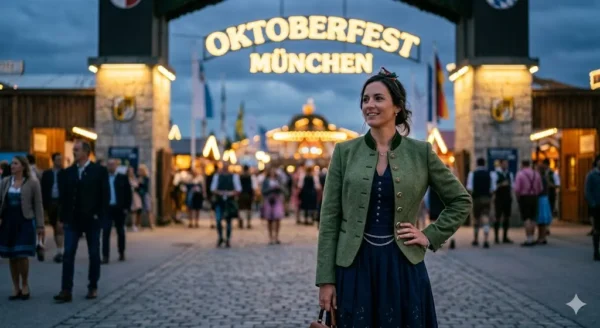
The Janker is cut to end at the natural waist — the same point where the Dirndl bodice ends and the skirt begins — so that it preserves the complete silhouette of the Dirndl when worn open. It covers the bodice when closed without obscuring the Dirndl’s visual structure below the waist. This specific cut is what distinguishes a Janker from a generic cardigan or jacket worn over a Dirndl — the proportions are designed specifically for this purpose.
Traditional Janker colours for women: loden green, dark navy, grey, and black are all correct and common. Bright or non-traditional colours exist in contemporary production but move away from authentic Trachten aesthetics. The material should be natural — wool or wool blend. Synthetic fabric jackets worn over an authentic Dirndl create an obvious material mismatch that undermines the overall look.
The Trachten Cardigan as a Simpler Alternative
A cropped Trachten cardigan — a knitted wool sweater ending at the natural waist, often with embroidered or decorative button detail — is a less formal and more widely available alternative to the Janker. It provides the same silhouette-preserving function and the same warmth, with a softer aesthetic that suits casual festival wear better than the more structured Janker suits formal occasions.
Both options are preferable to any generic modern jacket, blazer, or parka worn over a Dirndl. The goal of outerwear for a Dirndl is to extend the wearing temperature without breaking the cultural coherence of the outfit. A North Face fleece over a €400 silk Dirndl is not an outfit — it is two separate garments occupying the same body simultaneously.
Socks, Stockings, and the Legwear Decision
Legwear for Dirndl is covered fully in our guide on how to wear a Dirndl correctly, including specific guidance by Dirndl length and for different weather conditions. The short version for accessory purposes: white or cream lace-trimmed ankle socks for midi Dirndl in warm weather, opaque tights in neutral or coordinating tones for cooler conditions and longer lengths, cable-knit knee socks for ladyhosen and more casual styles. The legwear should coordinate with the Dirndl’s colour palette — it is part of the accessory system, not a separate afterthought.
Colour Coordination: Matching Accessories to Your Specific Dirndl
The Metal Consistency Rule
The single most important accessory coordination rule: choose one metal tone and maintain it across every metal element in the outfit. Silver eyelet bodice lacing, silver Kropfkette necklace, silver earrings, silver bag clasp. Or: antique brass eyelet lacing, pewter Charivari, pewter earrings, brass bag hardware. Mixing silver and gold or silver and brass creates visual inconsistency that experienced Trachten wearers notice immediately.
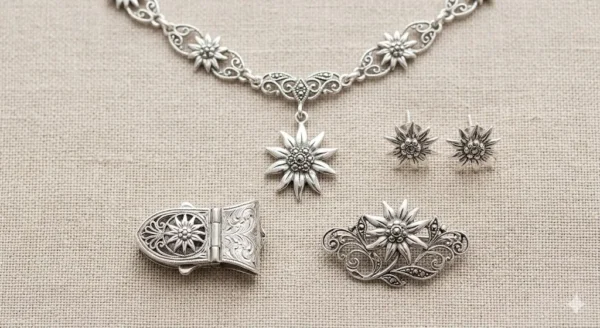
This rule applies to every metal surface in the outfit — including the buttons on the Janker, the clasp on the Trachtentasche, and any brooch or bodice pin. A consistent metal tone creates the impression of an outfit assembled with deliberate attention to detail. Mixed metals create the impression of an outfit assembled from whatever was individually available.
Accessory Colours by Dirndl Palette
| Dirndl Colour | Flower Crown | Jewellery Metal | Bag Colour | Cardigan/Janker |
|---|---|---|---|---|
| Forest green / sage | Cream, burgundy, white | Silver or pewter | Brown or tan leather | Loden green or dark grey |
| Navy / royal blue | White, pale pink, cream | Silver | Dark brown or black | Navy or dark grey |
| Burgundy / deep red | Cream, pale gold, blush | Silver or antique brass | Brown or tan | Black or dark grey |
| Black bodice | Any — maximum contrast works | Silver or gold | Black, tan, or red | Black or forest green |
| Brown / walnut / taupe | Rust, terracotta, cream | Antique brass or pewter | Brown or cognac leather | Loden green or dark brown |
| Champagne / ivory | Dusty pink, lilac, cream | Silver or rose gold | Cream, tan, or nude | Cream or pale grey |
The coordination principle is complement rather than match. An accessory in the identical colour as the Dirndl disappears into the garment. An accessory in a wildly contrasting colour competes with it. An accessory in a complementary tone adds visual depth without confusion.
Building the Complete Accessory Look by Occasion
For Oktoberfest Day Sessions
A practical, culturally correct accessory set for a daytime Wiesn session: a Kropfband or single Edelweiss pendant necklace at the throat, small Edelweiss stud or short dangling earrings, a Blumenkranz flower crown over a braided updo, a small leather or embroidered Trachtentasche within the 3-litre bag restriction, lace-trimmed ankle socks, and a Trachten cardigan for the late afternoon temperature drop. One piece of focused jewellery rather than layered pieces. Accessories that serve both cultural and practical purposes simultaneously.
For Oktoberfest Evening Sessions
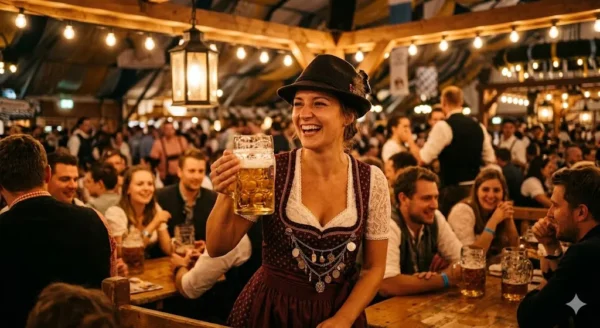
Evening sessions in the tents have a different atmosphere — more formal, more energetic, darker lighting. A Charivari rather than a simple Kropfband becomes a stronger evening choice — the chain catches the tent lighting and carries more visual presence in the lower light conditions. A Tirolerhut works better in the evening than the flower crown, which is more naturally suited to daylight outdoor settings. The Janker rather than the cardigan for the colder evening temperature outside the tent. A crossbody bag with secure zip rather than a structured heart bag — evening tent crowds are dense and active.
For Bavarian Weddings and Formal Cultural Events
Formal occasions call for the most considered accessory approach: a significant Charivari in quality silver with meaningful charms, a fine Kropfkette rather than a simple pendant, a Janker in quality loden rather than a casual cardigan, leather Haferlschuhe rather than simple Mary Janes, and a structured leather Trachtentasche in a neutral coordinating tone. No flower crown for formal occasions — a single decorative hairpin or comb is more appropriate to the register. Understated, high-quality, culturally coherent.
Frequently Asked Questions
What jewellery do you wear with a Dirndl?
The most traditionally correct jewellery is the Kropfband or Kropfkette — a traditional Bavarian choker necklace in silver or pewter worn at the throat. Edelweiss pendants, Charivari chains, heart and antler motif earrings, and bodice brooches are all authentic choices. The 2026 principle is one focused piece rather than multiple layered ones. Match all metal tones across the outfit — silver with silver, pewter with pewter — and choose motifs from the Alpine cultural vocabulary rather than generic fashion jewellery.
What bag can you bring into the Munich Oktoberfest?
The official Munich festival rule allows bags with a maximum capacity of three litres and maximum dimensions of 20 x 15 x 10 cm. Bags exceeding these dimensions are confiscated at the entrance. This means small crossbody bags, belt pouches, mini clutches, and traditional Trachtentasche within these dimensions only. No standard handbags, no backpacks, no tote bags. Plan your festival essentials — ID, one card, cash, phone, minimal personal items — to fit within this restriction before leaving the hotel.
What is a Charivari and should I wear one?
A Charivari is a traditional Bavarian decorative chain originally worn by men on Lederhosen, now also worn by women across the Dirndl bodice. It carries small charms representing events, achievements, and family heritage — old coins, antler fragments, carved animals, hunting trophies, regional symbols. A Charivari assembled with meaningful charms over years of festival attendance is culturally significant. For a first visit, a simple design with two or three quality charms is more honest and appropriate than an overloaded chain assembled entirely for appearance.
What flowers go in a Dirndl hair crown?
The most practical choice is silk or dried flowers in autumnal tones — deep red, burnt orange, burgundy, forest green, cream, and pale gold. These suit the September-October festival season and complement the muted natural tones of 2026 Dirndl fabrics. Fresh flowers look excellent at the start of the day and deteriorate through the afternoon. The crown must be worn over braided or pinned hair — against loose hair it slides continuously and loses the intentional effect. Match at least one crown colour to the apron or bodice accent colour for visual coordination.
What is the Lebkuchenherz and how is it worn?
The Lebkuchenherz is the large decorated gingerbread heart sold throughout the Munich festival grounds, inscribed with messages like “Ich liebe dich” or “Mein Schatz” and hung on a ribbon around the neck. It is a traditional festival accessory given by partners to wear throughout the day — not primarily a food item, though it is edible. Wearing one signals that someone gave it to you, which carries specific social meaning at the festival. Buying one for yourself to wear is possible but differs from the traditional meaning of the gift exchange.
Should I wear a flower crown or a Tyrolean hat?
Both are correct but suit different looks and occasions. A flower crown works best with midi and maxi Dirndl styles in lighter fabrics, with braided hair, and in outdoor and daytime settings. A Tirolerhut with a Gamsbart decoration suits ladyhosen outfits, darker and more structured Dirndl styles, and cooler weather when the hat also provides warmth. For a first Wiesn visit choosing between them: the flower crown is more universal, more widely worn, and easier to coordinate with most Dirndl styles. The Tirolerhut is the stronger choice if you are wearing ladyhosen or a dark, formal Dirndl.
What is the Wiesn-Glügerl?
The Wiesn-Glügerl is a small personalised pin or clip specific to the Munich festival, made at stalls within the grounds where your name or a short message is burned into the wood or metal surface. Regular Munich festival attendees accumulate one per year — each pin a dated record of a particular visit. These are attached to the Dirndl bodice, apron, or hat and are one of the most genuinely festival-specific accessories available. Finding the stall within the grounds and having one made during your visit takes only a few minutes and produces a keepsake that is specific to your individual festival experience.
The Accessory Principle That Holds Across All Occasions
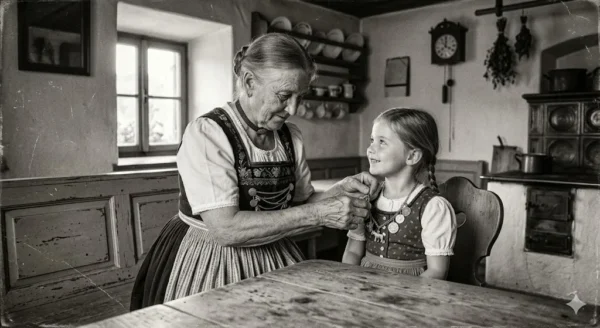
Every genuine Trachten accessory carries meaning — cultural, personal, or both. The Charivari tells the story of a life through its charms. The Lebkuchenherz communicates that someone loves you. The Wiesn-Glügerl records the specific year you were there. Even the flower crown connects the wearer to an Alpine natural tradition that predates the festival by centuries. Choosing accessories with this understanding — rather than simply filling the accessory categories because a guide told you to — is what separates an outfit assembled with genuine cultural engagement from one assembled with visual checklist thinking.
Browse our Bavarian traditional Dirndl collection for the authentic pieces that these accessories are designed to complement. Our Dirndl blouses collection covers the full range of neckline styles that work best with each jewellery type covered in this guide. For help selecting the right Dirndl size before you start building your accessory look, our guide on how to measure for a Dirndl covers every measurement correctly.
German Attire supplies authentic Bavarian Dirndl, Lederhosen, and traditional German Trachten to customers across the UK, US, and Australia. Visit our store at 27 Victoria Street, London SW1H 0EX, or browse our complete ladies’ Oktoberfest dress collection online — every piece designed to carry the accessories this guide describes with the authenticity they deserve.

Anna Bauer is a seasoned Bavarian fashion expert, cultural consultant, and heritage stylist with over a decade of hands-on experience in traditional German clothing. Born in Munich, the heart of Bavaria, Anna grew up surrounded by the rich traditions of Trachten fashion. Her passion for cultural attire led her to pursue a degree in Fashion and Textile Design at the prestigious University of the Arts Berlin, where she specialized in European folkwear.
Over the past 12+ years, Anna has collaborated with renowned Trachten designers, styled outfits for Oktoberfest events across Germany, and contributed articles to top fashion and culture magazines across Europe. Her work focuses on preserving the authenticity of Lederhosen and Dirndl wear while helping modern audiences style them with confidence and flair.
As the lead content contributor for German Attire, Anna combines her academic background, professional styling experience, and deep cultural roots to provide readers with valuable insights into traditional German fashion. Her blog posts cover everything from historical origins and styling guides to care tips and festival outfit planning—making her a trusted voice for anyone looking to embrace Bavarian heritage in a stylish, modern way.