

Blog
Traditional German Wedding Attire: Complete Expert Guide 2026
Traditional German Wedding Attire: The Complete Expert Guide
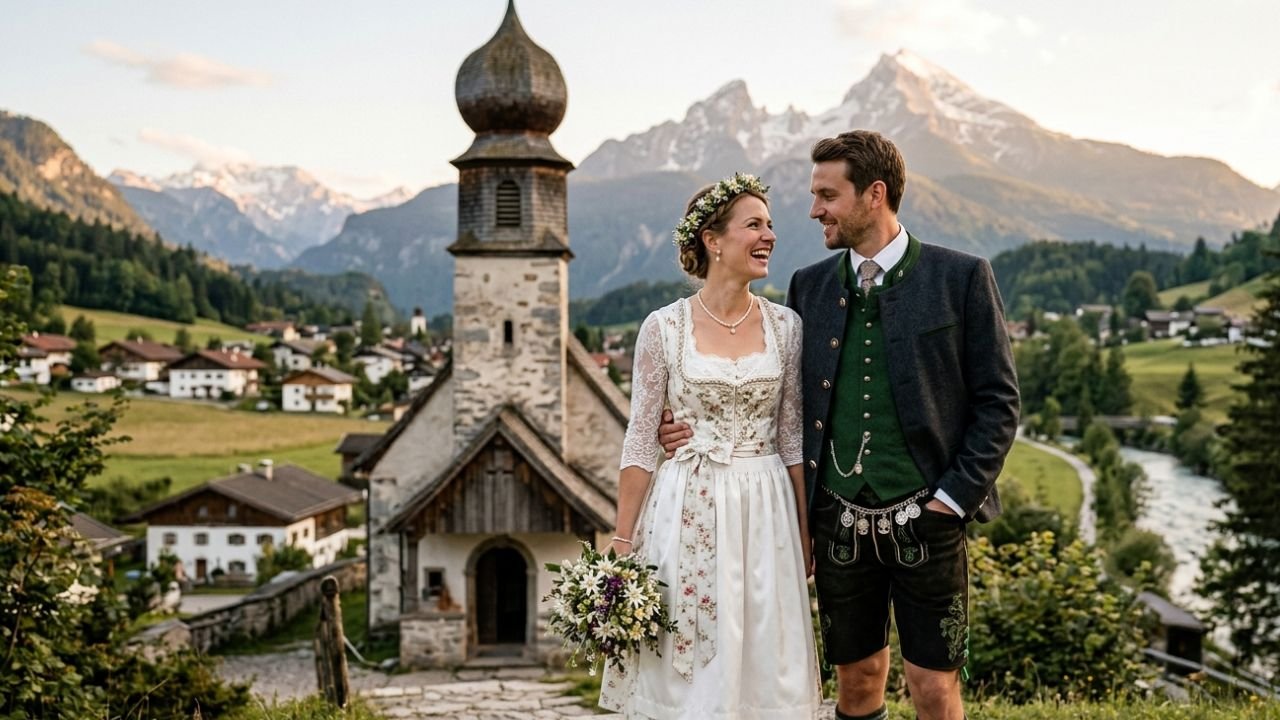
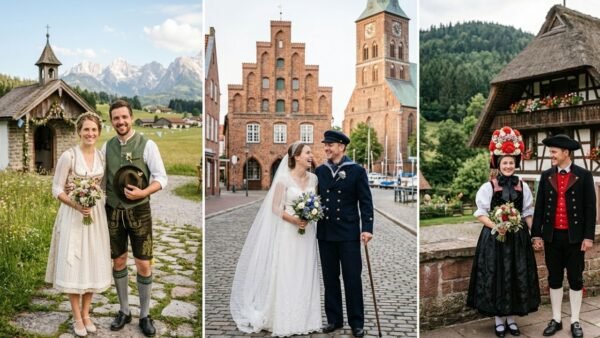
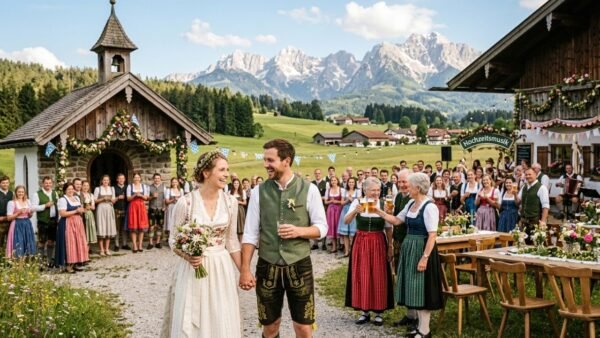
She stands at the church doorway in a white dirndl of silk and Bavarian lace, a crown of myrtle and edelweiss woven through her hair. He waits at the altar in dark Kniebundlederhosen, a fitted Janker jacket, and a Charivari chain carrying the silver coin his grandfather wore at his own wedding. The scene feels ancient and utterly contemporary at the same time — because it is both. Tracht wedding attire in Bavaria has centuries of roots and a genuine modern revival that makes it one of the most emotionally resonant wedding aesthetic choices available anywhere in the world today.
What surprises most people who begin researching German wedding attire is the discovery that there is not one German bridal tradition but three distinct ones, each with its own history, its own cultural logic, and its own modern expression. The first is the historical black wedding dress — worn throughout rural Germany for centuries, black not as mourning but as the highest formal occasion color available to working people who owned one good garment and wore it for every significant event of their lives. The second is the modern white gown that spread from Queen Victoria’s 1840 wedding through European bourgeois society and became the German standard through the twentieth century, developing its own distinctly German characteristics along the way. The third is the Tracht wedding — dirndl and lederhosen as bridal and groom attire — which was the Alpine tradition long before industrialization pushed it to the margins and which is now experiencing a genuine, enthusiastic revival among both rural Bavarians and German-heritage couples worldwide.
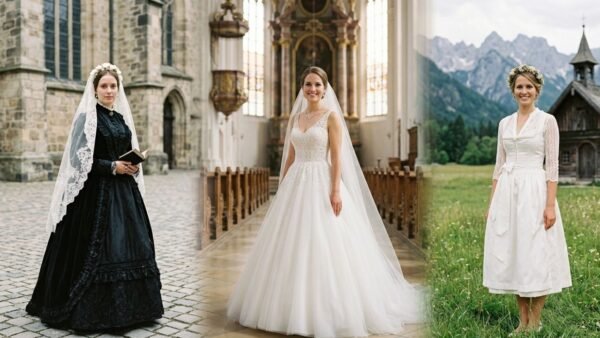
This guide covers all three traditions in full depth. It addresses the bride’s complete attire including accessories, the groom’s complete Tracht and formal options, regional differences across Germany, wedding party coordination, guest dress codes, attire-connected wedding traditions, modern interpretations, and where to buy authentic pieces. By the end, you will understand not just what to wear to a German wedding but why — and why the distinction matters.
Part 1: The History of German Wedding Attire
The Black Wedding Dress — Germany’s Forgotten Tradition
The image of the black-gowned German bride is so thoroughly displaced by the contemporary white-wedding visual that most people — including many Germans — do not know it existed at all. Yet the black wedding dress was the dominant bridal attire across rural Germany for centuries, and understanding why requires setting aside the modern association of black with mourning. In German folk culture, black was the color of formality, gravity, and occasion — not death. A woman who owned a black wool or silk dress owned her most serious and most valuable piece of clothing, and wearing it at a wedding communicated the full weight of the occasion as powerfully as any color choice could. The black dress was paired with a white veil, a combination that created the visual contrast most familiar from surviving photographs and museum records: stark white against absolute black, pure and serious simultaneously. Regional variations existed within this tradition — some communities in southern Germany and rural Bavaria favored very dark navy blue rather than true black, and embroidery details in the bodice and cuffs varied significantly by village tradition — but the broad pattern of dark formal dress rather than white ceremonial dress held across much of rural German-speaking culture until the Victorian influence began to displace it in the second half of the nineteenth century.
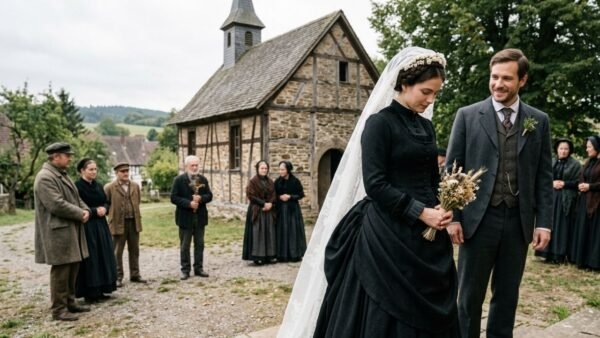
The displacement was not instantaneous. Queen Victoria’s white wedding dress in 1840 began a trend that spread through European aristocracy and bourgeois society over several decades, reaching rural German communities progressively through the late nineteenth and early twentieth centuries as industrialization, improved transportation, and increased social mobility brought provincial communities into contact with urban fashion trends. The black dress tradition survived longest in the most isolated and most economically traditional communities — mountain villages, agricultural regions, conservative Catholic areas — where the logic of dressing in one’s finest formal clothing rather than in a fashion-specific bridal color made continued practical and cultural sense. Today the black wedding dress tradition is documented in German textile museums and regional folk culture archives, and a small but growing number of contemporary German brides are choosing black wedding gowns specifically as a heritage statement — honoring the tradition that their great-grandmothers practiced before the white dress became the standard.
The White Wedding Dress — How It Became the German Standard
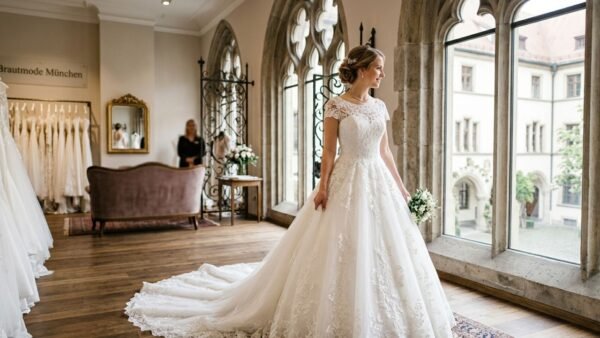
The white wedding dress arrived in Germany through the same channel through which it arrived everywhere else in Europe: the cultural authority of the British royal family and the aspirational adoption of aristocratic fashion by the expanding middle class. By the 1870s and 1880s, white bridal gowns had become the standard in German urban bourgeois society, and by the early twentieth century the transition was complete enough that the black dress tradition had retreated to rural holdouts and family memory. The specifically German form of the white wedding dress developed its own aesthetic characteristics over the following century that distinguish it, to an educated eye, from British, American, and Italian bridal traditions. German bridal fashion favored a structured bodice with a fuller, more generous skirt — the ballgown silhouette — over the sleeker, more body-conscious lines that other national traditions developed. The train was traditionally minimized or entirely absent: German brides preferred manageable, practical gown lengths that worked in actual church and reception environments rather than the extended trains that other bridal cultures adopted for maximum ceremonial impact.
The Cold War division of Germany created a period of divergence in bridal aesthetics that is rarely discussed but genuinely visible in surviving wedding photographs and textile records. West German bridal fashion tracked Western European and American trends through the 1950s, 1960s, and 1970s — becoming progressively more influenced by international fashion industry developments. East German bridal fashion operated under different economic constraints and different cultural influences, producing a distinct aesthetic characterized by simpler fabrication, more modest silhouettes, and stronger retention of folk elements that the West German industry had largely moved past. The reunification of 1990 brought these two streams back together, and contemporary German bridal fashion reflects elements of both traditions in ways that German dress historians find genuinely interesting even when the brides themselves are unaware of the lineage.
The Tracht Wedding — A Tradition Being Reborn
In Alpine communities throughout Bavaria and Austria, the distinction between “wedding attire” and “Tracht” did not historically exist — Tracht was the finest clothing available, and the finest clothing available was what one wore to a wedding. The dirndl for women and lederhosen for men were not folk costume alternatives to wedding dress; they were the wedding dress, worn with the best embroidery, the finest fabric, and the most carefully chosen accessories that the family could afford. The village wedding was also the occasion for displaying regional Tracht identity at its most elaborate — embroidery patterns that identified the community, jewelry that communicated family heritage, and accessories assembled over years of preparation for this specific occasion.
Industrialization and the urbanization of the twentieth century pushed Tracht weddings to the cultural margins for several generations — the aspiration for modern bourgeois respectability that white gowns and dark suits represented was powerful enough to displace tradition in most communities. The post-World War Two revival of Bavarian cultural identity — which included a deliberate embrace of Tracht as a marker of regional pride and historical continuity — began the process of rehabilitation that has accelerated dramatically over the past two decades. Current estimates suggest that approximately sixty to seventy percent of rural Bavarian weddings now incorporate Tracht clothing in some form, ranging from full Trachtenhochzeit in which every guest and wedding party member wears traditional dress to more selective incorporations where the couple wears Tracht while guests dress conventionally. Among German-heritage couples in the United States, Australia, and other diaspora communities, the Tracht wedding has found an audience that finds in it precisely the authenticity and distinctiveness that generic white-dress weddings cannot provide. The revival is not nostalgia. It is a living tradition claiming its contemporary relevance.
Part 2: The Bride’s Complete Attire Guide
The Modern German White Wedding Dress
The distinctly German aesthetic in contemporary white bridal fashion maintains the historic preferences for structured bodices and fuller skirts while incorporating modern fabrication and silhouette options that have expanded the category considerably over the past two decades. The ballgown silhouette — fitted through the bodice, dramatically full from the hip — remains the most traditional German bridal choice and the one that reads most clearly as German rather than internationally generic when photographed. The A-line is the most widely worn contemporary alternative, flattering to the widest range of body types and practical for the variety of venue environments — churches, outdoor locations, Gasthäuser — that German weddings occupy. The empire waist and the sheath silhouette are less commonly chosen but entirely appropriate in the right context. Neckline preferences in German bridal fashion have historically favored the sweetheart and the square neckline over the deep plunge or the strapless — both of which read as more American or Italian than German in character — though modern German brides make neckline choices across the full contemporary spectrum.
The train question in German bridal fashion is resolved more conservatively than in most other national traditions. The Cathedral train and the Royal train — extending several feet behind the bride and requiring a designated attendant throughout the ceremony — are less common in German weddings than in British and American ones, reflecting a practical cultural preference for manageable clothing in venues and celebrations that involve genuine physical activity. The most typical German bridal train is the chapel length — extending just beyond the hem — or no train at all. Church ceremonies, which remain the cultural aspiration for formal German weddings even among couples who are not deeply practicing, often require navigating narrow aisles and stone steps that make extended trains a genuine logistical problem. The fingertip-length veil is the German standard, corresponding to approximately 60–75 centimetres below the waist, though longer veils are worn at very formal church ceremonies and blusher veils remain popular for the processional portion of the ceremony. Many German brides now wear two outfits — a more formal gown for the civil ceremony at the Standesamt and a different, often more relaxed or Tracht-appropriate outfit for the subsequent church or outdoor celebration — a practice that reflects the structural German requirement to register marriages civilly before any religious ceremony takes place.
The Bridal Dirndl — The Tracht Wedding Dress
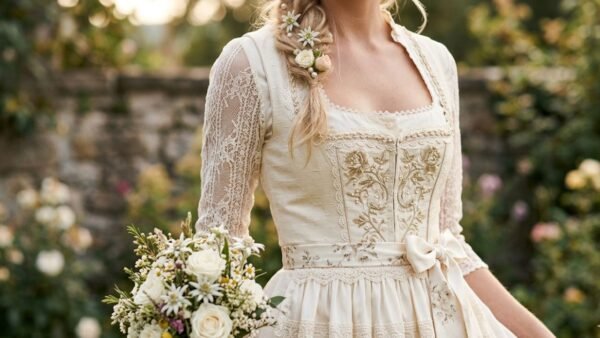
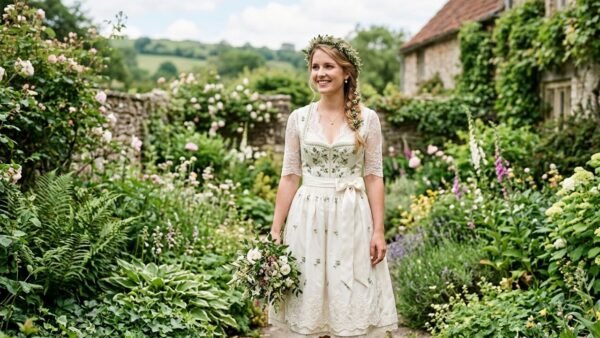
A bridal dirndl is not simply a dirndl in white. It is a purpose-built garment with elevated construction, premium fabrics, and specific design details that distinguish it from everyday and festive dirndls in every meaningful respect. The fabrication standard begins at silk — the most traditional and most formally appropriate fabric for a bridal dirndl, producing the deep lustre and precise drape that the occasion demands — and extends to lace, which has become increasingly popular as both a standalone fabric and a detail element at the bodice neckline and sleeve edges. Velvet is historically significant in bridal dirndl construction, providing a richness and depth of color particularly suited to non-white bridal dirndls in forest green, deep burgundy, or midnight blue. The current premium standard in bridal dirndl construction combines silk and lace — a silk skirt with lace panels at the bodice or sleeves, or a full lace overskirt above a silk underskirt — producing the most visually complex and most photographically beautiful bridal dirndl option available.
White and ivory are the most common bridal dirndl colorways and the ones that communicate most immediately that this is a wedding garment rather than a festive one. Non-white bridal dirndls are entirely appropriate and in some regional traditions more historically authentic — a bride choosing pale sage green, soft blush, or dusty blue communicates cultural knowledge rather than nonconformity, because the dirndl tradition accommodates color expression in ways that white-dress tradition does not. The bridal apron is the most visible color-choice element: a white or ivory dirndl with a blush or sage green apron creates a combination that reads as bridal and traditional simultaneously. The length requirement is important: midi length reaching to the mid-calf, or full length to the ankle, are both appropriate for a wedding; mini length is not, regardless of how beautifully constructed the garment is. The bodice of a bridal dirndl should be more heavily embellished than a festive dirndl — additional embroidery, ribbon trim, or lace appliqué at the neckline and front panel signals the elevation of the occasion — and the blouse beneath it should be white or ivory lace rather than the cotton voile that everyday dirndl blouses use. For those exploring the full range of dirndl options, the complete Bavarian traditional dirndl collection provides the authentic foundation. Understanding how to wear a dirndl correctly and which accessories complete the look ensures every element of the bridal dirndl is assembled with the same intentionality the occasion requires.
Color Symbolism in German Bridal Attire
White and ivory communicate purity and modernity in German bridal culture with the same meaning they carry internationally — these are the current standard and the colors that most immediately read as bridal. Black communicates historical formality and tradition in the specifically German sense described in the history section — a contemporary bride choosing black is making a deliberate heritage statement that culturally literate German guests will recognize and appreciate. Green is the most important traditional color in German bridal culture and the one most commonly overlooked by non-German observers. The myrtle wreath — the traditional German bridal crown made from the evergreen myrtle plant, symbolizing everlasting love — brings green to the bride’s appearance in its most significant form. Green sashes, green embroidery details on a white or ivory dirndl, and green accessories of various kinds all appear in traditional German bridal styling as markers of luck, fertility, and love. Green rather than blue is the German “something” for luck — a fact that surprises Anglo-American audiences accustomed to “something blue” as the standard-bearer of bridal good fortune. Red appears in certain regional traditions as a color of passion and celebration. Blue is less symbolically significant in German bridal culture than in Anglo-American tradition, though it appears in the embroidery and accessory palettes of various regional Tracht traditions.
The Bride’s Complete Accessories Guide
The Brautkranz — Bridal Wreath and Crown
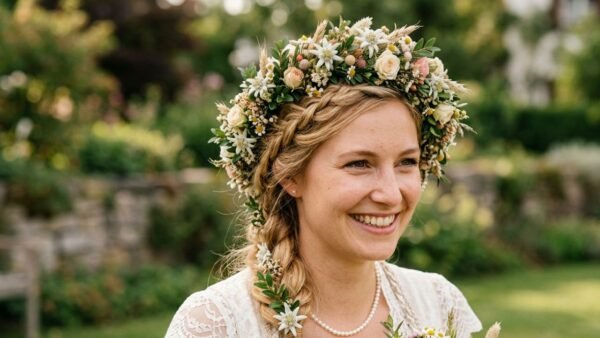
The Brautkranz — the bridal wreath or crown — is the most distinctly German of all bridal accessories and the one that most powerfully communicates German bridal heritage to any knowledgeable observer. The myrtle wreath has been the traditional German bridal crown for centuries: myrtle, an evergreen plant associated in German folk tradition with everlasting love, fidelity, and marital happiness, was woven into a crown worn over the bride’s head to communicate these qualities and to invoke their continuation through the marriage. The myrtle wreath was considered sufficiently important that families cultivated myrtle plants specifically in anticipation of daughters’ weddings, and receiving a cutting from a bride’s myrtle wreath was a meaningful gift to younger sisters and friends who would use it to grow their own bridal plant. Contemporary bridal wreaths incorporate fresh flowers alongside or instead of myrtle — roses for love, lilies for purity, forget-me-nots for remembrance, and edelweiss for Alpine authenticity — in combinations that reflect both seasonal availability and personal meaning. The Blumenkranz — the Alpine flower crown associated with Tracht tradition — is the dirndl bride’s most natural headpiece choice, made from fresh or silk flowers in colors that coordinate with the dirndl’s color palette and the season of the wedding. Preserving the bridal wreath after the wedding is a German tradition — dried and framed, or pressed and mounted — that treats the crown as a keepsake with the same emotional weight as the wedding dress itself.
The Veil and Its Meaning
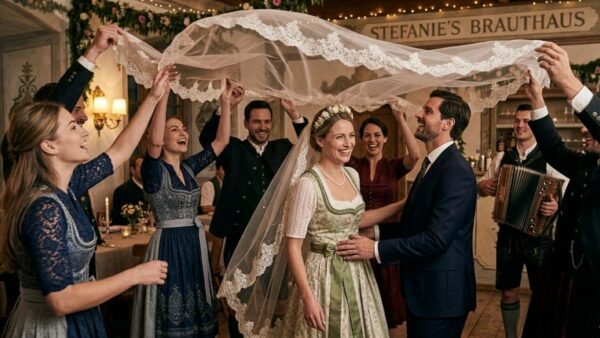
The German veil carries symbolic weight that extends beyond the conventional understanding of bridal veiling. In German wedding folklore, the veil serves a protective function — shielding the bride from evil spirits or malevolent influences at the moment of her most significant life transition — that gives it a more active role in the ceremony’s meaning than mere tradition or fashion would suggest. The Schleiertanz — the veil dance performed at midnight of the wedding reception — transforms the veil from a ceremonial object into a community celebration: the bride’s veil is held aloft by the guests who dance around it, it is torn into pieces, and whoever holds the largest piece is believed to be the next to marry. This tradition directly affects the veil choice of German brides who plan to honor it — a very expensive or intricate veil is replaced with a more practical version, or the dance is performed with a second veil kept for this purpose. Styling a veil with a dirndl requires different technique than styling it with a conventional gown — the veil typically attaches behind the Brautkranz or Blumenkranz rather than beneath it, and shorter lengths — elbow or fingertip — integrate more naturally with the dirndl silhouette than very long cathedral veils.
Jewelry, Shoes, and the Handbag
German bridal jewelry follows a restraint principle that is culturally specific and worth understanding before assembling accessories. The German aesthetic favors understatement — fewer pieces of greater meaning rather than accumulations of ornament — and heirloom jewelry carries particular weight in a tradition where wearing a grandmother’s pearl necklace or a mother’s garnet earrings on the wedding day is an act of family continuity rather than simply an accessory choice. Tracht jewelry for a dirndl bride uses a distinct vocabulary from conventional bridal jewelry: Trachtenschmuck — traditional Bavarian jewelry in silver with naturalistic motifs — is the correct category, including edelweiss pendants, hunting-motif pins, and Charivari-inspired chain pieces that connect the bride’s jewelry to the same tradition governing the groom’s Charivari chain. Pearl remains appropriate for both conventional and dirndl wedding attire; garnet, which has deep roots in Bavarian folk jewelry tradition, adds specifically regional authenticity.
The German bridal shoe tradition carries its own customs that inform what a bride actually chooses to wear on her feet. The penny-saving tradition — buying wedding shoes with coins saved specifically for this purpose, with a penny placed in the left shoe and carried through the ceremony for marital wealth — is one of Germany’s most charming specific bridal customs and one that most German brides have at least heard of even if they no longer practice it with full formality. The shoe auction at the reception — in which the best man “steals” the bride’s shoe and the groom must bid or perform increasingly absurd tasks to win it back — is another tradition that creates practical requirements: the shoe must come off easily, be identifiable, and preferably not be so expensive that the groom’s ransom performance feels genuinely painful. Dirndl brides who wear Haferlschuhe — the traditional Bavarian leather shoes with side lacing — are selecting footwear that is both authentically appropriate and practically suited to the movement and activity of a long celebration day. The heel height rule for dirndl brides follows the proportion logic described in any thorough dirndl styling guide: a modest block heel of two to four centimetres is appropriate and traditional; stilettos, wedges, and platforms create proportion mismatches with the dirndl’s silhouette. The complete dirndl undergarment guide addresses the foundation layer that a bridal dirndl requires as much as any wedding gown.
Part 3: The Groom’s Complete Attire Guide
The Modern German Groom — Suit and Formal Wear
For German weddings that follow the contemporary rather than Tracht tradition, the groom’s attire standard is the dark suit in charcoal, navy, or black — with charcoal occupying the position of most formal and most appropriate across the widest range of German wedding contexts. The German preference for dark formal wear over the lighter greys and blues that have become fashionable in British and American wedding culture reflects the same formal gravity that characterizes German occasion dressing generally: a German groom in a dark charcoal suit with a white shirt and a tie communicates seriousness and respect for the occasion in precisely the way the culture expects. The classic tuxedo is appropriate for the most formal German weddings — grand church ceremonies in major cities, evening receptions in formal venues — but is not the expected standard in the way it has become in some international wedding cultures. The German preference for tie over bow tie at weddings reflects a slight cultural bias toward the more conventional, though bow ties are entirely acceptable at weddings with a more deliberate aesthetic vision. Cufflinks, a pocket square that coordinates with but does not match the bride’s flowers, and a buttonhole in a flower from the bridal arrangement are the detail elements of a complete German formal wedding look.
The Groom in Lederhosen — The Full Tracht Wedding Look
The lederhosen choice for a Tracht wedding groom involves several decisions that together determine the formality and cultural register of the complete look. Short lederhosen — Kurze — are appropriate for outdoor, casual, or summer Tracht weddings where the overall aesthetic is relaxed and celebratory. Kniebundlederhosen — the knee-length buckled style — are the most traditional and most appropriate for formal Tracht wedding ceremonies, and they represent the gold standard of groom attire at a Bavarian Trachtenhochzeit. Dark brown or black leather is the correct wedding colorway for lederhosen — both communicate the elevated formality of the occasion through the depth and richness of the leather rather than the lighter, more casual tan and natural leather tones that festive but non-wedding lederhosen typically use. For those new to lederhosen selection, the guides on the history of lederhosen, what lederhosen are made from, and how lederhosen should fit provide the foundation for an informed purchase. The complete men’s lederhosen collection and the German Oktoberfest lederhosen range provide the authentic options.
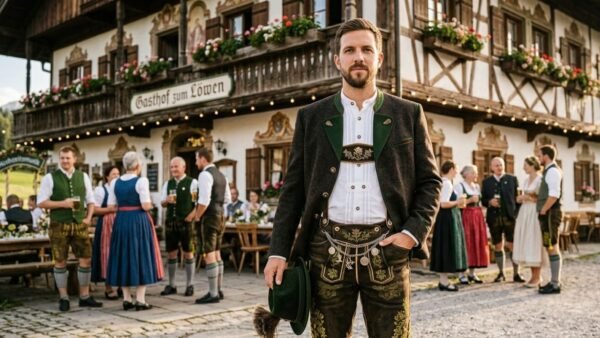
The Trachtenhemd — the Tracht shirt worn beneath the lederhosen’s front bib — should be white or ivory at a wedding, in a quality cotton or linen with embroidery details at the collar and cuffs that are more elaborate than the embroidery on festive Tracht shirts. The collar style most appropriate for a wedding is the stand collar, which has the most formal and most historically authentic character. The Bavarian Trachten shirt collection provides the range of wedding-appropriate options. The Weste — the vest or gilet worn over the shirt and beneath any jacket — is the essential layer of the Tracht wedding look and the element that most directly coordinates the groom’s appearance with the bride’s dirndl. Color coordination here is critical: a groom’s vest in forest green pairs with a bride’s dirndl in white with green apron details to create a visually unified wedding palette. Loden wool remains the most authentic and most appropriate vest material for a formal Tracht wedding, offering the texture depth and color richness that lighter or synthetic fabrics cannot replicate.
The Charivari — the decorative chain worn across the front of the lederhosen bib — is the most personally meaningful accessory element of a Tracht groom’s attire and the one that most rewards thoughtful composition. A Charivari is assembled from small decorative objects — traditional hunting trophies such as chamois beard or boar tooth, family heirloom coins or medals, regional Tracht jewelry pieces, and personal mementos — hung from a silver or gold chain in a combination that tells the wearer’s story and family history. A Charivari assembled specifically for a wedding, incorporating a coin from the grandfather who wore his own Charivari at his wedding, a small piece from the regional tradition of the bride’s family, and a charm representing the year of the marriage, becomes a deeply personal family artifact that the groom’s descendants will eventually inherit. The lederhosen belt collection and the embroidered suspenders range complete the accessories that frame the Charivari and the overall lederhosen look.
The Tracht Suit — The Middle Ground Option
The Trachtenanzug — the Tracht suit — occupies the space between fully traditional lederhosen and a conventional dark suit, making it the right choice for grooms who want to honor the Tracht tradition without the full physical commitment of lederhosen for a long celebration day, or for formal Tracht weddings in urban environments where the lederhosen look would feel too rural for the venue’s register. A Trachtenanzug typically consists of a Janker — the traditional Tracht jacket with stand-up collar, slightly flared skirt, and decorative button details — worn over matching or coordinating trousers in loden wool or a related fabric. Loden wool is the signature fabric of the Trachtenanzug: a felted, water-resistant wool with a characteristic texture and muted natural colorway — forest green, grey-green, dark grey, charcoal — that is immediately recognizable as Tracht to any German observer. The Trachtenanzug with a quality Trachtenhemd and appropriate accessories reads as formal traditional Bavarian attire rather than as lederhosen-adjacent festive wear, and it suits older grooms, more conservative family contexts, and venues that bridge traditional and contemporary aesthetics with particular grace.
Part 4: Regional Differences Across Germany
Bavaria — The Tracht Wedding Capital
Bavaria’s claim to the title of Germany’s Tracht wedding capital is not contested by any other German state, and it rests on a combination of factors that are historical, geographic, religious, and cultural simultaneously. The depth of Bavarian Tracht tradition — rooted in Alpine agricultural communities where regional dress was worn daily and where wedding attire was simply the best version of daily dress — gave Tracht weddings a cultural continuity in Bavaria that other German regions, where Tracht was already more ceremonial than quotidian by the nineteenth century, did not sustain. The rural-urban divide within Bavaria is real but perhaps less sharp than outsiders expect: Munich, for all its cosmopolitan sophistication, has a Tracht culture that is genuinely lived rather than merely performed, and Bavarian couples who move to Munich for work regularly return to their home villages for Tracht weddings that honor regional roots. The specific regional variations within Bavaria — the embroidery patterns of Upper Bavaria’s mountain valleys versus the more restrained Tracht of Franconia, which is culturally Protestant and wine-drinking in ways that set it apart from the Catholic beer-drinking identity of the Bavarian core — mean that even within the Tracht wedding category, attire signals regional identity with considerable precision to a Bavarian audience.
Northern Germany — The Formal Wedding
Northern German weddings in the Protestant tradition that shapes Hamburg, Bremen, Schleswig-Holstein, and the North Sea coastal regions favor contemporary formal attire over Tracht with a consistency that reflects both the geographic distance from Bavaria’s Tracht heartland and the cultural influence of Protestant restraint on celebratory aesthetics. The northern German wedding aesthetic tends toward the elegant and the understated — quality fabric, precise tailoring, minimal ornamentation — rather than the richly embellished and visually exuberant character of a fully traditional Tracht wedding. Maritime color influences — navy, white, and blue — appear in northern coastal wedding aesthetics in ways that echo the sea-facing identity of these communities. Berlin, as a city that has absorbed populations from every German region and cultivated a self-consciously cosmopolitan identity, produces wedding aesthetics that range from classically formal to deliberately avant-garde, with Tracht appearing occasionally as a heritage choice among couples with Bavarian roots rather than as a Berlin cultural tradition.
The Black Forest and Baden-Württemberg
The Black Forest region of Baden-Württemberg maintains one of Germany’s most visually distinctive regional Tracht traditions, and its wedding attire is correspondingly striking. The Bollenhut — the iconic Black Forest hat featuring large red wool pompoms worn by unmarried women and black pompoms worn by married women — is the most internationally recognized element of Black Forest regional dress, familiar from countless tourist representations of German folk culture. In traditional Black Forest weddings, the Bollenhut appears as part of the bridal attire alongside a distinctive regional dress that differs from the Bavarian dirndl in silhouette, fabric, and embroidery tradition. The Swabian wedding traditions of Baden-Württemberg’s eastern region share geographic proximity with Bavaria but maintain distinct folk dress traditions that reflect Alemannic cultural heritage rather than Bairisch Alpine tradition — a distinction that matters significantly to the communities that preserve these traditions even when it is invisible to outside observers.
Regional Attire at a Glance
| Region | Bride’s Traditional Attire | Groom’s Traditional Attire | Key Characteristic |
|---|---|---|---|
| Bavaria | Bridal dirndl — white or ivory silk | Kniebundlederhosen with Janker | Most Tracht-forward; highest Tracht wedding density |
| Northern Germany | White ballgown — structured, minimal train | Dark charcoal or navy formal suit | Most formal and contemporary; Protestant restraint |
| Black Forest | Regional Tracht dress with Bollenhut | Regional Black Forest Tracht suit | Most visually distinctive; Bollenhut tradition |
| Rhineland | White gown or Tracht | Formal suit or Trachtenanzug | Catholic formal influence; festive Karneval energy |
| Saxony and Eastern Germany | White gown; some Saxon regional Tracht | Dark formal suit; occasional Trachtenanzug | Post-reunification blend of East and West traditions |
| Baden-Württemberg | White gown or Swabian regional Tracht | Swabian Tracht suit or formal suit | Alemannic regional identity distinct from Bavarian |
Part 5: Wedding Party Attire
Bridesmaids at a German Tracht Wedding
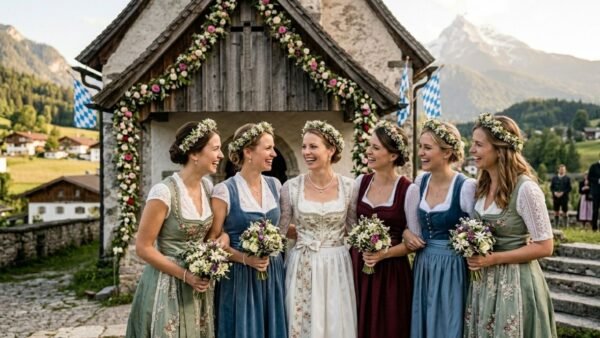
The coordinated dirndl approach for bridesmaids at a Tracht wedding requires navigating the same principles that govern bridesmaid attire in any cultural context — the wedding party should complement the bride without competing with her — within the specific vocabulary of Tracht dress. The primary rule is absolute: bridesmaids never wear white or ivory, because these colors belong exclusively to the bride in German wedding culture where the visual hierarchy of the wedding party is taken seriously. The most successful bridesmaid dirndl color palettes draw from the accent colors in the bride’s outfit — if the bridal dirndl is white with a forest green apron, bridesmaids in forest green or sage dirndls create a coordinated party that reads as intentionally designed. Dusty blue, soft burgundy, warm grey, and natural linen tones all work well as bridesmaid dirndl colors depending on the season and the bride’s palette. Bridesmaid dirndls should be slightly less embellished than the bridal dirndl — less intricate embroidery, simpler apron details — so that the visual hierarchy of the occasion is preserved. Blumenkranz flower crowns for the entire wedding party is one of the most charming visual elements of a fully realized Tracht wedding, unifying the party through a shared accessory while allowing individual color expression in the flowers chosen.
Groomsmen and the Trauzeuge
German wedding culture differs from Anglo-American tradition in a specific and important way regarding the wedding party structure: German weddings traditionally include only one Trauzeuge — a witness or best man — per partner, rather than the elaborate groomsmen and bridesmaid assemblies that British and American weddings normalize. This cultural difference means that Tracht wedding coordination for the groom’s party is typically simpler — one or perhaps two groomsmen whose lederhosen coordinate with the groom’s without matching exactly — rather than the larger coordinated group looks that other cultures manage. The Trauzeuge’s lederhosen should be in the same general color family as the groom’s but slightly less formally specified: where the groom wears dark brown Kniebundlederhosen with an embroidered vest and full Janker, the Trauzeuge might wear the same dark brown lederhosen with a simpler vest and no jacket, creating a visible hierarchy through the completeness of the outfit rather than through color differences. Charivari chains for groomsmen should be simpler and less elaborate than the groom’s — the personal narrative piece belongs to the groom specifically, and a groomsman with a more elaborate Charivari than the groom has committed a genuine etiquette failure that Bavarian wedding guests will notice.
Children in Tracht — Flower Girls and Ring Bearers
Children in Tracht at a German wedding are among the most charming visual elements of the tradition and one of the details that guests from outside Germany most reliably find delightful. Mini dirndls for flower girls follow the same construction principles as adult dirndls scaled to children’s proportions — the same bodice-apron-skirt structure, the same blouse beneath, and age-appropriate fabric choices that favor washable cotton over silk for children who will spend a full wedding day in their outfit. Mini lederhosen for ring bearers are equally authentic — small Kniebundlederhosen in appropriate dark leather with small Trachtenhemd shirts and simplified suspenders create a look that is genuinely traditional rather than costume-adjacent and that documents beautifully in wedding photographs. Hair accessories for flower girls at a Tracht wedding follow the same Blumenkranz tradition as adult women in the wedding party, typically in a smaller and simpler version than the adult crowns that uses more delicate flowers appropriate to a child’s scale.
Part 6: Wedding Guest Attire Guide
Reading the German Wedding Invitation Dress Code
German wedding invitations communicate dress expectations with a precision that rewards careful reading and that guests who miss the signals risk getting badly wrong. The phrase Tracht erwünscht — traditional dress welcome — is an invitation rather than a requirement: the couple would be pleased to see Tracht but understands that not every guest owns or has access to traditional dress, and guests in appropriate formal attire are entirely welcome. Tracht erforderlich — traditional dress required — is a stronger statement that means exactly what it says: this is a Trachtenhochzeit in the full sense, and appearing without some form of traditional dress will mark you as someone who did not honor the couple’s stated wishes. Festlich — festive or formal — is the general dress code for German weddings without Tracht expectations: this means your best dark suit or formal dress, not business casual. Feierlich — celebratory or semi-formal — allows a slightly more relaxed interpretation while still expecting real occasion dressing. When no dress code is stated, the safe assumption for a German wedding is to dress more formally than you think necessary rather than less — German wedding culture errs consistently on the side of occasion gravity.
Female Guest Attire at a Tracht Wedding
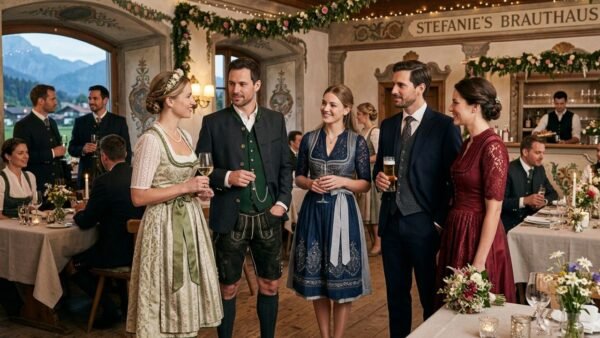
A female guest invited to a Tracht wedding who chooses to wear a dirndl should select a length, color, and formality level appropriate to the occasion rather than to their personal preference for casual or festival styling. Midi-length and full-length dirndls are appropriate for a wedding; mini-length dirndls are not. White and ivory are the bride’s colors and must not appear in any guest’s outfit in any form — this is the single most important color rule in German wedding guest culture and it is observed with complete seriousness. Cheap synthetic-construction costume dirndls are deeply disrespectful at a wedding where authentic Tracht is being worn — the visible quality difference between a costume and a genuine dirndl is immediately apparent to every Bavarian present, and the message it sends about the guest’s regard for the tradition is equally apparent. Traditional Tracht jewelry is appropriate and encouraged; elaborate statement jewelry that draws attention away from the wedding party is not. The complete guide to women’s Tracht attire provides the foundational styling reference, and the complete dirndl collection provides the authentic purchasing options.
Male Guest Attire at a Tracht Wedding
Male guests at a Tracht wedding face the same quality imperative that female guests face: costume lederhosen — the cheap synthetic versions sold at tourist markets — are not acceptable at a wedding where genuine leather lederhosen are being worn by the groom and wedding party. The quality difference is visible from across a room and communicates immediately that the wearer treated the occasion as a costume party rather than a cultural event. Genuine leather lederhosen in the correct formality level — dark brown or black for a wedding, knee-length for a formal Tracht ceremony — with a quality Trachtenhemd and appropriate accessories represent the correct guest attire for a Tracht wedding. A male guest who does not own lederhosen and cannot acquire quality ones in the time available is better served by wearing an excellent dark suit than by wearing costume lederhosen as a well-meaning but culturally counterproductive compromise. The complete lederhosen measurement guide ensures that a new purchase fits correctly before the event.
The Complete “What Not to Wear” List for German Wedding Guests
White in any shade — for female guests — is the most absolute prohibition in German wedding guest culture and should be treated as inviolable regardless of how pale or off-white or “not really white” a garment appears in the wearer’s estimation. If a knowledgeable German guest could describe the color as white, ivory, cream, or champagne, it does not belong at the wedding. Cheap costume Tracht — for guests of any gender at a Tracht wedding — is the second most significant guest attire failure, as explained above. Overly revealing clothing is inappropriate at German weddings, which are more conservative about décolletage and hemline than many international wedding cultures; this applies at both Tracht and conventional German weddings. Casual footwear — trainers, sandals, flip flops — worn with otherwise formal attire creates the same mismatch that casual shoes create in any formal context. Anything that draws attention away from the couple — very elaborate hats, extremely dramatic accessories, outfits that invite comment on the guest rather than appreciation of the occasion — violates the fundamental social contract of wedding guest dressing in German culture as much as anywhere else. The principle that resolves every guest attire uncertainty is the simplest: dress up, never down, and honor the occasion rather than expressing personal style at the expense of the couple’s day.
Part 7: Attire-Connected Wedding Traditions
The Schleiertanz — When the Veil Becomes the Celebration
The Schleiertanz — the veil dance — is performed at midnight during the wedding reception and transforms the bride’s veil from a ceremonial accessory into a community celebration object. The tradition begins with the groomsmen or wedding party holding the veil horizontally at shoulder height while the wedding guests dance around it in a circle, the dance growing more energetic as the night proceeds. At the tradition’s climax, the veil is offered to the guests who tear pieces from it — whoever tears the largest piece is believed to be the next to marry, a competitive element that brings genuine enthusiasm to the midnight hour. The veil is then removed from the bride’s head and replaced with a Haube — a matron’s cap — symbolizing her formal transition from bride to wife. This tradition has direct implications for the bride’s veil choice: brides who plan to honor the Schleiertanz typically either choose an inexpensive second veil specifically for the dance or accept that the veil they wear during the ceremony will not survive the reception intact. Brides who want to preserve their wedding veil keep it in the dressing room and wear the replacement for the midnight tradition.
Brautschuhe — The German Shoe Traditions
The German bridal shoe tradition encompasses several connected customs that together make the shoes one of the most storied elements of German wedding attire. The penny-saving tradition holds that a bride buys her wedding shoes with coins she has deliberately saved — rather than simply spending the amount from her general funds — and that the shoes are thus invested with her own disciplined care and intention from the moment of purchase. A penny from these savings is placed inside the left shoe and carried through the ceremony, an act intended to bring financial prosperity and material stability to the new household. The shoe auction tradition at the reception involves the best man — or Trauzeuge — removing one of the bride’s shoes during the celebration and auctioning it back to the groom through a sequence of escalating bids or absurd tasks, with the “proceeds” going to a fund for the wedding couple’s first joint purpose. The shoe kidnapping is a related tradition in which the Trauzeuge takes both shoes and hides them, requiring the groom to find and “ransom” them before the bride can continue the reception activities. These traditions collectively favor shoes that are identifiable and memorable rather than generically elegant, that come off easily enough to be removed in good humor, and that the bride can continue wearing comfortably through a long evening of celebration.
The Brautentführung and the Polterabend
The Brautentführung — the bride kidnapping — is a playful German wedding reception tradition in which the best man leads the bride away from the reception for a period, taking her to a nearby bar or restaurant while the groom must seek and “ransom” her, typically by buying drinks for the entire table that is sheltering her. For a dirndl bride, this tradition has practical attire implications: the dirndl must be practical enough for an unplanned departure and comfortable enough for continued wearing in a different venue. The Polterabend — the celebration held the night before the wedding — adds a separate attire consideration to the German wedding weekend. Guests at the Polterabend bring porcelain items to smash on the couple’s doorstep, the noise intended to drive away evil spirits, and the couple must sweep up the debris together as their first act of shared domestic labor. The traditional attire for the Polterabend is deliberately old or casual — a worn-out version of ordinary clothes rather than the finest formal attire — because the smashing and sweeping create genuine cleaning risks. Northern German Polterabend traditions sometimes include burning the groom’s old trousers at midnight, a symbolic farewell to his bachelor life, which creates its own attire consideration for the trousers in question.
Part 8: Modern Interpretations and Fusion Styles
The Modern Tracht Wedding — How Tradition Is Evolving
Contemporary German designers and Tracht fashion houses are reimagining the bridal dirndl and the Tracht wedding aesthetic in ways that honor the tradition’s roots while expanding its visual language for couples who want authenticity without strict historical recreation. The most exciting development is the dirndl-inspired wedding gown — a garment that uses the structural vocabulary of the dirndl (defined waist, full skirt, bodice-forward shaping) in non-traditional fabrics and silhouettes that would not be recognized as dirndl by a Bavarian farmer but that carry the tradition’s DNA unmistakably. Structured bodices in duchess satin with full organza skirts in ivory or blush incorporate the dirndl’s defining proportions into a garment that reads as contemporary bridal in any international context. Edelweiss and Alpine botanical motifs appearing as embroidered details on otherwise conventional wedding gowns are another approach — the tradition’s symbolism carried into a modern form. Color experimentation is also expanding: pastel bridal dirndls in dusty rose, soft sage, and pale lavender are finding audiences among couples who want Tracht authenticity without the expectation of white, and who see color as an additional layer of personal meaning rather than a departure from tradition.
The Heritage Couple — German-American and Diaspora Weddings
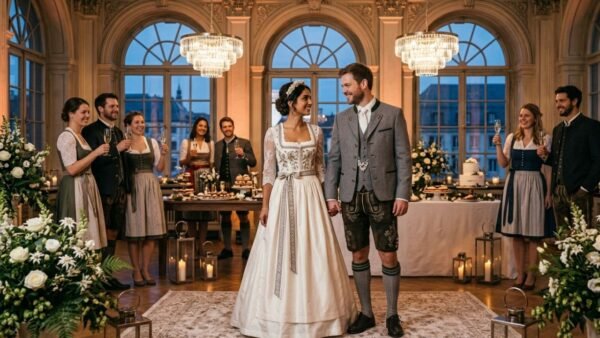
The global spread of the Tracht wedding beyond Bavaria reflects a genuine emotional need among German-heritage couples who grew up outside Germany but want to connect their wedding day to the cultural tradition that shaped their family. German-Americans, German-Australians, German-Canadians, and members of the German diaspora communities established throughout South America and Southern Africa are incorporating Tracht elements into their weddings with increasing frequency and sophistication — not as costume play but as an act of cultural reconnection that the wedding day’s significance makes deeply meaningful. The practical guidance for heritage couples assembling Tracht wedding attire outside Germany begins with authenticity: genuine leather lederhosen from a reputable source and a properly constructed dirndl from an authentic Tracht retailer communicate the couple’s seriousness about the tradition far more effectively than costume versions, and the quality of the garments is visible in every wedding photograph that will represent this moment for the rest of the couple’s lives. The ladies’ Oktoberfest dress collection, the full men’s German Oktoberfest outfit range, and the comprehensive resources at the GermanAttire blog support heritage couples in making authentic, informed choices regardless of their geographic distance from Bavaria.
Part 9: The Complete Buying Guide
Where to Buy Authentic German Bridal Attire
Sourcing authentic bridal dirndl and wedding-quality lederhosen requires navigating a market that ranges from genuine heritage quality to tourist-market costume, and developing the ability to distinguish between them before committing to a purchase at wedding dress price points. For couples based in the United States, the most practical starting point is a US-based Tracht specialist with genuine knowledge of authentic construction — avoiding the import complications, customs delays, and limited exchange options that European-only retailers create for American buyers. GermanAttire at germanattire.com provides the complete product range including traditional Bavarian dirndl dresses, dirndl blouses, and the full men’s Tracht range, with staff who understand fit requirements for wedding-quality Tracht in a way that general retailers do not. The physical location at 127 6th St S, La Crosse, WI 54601 provides in-person fitting for couples who want to try before committing to a bridal-level purchase.
For bridal dirndl specifically, the most important purchasing criteria are fabric quality — silk or silk-lace combination for wedding level, not polyester or polyester-cotton blends — and construction quality at the bodice, where the boning, structure, and lining must be sufficient to support the garment through a full day and evening of wedding activities. A bridal dirndl that is not properly fitted before the wedding is a risk regardless of its quality: the combination of the bodice’s structure, the blouse’s neckline, and the apron’s tie requires fitting adjustments that off-the-rack purchases rarely accommodate without tailoring. For those preparing the complete dirndl outfit including the correctly sized dirndl blouse and understanding how to lace a dirndl correctly for the wedding silhouette, the resources at GermanAttire provide step-by-step guidance. The guide to why quality dirndls cost what they cost helps couples understand what they are paying for at the premium end of the bridal dirndl market.
Conclusion: Honoring Where You Come From
Return to the opening image. The bride in her silk and lace white dirndl with myrtle and edelweiss in her hair. The groom in dark Kniebundlederhosen, his grandfather’s coin on the Charivari chain at his front bib. What makes this image work — what makes it feel simultaneously centuries old and entirely contemporary — is that every element of it is the product of genuine tradition rather than surface-level aesthetic choice. Every piece of the outfit carries meaning. Every accessory has a story. Every color communicates something within a cultural vocabulary that has been developing for centuries in the Alpine communities where these garments and their wearing traditions were born.

German wedding attire has three authentic traditions, and none of them is more correct than the others. The historical black dress honors the formal gravity with which German communities marked the most significant moments of their lives. The white gown honors the evolution of German bridal culture through the nineteenth and twentieth centuries. The Tracht wedding honors the Alpine heritage that gave the dirndl and lederhosen their cultural weight and that has never fully relinquished that weight despite the pressures of modernization. The couple who chooses any of these traditions with knowledge and intention is honoring their heritage correctly. The right German wedding attire is not the one that best matches a photograph found online — it is the one that most authentically reflects where you come from and what you want to carry forward into your marriage. Explore the complete bridal and Tracht collections at GermanAttire and visit the complete cultural blog for every guide and resource this tradition deserves.
Frequently Asked Questions (FAQs
What do German brides traditionally wear?
German brides have three distinct traditional attire options. The historical tradition was a black formal dress with white veil, worn as the height of occasion formality before the Victorian white dress influence arrived. The modern German standard is a white or ivory ballgown with structured bodice and fuller skirt, typically without an extended train. The Tracht tradition — still actively practiced and reviving strongly — is a bridal dirndl in white, ivory, or meaningful color, worn with a Brautkranz and traditional accessories.
Why did German brides wear black wedding dresses?
In German folk culture, black was not the color of mourning but of formality, gravity, and high occasion. A woman who owned a black wool or silk dress owned her finest garment, and wearing it at her wedding communicated the full weight of the occasion. The black dress was paired with a white veil for contrast and symbolism. This tradition was most common in rural southern Germany and persisted until the Victorian white dress influence spread through European culture in the second half of the nineteenth century.
What is a bridal dirndl?
A bridal dirndl is an elevated version of the traditional Bavarian dirndl designed specifically for wedding wear. It differs from a regular dirndl in its premium fabrics — silk, lace, velvet, or silk-lace combination — more elaborate embroidery and bodice detailing, white or ivory colorway, midi or full-length hemline, and a quality white or ivory lace blouse. A bridal dirndl should be properly fitted rather than purchased off-rack to ensure it performs correctly through a full wedding day.
What does a German groom wear at a wedding?
At a Tracht wedding, the German groom wears Kniebundlederhosen in dark brown or black leather with a white Trachtenhemd, an embroidered vest, optional Janker jacket, and the Charivari decorative chain. At a conventional German wedding, the groom wears a dark charcoal, navy, or black suit with a white shirt and tie — charcoal being the most traditionally correct German choice. The key distinction is the formality of the occasion and whether the wedding is a Trachtenhochzeit or a contemporary ceremony.
What is a Tracht wedding?
A Trachtenhochzeit is a German wedding in which the couple, wedding party, and guests wear traditional Bavarian or regional folk dress. The bride wears a bridal dirndl, the groom wears Kniebundlederhosen with full Tracht accessories, and guests are asked to dress in Tracht of their own. Tracht weddings are most common in rural Bavaria and are experiencing a significant revival across Germany and among German-heritage couples internationally who want to honor their cultural roots on the most significant day of their lives.
What does Tracht erwünscht mean on a wedding invitation?
Tracht erwünscht means “traditional dress welcome” — an invitation rather than a requirement. The couple would be pleased to see guests in Tracht but understands that not everyone owns it, and guests in appropriate formal attire are welcome. Tracht erforderlich — traditional dress required — is the stronger instruction where the couple expects genuine Tracht attendance. Festlich means formal, and feierlich means semi-formal — both apply at conventional weddings without Tracht expectations.
What do guests wear to a German wedding?
At a Tracht wedding, guests wear quality authentic dirndls (women) or genuine leather lederhosen (men) at wedding formality level — midi or full length for women, knee-length dark leather for men. At a conventional German wedding, guests wear formal attire: excellent dark suits for men, formal dresses in non-white colors for women. The universal rule: never wear white or ivory as a guest in any form. German weddings are more formally dressed than American ones — when uncertain, dress up rather than down.
What is the Brautkranz?
The Brautkranz is the German bridal wreath or crown — the most distinctly German of all bridal accessories. The traditional version is made from myrtle, an evergreen symbolizing everlasting love, often combined with roses, lilies, and forget-me-nots. For dirndl brides, the Blumenkranz — an Alpine flower crown in colors coordinating with the dirndl — is the most natural choice. The bridal wreath is traditionally preserved as a family keepsake after the wedding.
What is the Schleiertanz?
The Schleiertanz — veil dance — is performed at midnight during the reception. Guests hold the bride’s veil aloft and dance around it, then tear pieces from it — whoever holds the largest piece is believed to be the next to marry. The veil is removed from the bride’s head and replaced with a matron’s cap, marking her transition to wife. This tradition leads many German brides to keep an inexpensive second veil for the dance rather than sacrificing their ceremony veil.
Can non-Germans wear Tracht at a German wedding?
Yes — Tracht is a living cultural tradition that welcomes genuine participation from anyone who approaches it with respect. The critical distinction is quality: authentic leather lederhosen and properly constructed dirndls communicate genuine respect for the tradition; cheap synthetic costume versions communicate the opposite regardless of the wearer’s intentions. A non-German guest in quality authentic Tracht honors the tradition more effectively than a German guest in a costume version.
Is green an important color in German weddings?
Yes — green is the most significant traditional luck color in German bridal culture, quite distinct from the “something blue” of Anglo-American weddings. The myrtle wreath — Germany’s traditional bridal crown — brings green to the bride’s appearance as its most meaningful element. Green aprons on white bridal dirndls, green embroidery details, and green accessories appear as traditional markers of luck, fertility, and love. For German weddings, incorporate green — not blue — for traditional good fortune.
Do german get married in lederhosen?
Yes, some Germans get married in lederhosen, especially in Bavaria, where traditional wedding customs remain popular. Lederhosen are traditional Bavarian leather trousers often worn by grooms during cultural and regional weddings. However, most German weddings today feature modern formal attire, such as suits or tuxedos. While lederhosen are a recognized symbol of German heritage, they are primarily associated with Bavarian culture rather than Germany as a whole. In short, Germans can get married in lederhosen, but it is mainly a Bavarian wedding tradition and not a standard practice across the entire country.
What is the Polterabend?
The Polterabend is a pre-wedding celebration held the night before the wedding in which guests bring porcelain items to smash on the couple’s doorstep — the noise meant to drive away evil spirits. The couple then sweeps up the debris together as their first shared domestic act. Attire for the Polterabend is deliberately old or casual rather than formal — old clothes that can handle the cleaning activities that follow the smashing. Northern German Polterabend traditions sometimes include burning the groom’s old trousers at midnight as a farewell to bachelorhood.


Anna Bauer is a seasoned Bavarian fashion expert, cultural consultant, and heritage stylist with over a decade of hands-on experience in traditional German clothing. Born in Munich, the heart of Bavaria, Anna grew up surrounded by the rich traditions of Trachten fashion. Her passion for cultural attire led her to pursue a degree in Fashion and Textile Design at the prestigious University of the Arts Berlin, where she specialized in European folkwear.
Over the past 12+ years, Anna has collaborated with renowned Trachten designers, styled outfits for Oktoberfest events across Germany, and contributed articles to top fashion and culture magazines across Europe. Her work focuses on preserving the authenticity of Lederhosen and Dirndl wear while helping modern audiences style them with confidence and flair.
As the lead content contributor for German Attire, Anna combines her academic background, professional styling experience, and deep cultural roots to provide readers with valuable insights into traditional German fashion. Her blog posts cover everything from historical origins and styling guides to care tips and festival outfit planning—making her a trusted voice for anyone looking to embrace Bavarian heritage in a stylish, modern way.