Get 5% Off – Use promo code German Attire


Top Oktoberfest Games for Adults: Traditional, Drinking, and Party Ideas
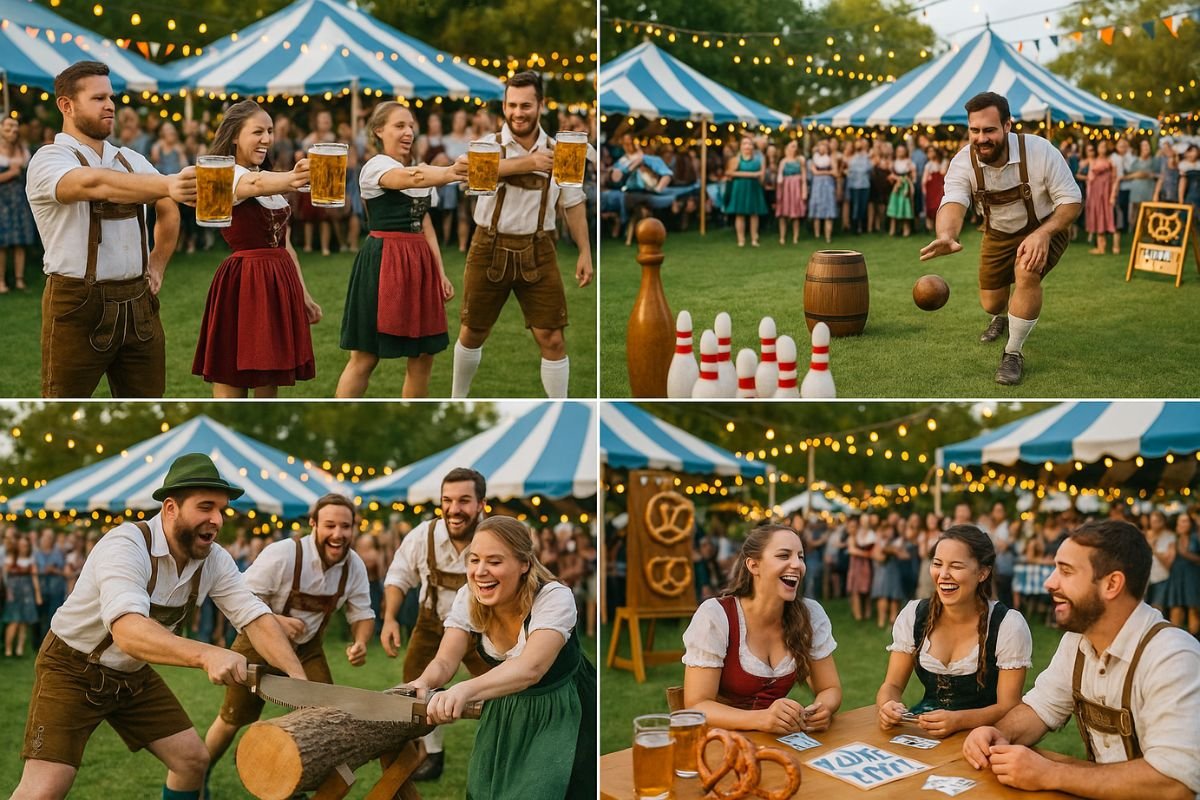
Oktoberfest Games for Adults — The Complete 2026 Guide
Beer and bratwurst get most of the attention when people talk about the Munich festival. What they underestimate — until they have been there — is how much of the atmosphere comes from the games. The communal energy of a Masskrugstemmen competition, the focused chaos of a Hammerschlagen crowd, the entire beer tent joining the Schuhplattler dance whether they planned to or not — these are the moments that define the Wiesn experience for most people who attend.
The games at the Munich festival and at replica events worldwide serve the same purpose they always have: bringing strangers into direct, joyful competition with each other. The German word Gemütlichkeit — roughly translated as warm conviviality, the feeling of belonging — is not something you achieve by sitting quietly with a Masskrug. You achieve it by losing badly at Fingerhakeln against someone whose grandfather also lost badly at Fingerhakeln, and laughing about it together.
This guide covers every game: the traditional Bavarian competitions with centuries of history, the party games that work for home events and corporate celebrations, and a practical guide to setting up your own festival game zone. For the full picture of what the Munich celebration involves before you plan around the games, our complete Munich festival guide covers dates, logistics, and what to expect across the full two weeks.
The Cultural Context: Why Games Have Always Been Part of This Celebration
The festival that became Oktoberfest began on October 12, 1810, as a celebration of the marriage of Crown Prince Ludwig of Bavaria and Princess Therese of Saxe-Hildburghausen. The wedding festivities included a horse race on the meadow that would later be named Theresienwiese after the princess. The games, contests, and communal activities that grew up around the event in the following decades were not entertainment additions — they were an expression of Bavarian community values.
Alpine Bavarian culture placed genuine value on physical strength, coordination, and the ability to perform under pressure in front of a crowd. The same qualities that made a man effective at felling timber, managing livestock, and working difficult terrain were the qualities that the traditional games tested. Stein holding, log sawing, barrel racing, and finger wrestling were not invented for festivals — they emerged from the skills of daily working life and migrated into the celebratory context because they were already familiar and respected.
Understanding this context matters for anyone wearing German Oktoberfest Lederhosen and participating in these games. The outfit and the activity are part of the same cultural expression. The history of Lederhosen traces the same arc — working clothing that became a cultural symbol. The games follow an identical pattern.
Traditional Bavarian Games: The Authentic Competition Events
Masskrugstemmen — Stein Holding Competition
Masskrugstemmen is pronounced MAHSS-kroog-stem-men and translates roughly as “the lifting of a litre mug of beer.” It is the most iconic competitive game in the festival tradition and the one that has travelled most successfully to replica events worldwide, partly because of the US Steinholding Association, which has formalised the rules and promoted the sport across America since the early 2000s.
The rules are precise and unforgiving. A regulation one-litre stein filled approximately 90% with liquid — typically water at home events, beer at the actual festival — is held by the handle only. No wrapping the hand around the glass body. No thumb placed over the top of the handle. The arm extends straight out, parallel to the ground, elbow completely straight. No lifting above shoulder height, no lowering below the horizontal, no angling to the side.
The stein weighs approximately 2.5 kg when filled — roughly 5.5 pounds. Holding this at arm’s length for two minutes sounds achievable until you try it. The trembling typically begins after 90 seconds. Shoulders burn. Elbows threaten to bend. The crowd watching makes it both harder and more interesting. Competitors at serious events regularly hold for five, six, and seven minutes. The world record sits above ten minutes — an extraordinary feat of sustained isometric endurance.
For home events: fill steins with water to the same weight. Mark the floor with tape to show the horizontal requirement. Appoint a judge who watches the elbow specifically — it is the first thing that fails and the hardest to self-monitor. A timer visible to competitors and audience creates pressure that transforms a simple strength test into a genuine spectator event.
Hammerschlagen — The Nail Hammering Game
Hammerschlagen is, by most accounts, the most popular single game at American Oktoberfest events. It was not imported directly from Bavaria — it was created in Minnesota in 1957 by Carl Schoene, a German immigrant, who brought the concept from a German tradition called Nagelspiel and formalised it for festival use. The game has since spread to replica events across the US and has returned to European festivals as a result of American interest.
The setup: a large tree stump, nails partially hammered into the surface, and a hammer with the head facing away from the nail. Players take turns striking the head of their nail with the flat side of the hammer — the blade-side strike is the rule that gives the game its particular challenge. Men must use one hand only. Women may use two. The goal is to drive the nail fully flush with, or below, the surface of the stump in as few strikes as possible.
The challenge is entirely about the angle of the strike. A straight-down blow from directly above the nail is far more effective than a swinging arc from the side. First-time players almost always swing too wide and hit the stump surface rather than the nail head. Experienced players read the angle, position the hammer directly above, and drive the nail with focused precision. The sound of a clean flush drive produces genuine crowd reaction.
Commercial Hammerschlagen kits are available for home and event purchase, typically including a proper stump section, a bag of nails, and a regulation hammer. At larger events, Hammerschlagen stations often run continuously throughout the day with small per-round fees contributing to prizes for the fastest drives.
Fingerhakeln — Finger Wrestling
Fingerhakeln predates the festival by centuries. It originated in Alpine Bavaria and Austria as a genuine test of strength and determination — not quite combat, but with the same directness. Two competitors sit across a table, connect through a leather strap or loop placed over the middle finger of each player’s dominant hand, and attempt to pull each other across the table surface. The first competitor whose elbow leaves the table, or who releases the strap, loses.
The physical demand is specific: the forearm and wrist extensors, the fingers, and the core stabilisers all engage under concentrated load. Professional Fingerhakeln competitors in Bavaria have forearms that resemble something architectural. At festival events, the game typically runs in elimination rounds with a bracket system, and the crowd involvement builds naturally as the field narrows to the final pairs.
The leather strap is the traditional equipment. A loop of quality leather approximately 15-20 cm in circumference, strong enough to handle the load of two determined adults pulling hard. At home events, a sturdy cloth loop or a specifically purchased Fingerhakeln strap works. The table should be stable enough not to move during the pull. Mark the centre of the table so the judge has a clear reference line.
Baumsägen — Log Sawing Competition
Log sawing at Alpine festivals traces directly to the working tradition of timber cutting in the Bavarian and Austrian mountains. The two-man crosscut saw was the primary tool for felling trees before power saws existed, and the rhythm and coordination required to use it effectively was a genuine skill. The fact that log sawing became a competitive event reflects how naturally Bavarian culture celebrated and tested the skills of daily working life.
The competition format pairs participants — traditionally couples but any two-person team — to saw through a log section as quickly as possible using a traditional two-handled crosscut saw. The saw pulls only, never pushes — pushing binds the blade in the wood and stops all progress. Each partner pulls alternately in a smooth rhythm, and the coordination required is more demanding than it appears. Uncoordinated pulling creates binding, slows the cut, and exhausts both participants faster than smooth rhythm does.
At the Munich festival, log sawing is occasionally seen at the Oide Wiesn heritage section. At American replica events, it is a reliable crowd favourite, particularly at outdoor festivals with adequate space. The visual drama of the sawdust flying, the physical effort visible on both faces, and the moment the log section drops free make it one of the most photogenic competition events at any festival.
Fassrollen — Barrel Rolling Race
Barrel rolling competitions emerged from the physical reality of historical brewery work. Moving full barrels of beer from cellar to delivery cart and from cart to cellar was skilled manual labour requiring the ability to control a heavy rolling barrel accurately over uneven ground. The Fassrollen competition tests the same skill with empty barrels — keeping a large, heavy, rolling cylindrical object on a defined course while racing against other competitors.
The setup requires enough outdoor space for a defined course — typically 20-30 metres with at least two turns. Teams of two push and guide their barrel through the course, passing it between themselves at designated exchange points. The barrel wants to roll sideways, speed up on slopes, and bounce off obstacles. Controlling it requires constant communication and physical adjustment, which is why the game works so well for pairs who think they know each other well.
Genuine wooden beer barrels are ideal but heavy and expensive. Plastic barrels or lightweight replicas work adequately for home and small event use. The defining characteristic of good Fassrollen is the unpredictability — every barrel behaves slightly differently, and the same team that dominated the first heat will often struggle in the second for reasons nobody can fully explain.
Schuhplattler — The Slapping Dance
The Schuhplattler is not a game in the competitive sense — it is a traditional Bavarian folk dance, and one of the most visually dramatic in European folk tradition. Male performers slap their thighs, calves, and the soles of their shoes in rhythmic patterns while circling a female partner who turns and spins in place. The slapping is percussive, forceful, and precisely timed to the music. A skilled Schuhplattler performer looks like controlled chaos and sounds like a group of people applauding very fast with their own bodies.
The dance originated in the Alpine regions and was traditionally performed by men competing to attract the attention of women. The athletic ability required — squatting, leaping, slapping below the knee, maintaining rhythm throughout — was a genuine display of physical capability. At festivals, Schuhplattler groups perform formally, but the spirit of the tradition invites participation, and many events include beginner instruction specifically to pull visitors onto the dance floor.
Polka dancing, while simpler than the Schuhplattler, is the more widely participatory option at festival events. The fast circular stepping, the partner holds, and the energy of a polka-capable brass band create the communal dancing atmosphere that is genuinely part of the authentic Wiesn experience. At the actual Munich festival, the music inside the tents shifts between drinking songs with crowd participation and polka rhythms designed to pull people to the open dance areas.
Party Games for Home Events and Replica Festivals
The traditional games above require specific equipment and, in some cases, significant space. The games in this section scale to home parties, corporate events, and smaller festival zones where space and budget are more constrained. They carry the spirit of the celebration — competition, laughter, shared energy — without requiring a tree stump or a crosscut saw.
Bierlauf — Beer Stein Race
The Bierlauf combines the endurance testing of Masskrugstemmen with the forward momentum of a race. Competitors line up at a starting line holding a full stein — beer at genuine events, water at events where spill management matters — and race to a finish line while keeping the stein as level as possible. Spillage is penalised: a judge watches each competitor and deducts points or adds time for visible spills.
The challenge is the conflict between speed and steadiness. Running fast causes the liquid to slosh. Moving slowly loses time. Finding the pace that minimises spill while maximising speed is a genuine skill that varies significantly between competitors. The game produces excellent crowd entertainment because the outcomes are consistently surprising — confident fast runners often spill more than careful slow ones, and the competitive tension builds naturally.
For home events: set a course of approximately 10 metres with a clear finish line. Two competitors race simultaneously rather than individually — the direct competition produces more energy than time trials. Use tall, narrow cups rather than wide-mouthed steins to increase the difficulty of controlling the liquid. Award small prizes for the winner of each heat and a final prize for the fastest dry-handed finisher across all heats.
Brezelwerfen — Pretzel Tossing
Brezelwerfen is a simple game that requires almost no setup, works in very small spaces, and consistently produces both skill demonstrations and spectacular failures in equal measure. Participants attempt to toss soft or rigid pretzels onto a peg, hook, or target from a defined distance. The irregular shape of the pretzel makes it aerodynamically unpredictable — it tumbles, tilts, and frequently refuses to behave in the way the thrower expects.
The traditional German version involves tossing a pretzel onto a Stecken — a traditional Bavarian walking stick held horizontally by a partner. This version requires two people working cooperatively, which changes the social dynamic from individual competition to paired coordination. The catcher must hold the stick steady while tracking the incoming pretzel, and the thrower must aim for a horizontally moving target at a distance.
For large events: set up multiple Brezelwerfen stations simultaneously so many people can play at once rather than queuing. Use a consistent distance marker and the same size pretzel for all competitors to ensure fair comparison. Soft pretzels are more visually dramatic when they land badly. Hard pretzels are easier to throw consistently and last longer over multiple rounds without structural failure.
Flunkyball — The Classic German Team Game
Flunkyball is a German outdoor yard game that predates its appearance at festival events — it is a staple of German outdoor gatherings, university events, and summer celebrations. It requires outdoor space, at least eight players divided into two teams, and one bottle or can placed in the centre of the playing area for each team.
The basic format: teams stand on opposite sides of a neutral zone. One team throws a ball at the opposing team’s centre bottle. If the bottle is knocked over, all members of the throwing team must drink a predetermined amount before someone from the opposing team runs to the centre, stands the bottle back up, and returns to their side. If the opposing team’s restorer returns before all throwers have finished drinking, the throwing team’s turn ends. Teams alternate throwing. The first team to finish all members’ drinks wins.
The game creates natural bursts of frantic activity followed by recovery periods, which suits festival energy well. It is loud, physical, and requires coordination between teammates about who runs for the bottle and when. Non-drinking versions work identically with water, juice, or any other beverage, making it suitable for inclusive events.
Bavarian Bingo
Bavarian Bingo brings the structure of standard bingo into the festival context by replacing numbers with German cultural vocabulary, festival-related words, and Bavarian geographic references. Cards contain words like Prosit, Lederhosen, Weisswurst, Schuhplattler, Masskrug, Brezel, Trachten, Edelweiss, Haferlschuhe, and Wiesn. The caller draws words randomly rather than numbers and announces them in either German or English depending on the crowd’s familiarity.
The game works particularly well during quieter moments — after dinner, during a musical break, or as the first structured activity to warm up a crowd that has just arrived. It requires no physical ability, scales to any group size, and can be played simultaneously by everyone present without elimination rounds or waiting. The cultural vocabulary embedded in the cards also serves as a gentle introduction to Bavarian tradition for guests unfamiliar with it.
Print cards in advance or purchase festival-themed bingo card sets. Run multiple simultaneous winners if the group is large — the goal is engagement, not competition pressure. Small prizes in Bavarian theme — pretzel bags, novelty steins, Bavarian flag bunting — reinforce the cultural atmosphere of the event.
German Beer Blind Taste Test
The blind taste test works best for groups with some genuine interest in German brewing tradition. Participants sample three to six German beer styles — unmarked cups identified only by number — and attempt to identify the beer style, brewery, or regional origin of each sample. Scorecards track results across all participants, and the person with the most correct identifications wins.
The educational dimension is what distinguishes this from a generic drinking game. German beer styles worth including: Weissbier (wheat beer with banana and clove notes), Märzenbier (the traditional Oktoberfest style — amber, malty, smooth), Dunkel (dark lager with bread and toffee character), Helles (pale lager, crisp and clean), and Rauchbier (smoked beer from Bamberg, dramatically polarising). The contrast between styles is significant enough that attentive tasters can distinguish categories reliably after two or three rounds of practice.
For non-drinkers, the same format works with German soft drinks — Apfelschorle (apple juice and sparkling water), Malzbier (low-alcohol malt beer), Radler (beer and lemonade), and various German herb and fruit drinks. The tasting format and scorecard structure remain identical regardless of the beverage category.
Wurst-Essen-Wettbewerb — Sausage Eating Competition
Eating competitions have a legitimate place in German festival tradition — the Wurst-Essen-Wettbewerb (sausage eating competition) appears at events across Bavaria and at replica festivals worldwide. The format: each participant receives an equal portion of sausage. A time limit of two to five minutes is set. No utensils — hands and mouth only. The participant who consumes the most within the time limit wins.
A genuine safety note that belongs in every guide covering this game: eating competitions carry real risk. Rushed consumption of large quantities of food causes choking, nausea, and in serious cases more significant medical events. The fun of the competition depends on participants managing their own pace honestly. No external pressure to continue past the point of comfort. Water available throughout. A clear rule that anyone may stop at any moment without penalty. These are not excessive cautions — they are the conditions that make the game genuinely fun rather than genuinely dangerous.
A more relaxed and equally entertaining alternative: a Brezel-Essen-Wettbewerb using large soft pretzels. The dry, chewy texture of a large Bavarian pretzel makes consumption challenging in a way that is unpleasant but not dangerous, and the sight of a row of adults struggling through a large pretzel without water creates reliable crowd amusement.
The Trachten Costume Contest — Where Fashion Meets Competition
The costume contest is a natural centrepiece for any replica festival event and one that involves the entire crowd rather than just active competitors. Participants who have made genuine effort with their traditional Bavarian attire — men in authentic Lederhosen with embroidered suspenders, Trachtenhemd, and Haferlschuhe; women in well-fitted Dirndl with correctly tied apron bows — are judged by a panel or by crowd applause across several categories.
Category options that produce better competition than a single overall winner: most authentic traditional outfit, most creative interpretation, best couple in matching Trachten, best accessories, most impressive Dirndl embroidery detail. Multiple categories mean more participants feel genuinely considered and more of the crowd has a reason to engage with the judging.
The costume contest also creates an incentive for guests to invest properly in their outfits before the event rather than arriving in casual clothes and regretting it. For men, our men’s Lederhosen collection and for women, our ladies’ Oktoberfest dress collection cover authentic options that will genuinely compete. Our guide on what to wear with Lederhosen covers the complete traditional men’s outfit if guests are building their look from scratch.
Festival Trivia: Testing Cultural Knowledge Between Rounds
Sample Questions That Work at Any Level
Trivia about the festival and Bavarian culture serves a different function from the physical games — it creates mental engagement during recovery periods, generates conversation between strangers at shared tables, and introduces cultural depth to an event that might otherwise remain at the level of beer and bratwurst. The best trivia questions reward genuine knowledge while remaining accessible enough that first-time festival participants can answer some correctly.
Starting questions that work at any knowledge level: In what year did the first Munich festival take place? (1810) What is the name of the meadow where the Munich festival is held? (Theresienwiese) What is the German word for the one-litre beer mug? (Masskrug or Mass) What animal is on the Bavarian state flag? (The Bavarian lozenge diamonds — no animal — though the Bavarian lion appears on the coat of arms) What does Gemütlichkeit mean? (Warm conviviality, cosiness, communal comfort)
Intermediate questions for more knowledgeable crowds: What was the original occasion that started the festival in 1810? (The royal wedding of Crown Prince Ludwig and Princess Therese) What are the six traditional Munich breweries whose beer is served at the festival? (Augustiner, Paulaner, Hofbräu, Spaten, Hacker-Pschorr, Löwenbräu) What does the apron bow position on a Dirndl traditionally communicate? (Left = single, right = taken) What is the traditional Bavarian nail-hammering game called? (Hammerschlagen or Nagelspiel)
Formats That Keep the Energy High
Team trivia with four to six people per team works better than individual competition at festival events because the team format creates immediate social connection between people who may not know each other. A shared wrong answer generates more laughter than an individual one. A shared right answer creates a moment of collective satisfaction that bonds strangers faster than most other social mechanisms.
Digital formats using phone-based quiz apps allow real-time scoring without the administrative burden of paper scorecards. A projector or large screen displaying questions and the running score creates the audience awareness that sharpens competition. Audio questions read aloud by a charismatic host work better than written questions at a loud festival event where reading conditions are imperfect.
Setting Up Your Own Festival Game Zone
Planning the Space
A well-organised game zone for a home or small festival event separates competitive stations far enough apart that noise and activity from one game does not distract from another. The minimum practical spacing: two metres between adjacent stations, with clear path access so spectators can move between stations without crossing active competition areas. Mark stations with Bavarian blue and white signage — the aesthetic reinforces the cultural context and helps guests understand immediately what each station involves.
Designate specific areas by activity type: physical competition games (Masskrugstemmen, Hammerschlagen, log sawing) grouped together with judge stations and spectator space; table games and trivia in quieter areas away from the physical competition noise; the dance area near the music source with enough floor space for polka participation. The flow between stations should feel natural — guests should be able to see what is happening at adjacent stations and drift toward whatever interests them.
Equipment and Props
The essential equipment list for a complete festival game zone: one-litre beer steins (real or weighted replicas) for Masskrugstemmen, a Hammerschlagen kit with stump, nails, and hammer, a crosscut saw and log sections for Baumsägen, plastic or lightweight barrels for Fassrollen, soft pretzels and hooks or pegs for Brezelwerfen, a ball and bottles for Flunkyball, printed Bavarian Bingo cards, scorecards for trivia, and a timer with audible alert visible to all competitors.
Prizes reward participation rather than just winning. Practical Bavarian-themed prizes work better than generic gift cards: pretzel bags, beer coaster sets, small novelty items, German chocolate selections, Bavarian flag bunting. The cultural theme of the prizes reinforces the event’s atmosphere through the prize-giving ceremony, which is itself a social moment worth structuring properly — a brief announcement of each winner with a reason for their win creates the kind of recognition that people remember.
The Schedule: Loose Structure Works Best
Festival game schedules should feel flexible rather than mandatory. Announce a loose timeline — stein holding at one time, trivia at another, dance competition later — but allow guests to move freely between stations throughout. Compulsory participation in a scheduled game at a specific time creates the wrong kind of pressure at a celebration. The goal is a flow state where guests are always aware that something interesting is happening somewhere and can choose their level of involvement.
For the actual Munich festival, games happen organically throughout the event rather than on a formal schedule. Masskrugstemmen competitions run at specific tents at advertised times, but the general atmosphere of playful competition is constant. Replicating this energy at home events means having enough game options running simultaneously that no guest feels obligated to participate in anything specific — only invited to join whatever looks like the most fun.
Responsible Celebration: The Honest Note
Several of the games in this guide involve alcohol. The responsible approach to festival games is simple and non-preachy: maintain water availability throughout all physical competition games, ensure all food games have clear opt-out options, and never structure any game in a way that makes stopping feel socially costly. The best Bavarian celebration is the one where every guest feels genuinely well — not obligated.
Non-alcoholic versions of every drinking game in this guide work identically with appropriate substitutes. Sparkling water in the steins for Masskrugstemmen. Apple juice in the cups for the taste test. The physical and competitive elements that make the games engaging do not depend on the specific beverage involved.
Frequently Asked Questions
What games do they actually play at the real Munich festival?
The actual Munich celebration is less structured around formal games than most people expect from film portrayals. The most commonly seen competitive activities are Masskrugstemmen stein holding, which runs at specific tents on scheduled days, and occasional Fingerhakeln finger wrestling at smaller tent events. The Hammerschlagen nail-hammering game is widely seen at American replica events but less common at the Munich original. Most of the game-like activity at the genuine festival happens organically — singing competitions, dance participation, and informal stein challenges between tables.
How do you play Masskrugstemmen correctly?
Fill a one-litre stein approximately 90% full. Hold it by the handle only — no wrapping the hand around the body of the stein. Extend the arm completely straight, parallel to the ground. The elbow must remain straight throughout. No lifting above shoulder height, no lowering below horizontal. The last competitor holding their stein in the correct position wins. Men typically hold one stein; women one stein also, though some event formats have women hold two lighter vessels.
What is Hammerschlagen and where did it come from?
Hammerschlagen is a nail-hammering game in which players attempt to drive a nail into a tree stump using the flat face of a hammer held with the blade facing away from the nail — making direct strikes difficult. It was created in Minnesota in 1957 by Carl Schoene, a German immigrant who developed it from the older German game Nagelspiel. It became one of the most popular games at American Oktoberfest events and has since spread globally. Men use one hand, women may use two, and the objective is to drive the nail flush in as few strikes as possible.
What is Fingerhakeln and how is it played?
Fingerhakeln is a traditional Alpine Bavarian finger wrestling game in which two competitors connect through a leather loop placed over the middle finger of each player’s dominant hand and attempt to pull each other across a table. The first competitor whose elbow leaves the table surface loses. The game originated as a genuine test of strength in Alpine communities and has been practised competitively in Bavaria for centuries. Professional competitions with brackets and championships still take place at traditional Alpine events across Bavaria and Austria.
What games work best for a home Oktoberfest party?
Five games scale reliably to home settings without special equipment: Masskrugstemmen using standard steins weighted with water, Brezelwerfen using large soft pretzels and improvised hooks, the Bierlauf stein race across any clear floor space, Bavarian Bingo using printed cards, and German trivia with team scorecards. Flunkyball works outdoors with a ball and plastic bottles. The costume contest works at any party size and produces engagement from guests who are not interested in physical competition. None of these require purchasing specialist equipment beyond the steins.
Can children participate in Oktoberfest games?
Several traditional games work well for mixed-age participation. Log sawing with appropriate supervision is safe and genuinely fun for older children and teenagers. Brezelwerfen is entirely suitable for all ages. Bavarian Bingo works for children who can read. The costume contest actively benefits from children participating — the sight of a child in a genuine Bavarian Trachten outfit is one of the most characterful elements of any authentic festival event. Masskrugstemmen works for older children using smaller, lighter vessels. Hammerschlagen requires supervision and the strength to control the hammer safely.
What is Flunkyball and how do you play it?
Flunkyball is a German outdoor team game in which two teams stand on opposite sides of a neutral zone with a bottle or can at the centre of each team’s side. Teams alternate throwing a ball at the opposing team’s bottle. When a bottle is knocked over, all members of the throwing team drink until a member of the opposing team runs to the centre, stands the bottle back up, and returns to their side. If the runner returns before the throwing team finishes drinking, the throwing team’s turn ends. First team to finish all members’ drinks wins. Non-alcoholic versions work identically.
Making the Games Part of Something Larger
The games at a well-run festival event do not exist in isolation from everything else happening. They are embedded in the music, the food, the clothing, and the genuine warmth of communal celebration that Bavarians call Gemütlichkeit. A row of people trembling through a Masskrugstemmen competition while a brass band plays and the smell of bratwurst fills the air is a specific and irreplaceable kind of experience. The games are the mechanism — the Gemütlichkeit is the outcome.
Whether the event is the actual Munich celebration, the La Crosse festival, the New Glarus gathering, or a garden party for twenty people who found some steins and a pretzel recipe, the same principle holds. The games work when they bring people into direct, joyful connection with each other. Set them up with care, run them with flexibility, and let the crowd take them where they want to go.
German Attire supplies authentic Bavarian Lederhosen, Dirndl, and traditional German attire to customers across the UK, US, and Australia. For your festival event — whether in Munich or your own backyard — browse our complete range of men’s Lederhosen and ladies’ Oktoberfest dresses to arrive dressed the way the games were designed to be played in.
Anna Bauer is a seasoned Bavarian fashion expert, cultural consultant, and heritage stylist with over a decade of hands-on experience in traditional German clothing. Born in Munich, the heart of Bavaria, Anna grew up surrounded by the rich traditions of Trachten fashion. Her passion for cultural attire led her to pursue a degree in Fashion and Textile Design at the prestigious University of the Arts Berlin, where she specialized in European folkwear.
Over the past 12+ years, Anna has collaborated with renowned Trachten designers, styled outfits for Oktoberfest events across Germany, and contributed articles to top fashion and culture magazines across Europe. Her work focuses on preserving the authenticity of Lederhosen and Dirndl wear while helping modern audiences style them with confidence and flair.
As the lead content contributor for German Attire, Anna combines her academic background, professional styling experience, and deep cultural roots to provide readers with valuable insights into traditional German fashion. Her blog posts cover everything from historical origins and styling guides to care tips and festival outfit planning—making her a trusted voice for anyone looking to embrace Bavarian heritage in a stylish, modern way.