

Blog
How Are Bavarians Different From Other Germans? The Complete Cultural Guide
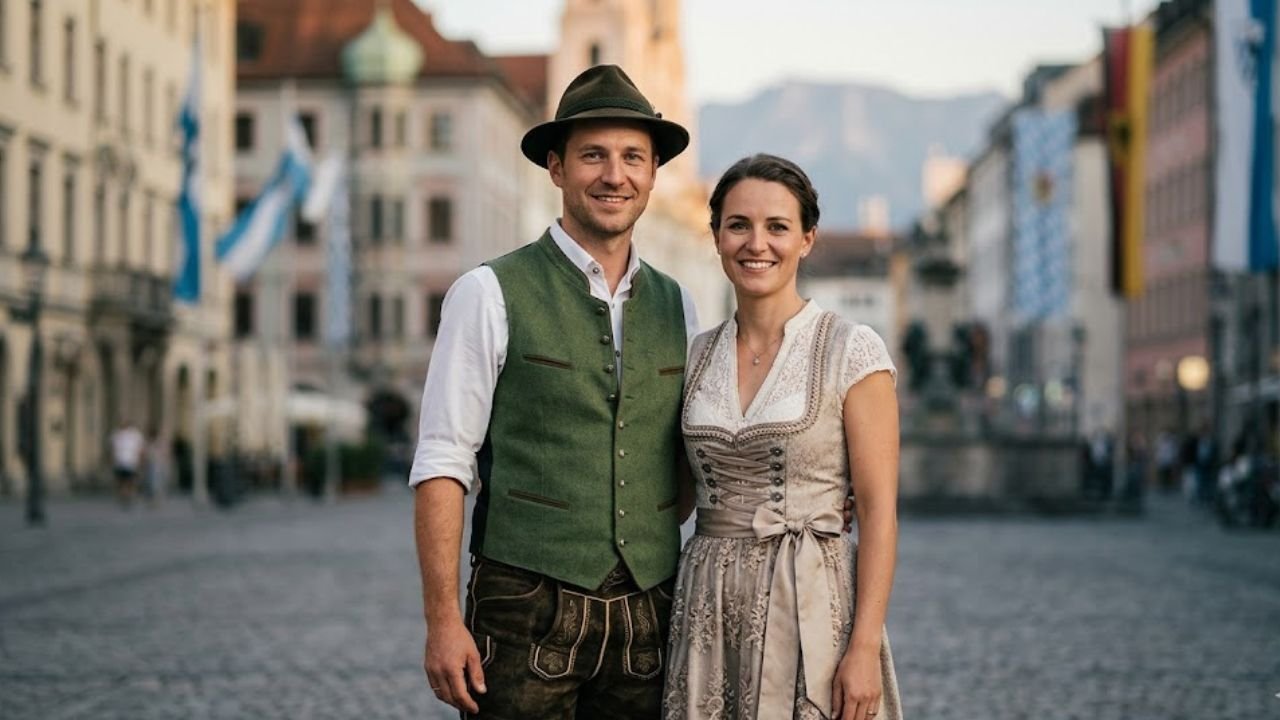
How Are Bavarians Different From Other Germans? The Complete Cultural Guide
Picture this. You are at a dinner in Munich and you make an innocent comment — something friendly, something meant to connect — about how you love Germany. The Bavarian across the table goes quiet. Not hostile, exactly. But something shifts behind the eyes. A polite correction follows: “Well, Bavaria and Germany are not quite the same thing.” You nod and move on. But the correction lingers, because it was not delivered defensively. It was delivered as a simple statement of fact that the speaker assumed everyone already knew.
This is not a rare encounter. It happens constantly, to tourists, to expats, to Germans from Hamburg or Berlin who relocate to Munich and discover — sometimes gently, sometimes not — that regional identity in Bavaria operates at a depth and intensity that no other German state approaches. Many Bavarians consider themselves Bavarian first and German second. Some consider the ordering self-evident. A vocal minority questions whether the ordering matters at all, since Bavaria, in their view, is its own civilization that simply happens to share a passport with the rest of the country.
They are not entirely wrong. Bavaria was an independent kingdom until 1871 — only 154 years ago. It has its own dialect that northern Germans genuinely struggle to understand. Its own dominant political party that exists in no other state. Its own Catholic calendar of holidays. Its own food philosophy, its own festival culture, its own character type, and its own four-word motto — Mia san mia — that functions less as a slogan and more as a complete psychological identity. Germany is one country. Bavaria operates like its own civilization. It always has.
This guide covers the complete picture: the history that most people do not know, the language that reveals the divide, the religion that changes everything, the politics that confuse outsiders, the food that cannot be replicated elsewhere, the festivals that have no equivalent, and the character type that is genuinely, measurably different from the stereotype of “the German” that the rest of the world inherited from Prussia. By the end, you will understand not just what makes Bavaria different but why that difference matters and why Bavarians insist on it so consistently.
Part 1: The Historical Foundation
Bavaria Was Its Own Kingdom — Not Just a Region
The single most important fact for understanding Bavarian identity is one that most non-Germans — and many Germans outside Bavaria — do not know: Bavaria was an independent kingdom until 1871. Not a province. Not a territory. A kingdom, with its own monarch, its own military, its own foreign policy, and its own deeply developed sense of political sovereignty. The Duchy of Bavaria was established in 555 AD under the Agilolfing dynasty, making it one of the oldest continuously recognized political entities in central Europe. The Wittelsbach dynasty, which assumed control in 1180, ruled Bavaria for over 700 years — one of the longest-reigning royal lineages in all of European history, outlasting the Habsburgs in longevity of unbroken rule over a single territory. The Kingdom of Bavaria, formally declared in 1806 under Napoleon’s reorganization of European power, was a sovereign nation on the world stage for sixty-five years before Bismarck’s unification project absorbed it into a German empire that Bavaria had serious reservations about joining.
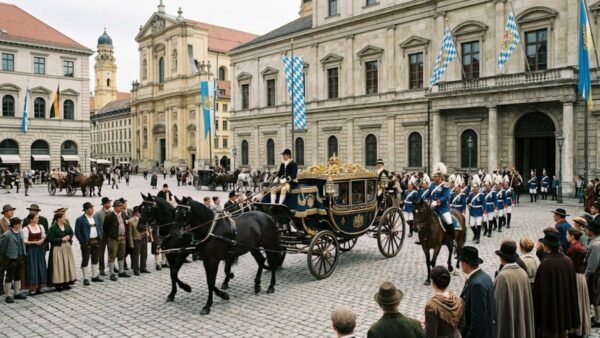
The critical distinction that Bavarians draw — and that historians support — is that Bavaria did not join Germany so much as Germany was built around Bavaria’s reluctant participation. The Austro-Prussian War of 1866 placed Bavaria on Austria’s side, fighting against Prussia, the very state that would go on to unify Germany on its own terms in 1871. Bavaria lost. The unification that followed was a Prussian project that Bavaria entered with significant negotiated concessions, including the right to maintain its own postal system, railway administration, and military command structure in peacetime. These were not minor administrative details — they were the conditions under which a sovereign kingdom agreed to share a political union with a Prussian-dominated empire it had just fought against five years earlier. The resentment was structural from the beginning, and it never fully dissolved.
The twentieth century added further chapters. The 1919 Bavarian Soviet Republic — a short-lived radical government established in the aftermath of World War One — represented Bavaria’s attempt to define its own political future outside the framework of the new German republic. It lasted six weeks before being suppressed, but it is a chapter of Bavarian history that most Germans outside the state cannot place accurately because it complicates the simple narrative of Bavaria as a conservative, traditional, deeply Catholic region. Bavaria has always been willing to chart its own course, even when that course is surprising. After World War Two, under American occupation, Bavaria came genuinely close to being reconstituted as an independent state. The decision to integrate it into the Federal Republic of Germany was made by external powers, not by any Bavarian popular mandate. Bavarians remember this. The historical weight of independence — real, not romanticized — underlies every contemporary expression of Bavarian distinctiveness.
The Prussia Problem — The Root of Everything
To understand why Bavarians are different from other Germans, you must understand what “other Germans” actually means as a cultural category — and that category is overwhelmingly Prussian in its origins. Prussia was the dominant force in German unification, and Prussian values — rigorous discipline, military efficiency, Protestant work ethic, formal reserve, deference to institutional authority — became the defining characteristics of “the German” stereotype that the rest of the world inherited and that northern Germans largely recognize in themselves. When a non-German says “Germans are very punctual, very serious, very direct,” they are describing a Prussian value system that became generalized as German through the dominance of the Prussian state in shaping the new united country after 1871.
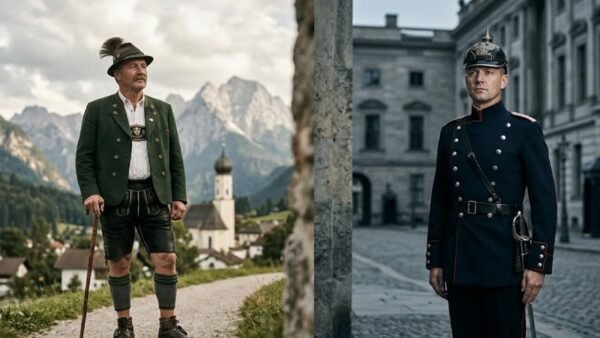
Bavarians were never Prussian. They were never shaped by Lutheranism, which drove the Protestant work ethic and the particular kind of individual moral seriousness that characterizes northern German culture. They were never organized around military discipline as a primary social value. Their dominant institution was not the Prussian state bureaucracy but the Catholic Church, with its feast-day calendar, its communal rituals, its emphasis on community over individual, and its fundamentally different relationship to work, rest, and celebration. The anti-Prussian sentiment that surfaces in Bavarian humor and everyday speech — the use of Saupreiss (Prussian pig) as a characterization of northern Germans that is simultaneously derogatory and half-affectionate — reflects a genuine historical and cultural rift that 154 years of shared national identity have not erased and that Bavarians show no particular interest in erasing.
The Three Bavarias — Not Even Bavaria Is One Thing
Generalizing Bavaria as a single unified cultural entity is itself a mistake that reveals how little most outsiders understand about German regional complexity. The modern state of Bavaria contains three historically and culturally distinct regions that were not always governed together and that still maintain separate identities within the larger Bavarian framework. Altbayern — the traditional core comprising Upper Bavaria, Lower Bavaria, and the Upper Palatinate — is the Bavaria that most people picture: Catholic, dialect-speaking, Tracht-wearing, beer-drinking, fiercely proud of its Alpine heritage. This is Munich’s Bavaria. It is the Bavaria of Oktoberfest and the Wittelsbach monarchy and the Bavarian identity politics that makes national headlines.
Franconia — the large northern region comprising Upper, Middle, and Lower Franconia — is a substantially different place. Franconia is largely Protestant, a product of the Reformation that swept through it while Altbayern remained Catholic. Franconia drinks wine more than beer — its wine region centered on Würzburg is among Germany’s most respected, producing Silvaner in the distinctive flat Bocksbeutel flask that is iconic to this region alone. Franconians have their own dialect, their own cultural traditions, and a significant portion of the population that identifies as Franconian first and Bavarian reluctantly second — a mirror of the Bavarian vs German debate played out one level down in the regional hierarchy. Bavarian Swabia, the southwestern corner of the state, sits closer culturally to Baden-Württemberg than to Munich, sharing linguistic and cultural characteristics with the Alemannic tradition rather than the Bairisch one. When you encounter a claim about what Bavarians are like, the honest first question is always: which Bavaria?
Part 2: Language and Greetings
Bairisch — A Language Within a Language
Bavarian dialect — Bairisch — is not merely an accent. It is a distinct dialect group within the Upper German branch of the Germanic language family, related to but grammatically and phonologically distinct from standard German (Hochdeutsch) in ways that go well beyond regional pronunciation differences. A northern German speaker who arrives in a rural Bavarian village and encounters genuine deep-dialect speech is not having the experience of hearing an unfamiliar accent — they are having the experience of encountering a language they cannot reliably follow. This is not an exaggeration made by Bavarian pride. It is a documented linguistic reality that researchers and northern Germans who have lived in Bavaria consistently confirm.
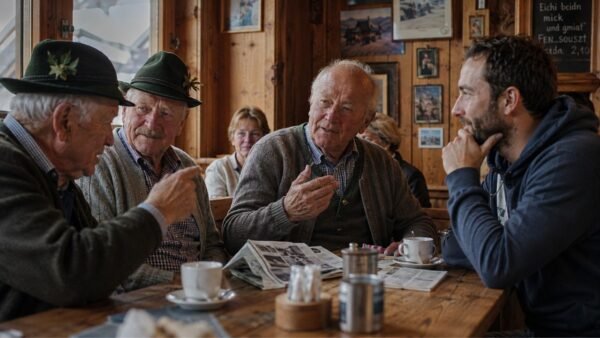
The three layers of Bavarian speech operate in different social contexts with a code-switching sophistication that Bavarians navigate unconsciously. Hochdeutsch appears in formal professional environments, written communication, schools, and any context where the speaker is addressing an audience that includes non-Bavarian Germans or international speakers. Colloquial Bavarian — the everyday spoken German of Munich and larger Bavarian cities — sits between standard German and deep dialect, instantly recognizable as southern by its intonation, vocabulary, and grammatical constructions but broadly comprehensible to most German speakers with patience. Deep dialect is the speech of rural communities, older generations, and the unguarded private conversations of people who grew up speaking it before they learned anything else. It is impenetrable to most outsiders and is increasingly endangered as younger Bavarians grow up with more media exposure to standard German — though active preservation efforts in schools, cultural associations, and regional media are slowing the erosion.
Essential Bavarian Words and Phrases That Reveal Cultural Difference
Mia san mia — “We are who we are” — is the four-word summation of the entire Bavarian identity discussed in this guide. It is simultaneously a statement of pride, a declaration of self-sufficiency, a gentle warning to outsiders not to expect Bavaria to accommodate itself to external expectations, and a reminder to Bavarians themselves of who they are supposed to be. It functions as the unofficial Bavarian motto, the name of FC Bayern Munich’s internal championship philosophy, and the phrase most Bavarians would choose if asked to identify themselves in four words. Nothing in northern German regional culture comes close to this level of concentrated, universally recognized identity expression.
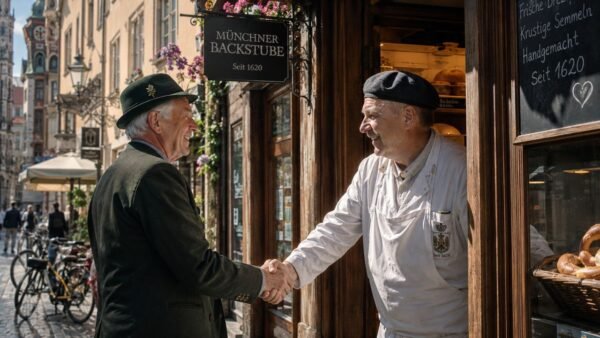
Servus is the greeting that immediately marks you as Bavarian or Austrian and that is used nowhere in northern Germany. It derives from the Latin servus (servant) and functions as both a hello and a goodbye — a linguistic flexibility that makes it doubly useful and doubly distinctive. Grüß Gott — literally “God’s greeting to you” — is the Catholic greeting that structures daily social interaction in Bavaria in ways that have no parallel in the secular north. In Hamburg or Berlin, saying Grüß Gott to a stranger would feel strange and slightly theatrical. In Bavaria, saying Hallo to a tradesman or shopkeeper feels oddly abrupt and vaguely cold. These greetings are not interchangeable regional variations on the same practice — they are markers of entirely different cultural and religious frameworks. Other essential Bairisch terms include Gemma (let’s go), Schmarrn (nonsense, used with colorful frequency), Watschn (a slap, literal and figurative), and Auf geht’s (let’s get going / here we go) — a phrase that marks Bavarian speech patterns instantly and appears at football matches, festival openings, and ordinary conversations with equal frequency.
Part 3: Religion — The Deepest Dividing Line
Catholic Bavaria vs Protestant North — Why This Changes Everything
The most fundamental and most consistently overlooked difference between Bavaria and northern Germany is religious, and it operates not merely as a matter of personal faith but as a structural force that shapes the entire organization of daily life, social community, work culture, artistic tradition, and political identity. The Protestant Reformation, which Martin Luther launched in 1517, swept through northern and central Germany with transformative completeness. It reshaped how northern Germans relate to authority, to work, to individual conscience, to community, and to celebration. The Protestant work ethic — the theological conviction that disciplined labor and avoidance of excess are expressions of moral seriousness and divine favor — became the cultural operating system of northern Germany and was later theorized by Max Weber as the psychological foundation of northern European capitalism.
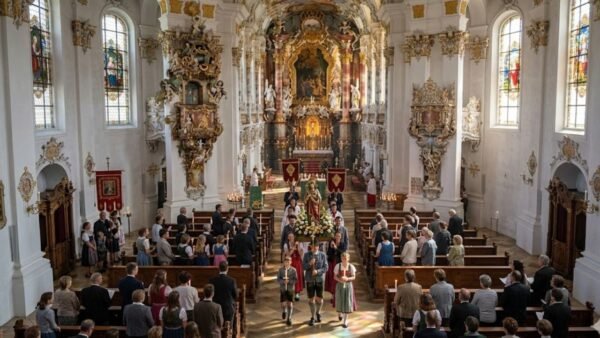
Bavaria remained emphatically, visibly, institutionally Catholic. The Counter-Reformation found its most effective European stronghold in Bavaria, and the Wittelsbach dynasty’s militant Catholicism ensured that the Reformation’s cultural revolution simply did not happen here in the way it happened in Saxony, Brandenburg, or the north. The consequences are visible everywhere you look in Bavaria. Roadside shrines — Wegkapellen — dot the countryside at intervals that reflect a landscape organized around Catholic devotion. Church bells in Bavarian towns genuinely structure daily life, marking canonical hours in ways that most urban northern Germans have not experienced since childhood if ever. Crucifixes hang in public school classrooms throughout Bavaria — a practice that has been legally contested in the European Court of Human Rights and survived because the state government defended it as a cultural rather than purely religious practice. Religious processions through town centers for Corpus Christi, Epiphany, and local feast days involve the entire community, not merely the practicing faithful, in ways that reflect Catholicism’s historical role as the organizing framework of Bavarian community life rather than simply one personal belief option among many.
Bavaria’s Catholic Calendar — More Holidays Than Anyone Else
Bavaria has more public holidays than any other German federal state, and the surplus comes directly from its Catholic calendar. Corpus Christi — Fronleichnam — is a public holiday in Bavaria during which businesses close, processions move through village streets, and the community observes a religious feast that most northern Germans acknowledge exists but few have personally observed in any public form. Epiphany — Dreikönigstag, January 6th — is a Bavarian state holiday that is not a national holiday, creating the surreal situation in which a Bavarian employee has a day off work that their colleague in Hamburg does not. All Saints Day is a major Bavarian observance on which families visit cemeteries, place candles on graves, and maintain connections to their dead in a communal ritual that reflects Catholic theology’s continuous engagement with the departed. The Sternsinger tradition — groups of children dressed as the Three Kings who travel door to door singing carols and writing the blessing C+M+B in chalk above doorframes — belongs to the Catholic calendar in a way that has made it a Bavarian cultural institution regardless of the individual household’s personal religious observance. The holiday density in Bavaria does not merely give residents more time off — it creates a fundamentally different rhythm of communal life in which celebration, rest, and community gathering are built structurally into the calendar rather than being individually negotiated against work obligations.
Part 4: Character, Personality and Daily Life
The Bavarian Personality — Gemütlichkeit vs Northern Reserve
Gemütlichkeit is the word that most reliably describes the Bavarian social ideal, and it has no adequate English translation. It encompasses warmth, coziness, conviviality, ease, a certain quality of unhurried comfort in the company of others, and the active creation of an environment in which people feel genuinely welcome rather than merely tolerated. It is not simply friendliness — it is a life philosophy organized around the conviction that human beings flourish in warm, relaxed, communal settings and that creating those settings is a legitimate and serious social priority. The Biergarten is Gemütlichkeit’s physical expression. The Stammtisch is its social institution. The Bavarian Sunday is its temporal guarantee.
Northern German social culture operates by different principles that are equally valid but genuinely different in character. The reserve associated with Hamburg or Berlin — where strangers do not make small talk, where personal space is respected scrupulously, where warmth is expressed through reliability and directness rather than through expansive hospitality — reflects the Protestant cultural tradition of individual seriousness and the Prussian value system in which personal discipline is a virtue that public conviviality can compromise. Neither system is superior. But they produce people who interact with the world, with strangers, and with the social possibilities of an ordinary Tuesday afternoon in measurably different ways. The paradox of Bavarian character is that the same person who offers a stranger at the next Biergarten table a piece of their Brotzeit will also prove immovably stubborn about doing things any way other than the Bavarian way. Sturheit — stubbornness, a pride in one’s own established methods — coexists with Gemütlichkeit in Bavarian character not as a contradiction but as two aspects of the same deep self-assurance.
The “Mia San Mia” Mentality — Bavarian Pride Examined
Bavarian regional pride differs from the regional pride expressed in other German states not merely in degree but in kind. No other German state has its own anthem, its own flag flown with the frequency and seriousness that the white-and-blue diamond pattern appears in Bavaria, its own dominant political party, and its own traditions treated as sovereign expressions of a distinct civilization rather than regional variations on a national theme. The Bayernpartei — a minor but persistent political party advocating genuine Bavarian independence from Germany — has never achieved significant electoral results but has never disappeared either, reflecting the fact that complete independence remains a position that a small but real portion of the Bavarian population finds genuinely reasonable rather than merely provocative. The FC Bayern Munich phenomenon is inseparable from this identity: when Bayern wins the German championship, many Munich residents experience it less as a sporting victory than as a cultural and political validation — the best team, from the best region, proving once again what Mia san mia means in practice.
Work Culture and Life Pace
The Protestant work ethic that shaped northern German professional culture has a southern counterpart in the Catholic tradition of Feierabend — the end of the workday — as a genuinely sacred transition. Feierabend means literally “celebration evening,” and its structure reflects a theology in which rest and celebration are not rewards for completed work but essential human activities with their own dignity independent of productivity. In rural Bavaria particularly, Sunday closure laws are enforced with a seriousness that surprises visitors from more commercially continuous urban environments — shops close, construction is prohibited, and the social expectation is that Sunday functions as a genuine day of rest and community rather than an extension of the working week with lighter traffic. Munich bucks some of these trends — it is a fast-paced, expensive, internationally cosmopolitan city where professional culture is as demanding as anywhere in Germany — but even Munich’s professional culture retains a Bavarian quality in its relationship to hospitality, community gathering, and the Biergarten as a legitimate use of a Tuesday evening that no business obligation should routinely supersede.
Social Life — Biergarten, Stammtisch and Vereine
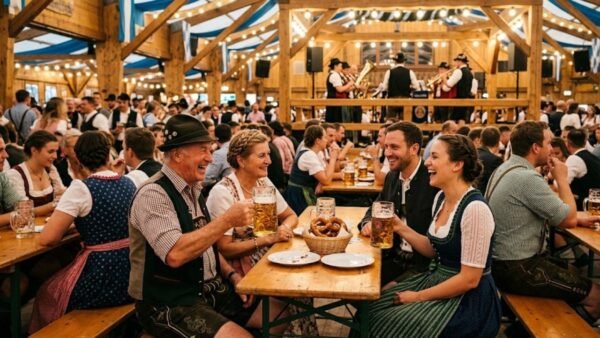
The Biergarten is the most misunderstood institution in Bavarian social life precisely because it looks like something familiar to international visitors — an outdoor pub — when it is actually something substantially different. A traditional Bavarian Biergarten operates as a democratic community space where social hierarchies are suspended, where bringing your own food from home is culturally accepted and expected (only the beer is compulsory), where strangers at shared long tables make conversation with the natural ease of neighbors who have known each other for years, and where the presence of children and elderly people alongside young adults reflects a communal design rather than an age-specific venue. It is not a bar with tables outside. It is a social institution that predates the modern concept of a bar by centuries.
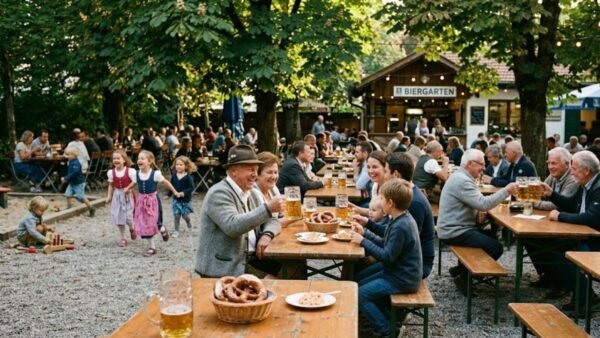
The Stammtisch — the reserved regular table at a restaurant, Gasthaus, or Biergarten where the same group of people meets on the same evening each week — is the social glue of Bavarian community life in ways that have no precise equivalent in northern German urban culture. A Stammtisch might be a group of farmers, a group of craftsmen, a group of municipal workers, or a group of retired professionals — the composition is less important than the regularity, the belonging, and the informal governance function the table sometimes serves as a forum for local opinion and community concern. Bavaria also has the highest density of Vereine — civic clubs and associations — of any German state. Shooting clubs, folk dance groups, Trachtenvereine dedicated to preserving traditional dress, choral societies, church associations, and dozens of other organized community groups create a social infrastructure of belonging that reflects the Catholic tradition of communal life and contrasts sharply with the more individualistic social organization of Germany’s larger, more secular northern cities.
Part 5: Traditional Dress and Tracht
Tracht — Worn With Pride, Not as Costume
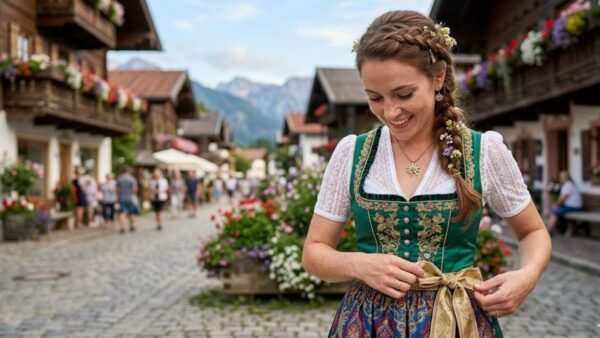
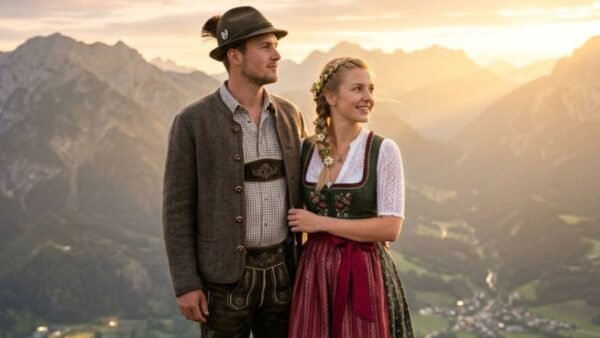
The single most important thing to understand about Bavarian traditional dress is the distinction between authentic Tracht and the cheap Oktoberfest costume versions sold to tourists — and the fact that this distinction matters enormously to Bavarians and not at all to the international market that has turned Lederhosen and Dirndl into generic German symbols. Authentic Tracht is not a costume. It is daily life. In Munich, a young professional wearing a Dirndl to a restaurant on a Saturday evening is making no more of a deliberate cultural statement than a New Yorker wearing jeans — it is simply what one wears for that occasion. In rural Upper Bavaria, Lederhosen appear at Sunday Mass, at village festivals, at community gatherings, and at the agricultural events that still structure life in the Alpine foothills. Tracht is living, worn, active clothing, not a folkloric artifact deployed for tourist photography.
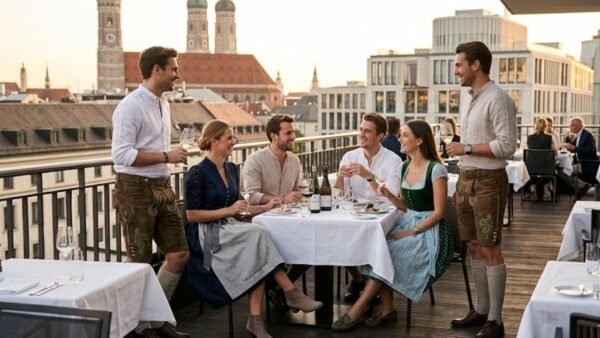
The historical origins of Tracht reflect the geographic specificity of Alpine culture. Each valley historically developed its own distinctive dress traditions — specific color combinations, embroidery patterns, cut details, and accessory traditions that identified the wearer’s community of origin as precisely as a passport. The Trachtenvereine — associations dedicated to preserving and performing traditional dress in specific regional styles — maintain this granular geographic specificity with considerable seriousness. A Trachtenverein from a specific Upper Bavarian village will have a different costume from one five valleys away, and the differences are not arbitrary — they encode centuries of local craft tradition. Northern Germans, encountering Tracht as outsiders, tend to view it with a mixture of curiosity, admiration, and occasional bemusement. The bemusement reflects their own distance from this kind of embodied regional identity, not a superior position. Bavaria’s young generation has found a way to navigate this heritage with genuine creativity — contemporary Dirndl fashion has moved from village costume into Munich fashion weeks, with designers reworking traditional silhouettes in modern fabrics and colors that retain their Tracht DNA while speaking fluently to contemporary aesthetics.
Dirndl — More Than a Dress
The Dirndl’s history as a class marker reflects the complexity of Bavarian social history. Originally the practical dress of Alpine working women — dairy maids, farmhands, domestic workers — it was adopted by the Bavarian aristocracy and upper classes in the nineteenth century as part of the broader folk revival that elevated regional rural dress into an expression of national and regional identity. This class reversal — in which the dress of working women became the aspirational dress of the privileged — gives the Dirndl a historical richness that its contemporary global image as a festival costume entirely erases. The apron bow tradition — in which the bow tied on the left signals that the wearer is unmarried or available, tied on the right signals that she is in a relationship or married, tied at the back signals widowhood, and tied at the front center signals a professional context — is a genuine and still-observed Bavarian social code that encodes information about the wearer’s status in a way that the rest of the Western world has no equivalent for in contemporary dress. Austrian and Bavarian Dirndl traditions differ in subtle but consistent ways — Austrian styles tend toward deeper, more saturated colors and slightly different bodice constructions, while Bavarian styles vary significantly by sub-region. For those seeking to understand or wear authentic Tracht, the guides on how to wear a Dirndl correctly, the full history of the Dirndl, and which accessories complete the look provide the depth that the subject deserves. The full collection of authentic Bavarian Dirndl dresses and men’s Lederhosen at GermanAttire reflects this tradition with genuine quality rather than tourist-market shortcuts.
Part 6: Food and Drink
Bavarian Food Philosophy vs the Rest of Germany
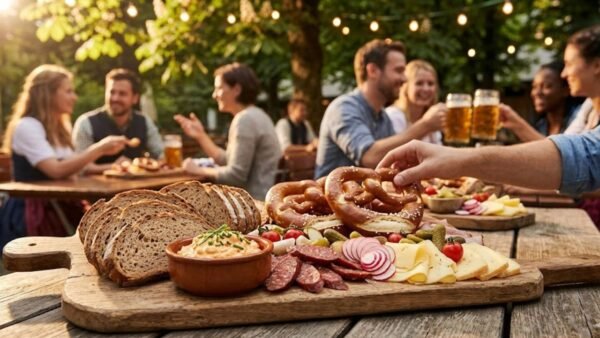
Bavarian food is hearty, pork-forward, ceremonial, communal, and inseparable from the social rituals that give it meaning. Northern German food is simpler, more fish-forward in coastal areas, more functional in its relationship to the meal as a fueling event rather than a social performance. Neither characterization is a criticism — they reflect genuinely different relationships to the act of eating that derive from different geographies, different religious traditions, and different social histories. The Brotzeit — literally “bread time,” the Bavarian cold meal of bread, sausage, cheese, radishes, and pickles eaten as a mid-morning or evening meal rather than cooked from scratch — reflects a Bavarian philosophy in which eating is both casual and communal, requiring no kitchen labor but demanding proper attention and good company. It is also, crucially, what you eat at the Biergarten table alongside your beer, because Bavarian food and Bavarian drink have always been understood as a unified experience rather than separate categories of consumption.
Essential Bavarian Dishes With Cultural Context
Weißwurst — white veal sausage made from minced veal and pork back fat, seasoned with parsley, lemon zest, and cardamom — comes with a ritual so specific and so seriously observed that it functions as a cultural test for outsiders. The sausage must be eaten before noon — the traditional rule holds that it should not hear the noon church bells, a guideline that reflects its origins as a fresh, unpreserved product in an era before refrigeration made all-day freshness possible. It is served in hot water to keep it warm, accompanied exclusively by sweet mustard and a pretzel, and it is eaten by either sucking the filling from the casing or carefully peeling the skin away — never by cutting and eating it with the skin on, which marks the eater as someone who does not know the rules. The Weißwurst breakfast is Bavaria’s most distinctive meal, available at every traditional Gasthaus and Biergarten in the morning, and it is an experience that simply does not exist in the same form anywhere else in Germany.
Schweinshaxe — the roasted pork knuckle with its crackling skin and slow-braised interior — is the architectural achievement of Bavarian meat cookery, a dish that requires hours of preparation and produces a result of extraordinary richness that is simultaneously festival food and everyday restaurant fare. Obatzda — a spreadable mixture of ripe Camembert, butter, cream cheese, onion, and paprika — is the quintessential Biergarten accompaniment, served with pretzels and radishes as the ideal vehicle for unhurried outdoor eating. Kaiserschmarrn — the shredded, caramelized pancake dessert dusted with powdered sugar and served with plum compote — is shared with Austria in origin and with the entire Alpine tradition in spirit, reflecting the cultural continuity between Bavaria and Austria that predates their separate national trajectories. Knödel — the dumpling in its many Bavarian variations — divides even Bavarians along regional lines, with the precise composition, size, and accompaniment of the ideal Knödel being the subject of opinions held with a seriousness disproportionate to the stakes but entirely proportionate to the depth of Bavarian food culture’s local specificity.
Beer — The Bavarian Religion Within a Religion
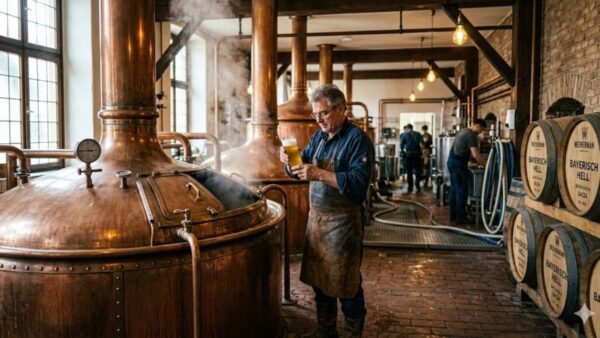
The Reinheitsgebot — the Beer Purity Law of 1516, enacted by Duke Wilhelm IV of Bavaria — is the oldest food safety regulation in the world still in active use and the foundational document of Bavarian beer identity. It specified that beer could be brewed using only water, barley, and hops (yeast was added to the permitted ingredients after its role in fermentation was understood). It was a Bavarian law before there was a Germany, and it remains the framework within which Bavarian breweries define their standards and their pride. Bavarian beer culture resists the global craft beer explosion that has transformed brewing in the United States, the United Kingdom, and increasingly in northern Germany — not because Bavarians are incurious about flavor, but because the traditions established by the great Munich and Bavarian breweries represent a depth of craft that the Reinheitsgebot and centuries of refinement have produced, and that the addition of unusual adjuncts or experimental techniques is seen as complicating rather than improving.
The regional beer geography of Germany is as specific and as culturally significant as the regional food geography. Bavaria produces Weißbier, Märzen, Helles, Dunkel, and Bock — a range of styles centered on malt expression and balance rather than hop intensity. Northern Germany is Pilsner territory — lighter, crisper, more bitter, completely different in character from the southern styles. Cologne produces Kölsch, served in tiny 0.2-liter straight glasses by dedicated Köbes waiters who replenish automatically until you indicate you are finished — a service model and a glass size that a Bavarian accustomed to the one-liter Maßkrug would find comically inadequate. Düsseldorf’s Altbier is another regionally specific product with its own fierce local loyalty. The Maßkrug — the one-liter ceramic or glass stein — is not merely a container. It is a statement about what beer drinking in Bavaria means: abundance, commitment, and the pleasure of sitting in one place long enough to finish something properly.
Wine — Franconia’s Secret That Breaks the Stereotype
The assumption that Bavaria equals beer breaks apart almost completely in Franconia, where wine culture has deep roots and serious international standing. The wine region centered on Würzburg along the Main river produces Silvaner — a white grape variety that thrives in Franconia’s specific limestone-rich soils — with a distinctive mineral quality that has attracted increasing international recognition. Franconian wine comes in the Bocksbeutel, a flat-sided flask with a rounded body and a narrow neck that is unique to this region and legally protected — no other German wine region is permitted to use this bottle shape. Walking through Würzburg’s old town on a warm afternoon, past wine taverns and vineyards climbing the hillsides of the Main valley, you are in Bavaria by every administrative definition and in a completely different cultural world from Munich by every sensory one.
Part 7: Festivals and Traditions
Oktoberfest — What It Actually Means to Bavarians
Oktoberfest began in 1810 as a public celebration of the marriage of Crown Prince Ludwig of Bavaria to Princess Therese of Saxe-Hildburghausen — a royal wedding made into a public horse race that proved popular enough to repeat annually and expand over two centuries into the world’s largest folk festival. The relationship between Munich residents and their own festival is more complicated than the tourist experience suggests. Many Munich locals deliberately avoid the Wiesn during its peak tourist weeks, preferring the first weekend — which retains more local character — or avoiding it entirely and retreating to the Biergartens and Gasthäuser that operate at normal pace while the city center transforms into something they find simultaneously impressive and overwhelming. The Oktoberfest they feel proud of is the one that exists in the imagination built by experience and the memory of previous years — the real Wiesn of their childhoods and their cultural inheritance — not always the contemporary event in which local color competes with international tourism for space in every tent. For those attending, the guides on Munich Oktoberfest duration and travel, where Oktoberfest is held, and where to buy Oktoberfest 2025 tickets provide the practical foundation. Understanding what women wear at Oktoberfest and the full men’s German Oktoberfest outfit range helps ensure that the experience is authentic rather than tourist-adjacent.
Festivals the Rest of Germany Does Not Have
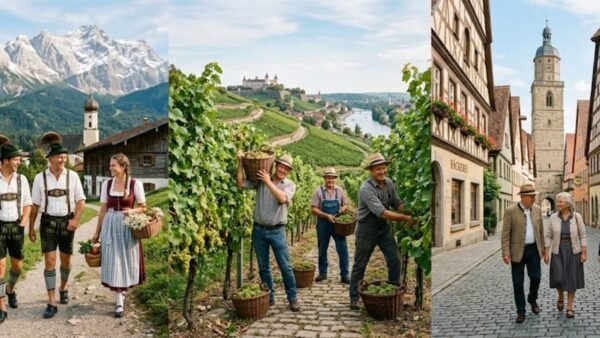
The Starkbierfest — the Strong Beer Festival held in the weeks before Lent — is the pre-Oktoberfest tradition that most outsiders have never heard of and that many Munich residents prefer to the main September event. It originated in the seventeenth century when Paulaner monks began brewing an extremely strong, calorie-dense beer to sustain themselves through the fasting periods of Lent — a theological loophole that turned liquid bread into a liturgical necessity and eventually a public festival. The Schäfflertanz — the Cooper’s Dance — is performed only once every seven years in Munich, a tradition maintained since the mid-eighteenth century by the coopers’ guild, which danced through the streets during a plague year to demonstrate that it was safe to venture outside. The rarity of its occurrence makes each performance a genuine civic event. The Leonhardifahrten — equestrian processions honoring the patron saint of horses and livestock — take place each November in a number of Upper Bavarian communities with a ceremonial seriousness that reflects the agricultural heritage of a region where the working animal was central to survival. The Almabtrieb — the autumn drive of cattle down from summer mountain pastures — is both a genuine working tradition and a celebrated community festival, with the lead cow traditionally decorated with elaborate flower and herb arrangements in a ritual that marks the transition from summer abundance to winter preparation.
Part 8: Politics and Economics
The CSU — Bavaria’s Own Political Party
The Christlich-Soziale Union — the Christian Social Union — is the only major political party in Germany that operates in a single state. It exists nowhere outside Bavaria, contests no elections outside Bavaria, and represents Bavarian interests within the national political system through its formal alliance with the CDU — a sister relationship that has produced tensions precisely because the CSU is not merely a regional branch of the CDU but a genuinely distinct political entity with its own priorities, its own voter base, and its own understanding of what Germany should be. Bavaria has returned the CSU to power in state elections with remarkable consistency since 1957, a record of electoral dominance unmatched by any other party in any other German state. The CSU’s political character — Catholic-social conservatism combined with aggressive regional identity politics, strong support for Bavarian economic interests, and a cultural philosophy that treats Bavarian tradition as a political resource rather than a museum artifact — reflects the Bavarian electorate’s own character with considerable accuracy.
Bavaria’s Economic Power and What It Creates
Bavaria’s economic transformation over the seventy years since World War Two is among the most remarkable regional economic stories in postwar European history. In 1945, Bavaria was Germany’s poorest state — predominantly agricultural, lacking the industrial base of the Ruhr, the commercial infrastructure of Hamburg, or the administrative power of the Prussian core. By the early twenty-first century, Bavaria had become Germany’s wealthiest state by GDP, home to BMW, Siemens, Allianz, Adidas, and MAN among dozens of other major international corporations, and the site of a technology and innovation cluster centered on Munich that rivals any in Europe. This economic transformation is a source of enormous Bavarian pride and a source of significant resentment directed at the federal Länderfinanzausgleich — the fiscal equalization system through which Germany’s wealthier states transfer revenues to poorer ones. Bavaria, which was a beneficiary of this system for most of the postwar period, became a net contributor as its economy grew and now pays among the largest transfers of any state — a situation its politicians address publicly and repeatedly as evidence that Bavarian success funds federal redistribution that Bavarians did not choose and do not entirely accept.
Part 9: Bavaria vs Specific German Regions
Bavaria vs Berlin — The Great German Cultural Divide
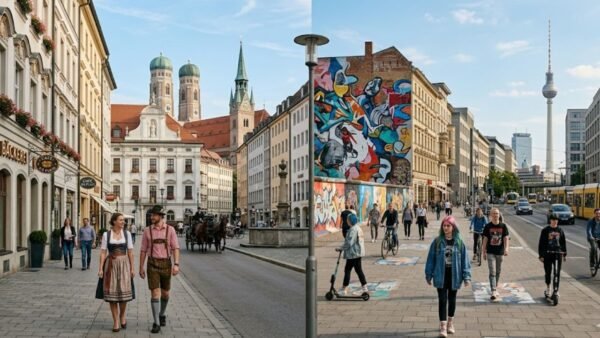
No cultural contrast within Germany is sharper or more immediately legible to outsiders than the one between Bavaria and Berlin. Munich is wealthy, conservative, clean, expensive, punctual, orderly, and organized around the Catholic tradition of community and celebration. Berlin is secular, progressive, cosmopolitan, affordable by comparison, creatively anarchic, and shaped by the particular history of a city that was divided, destroyed, rebuilt, divided again, reunified, and transformed into a global capital of counterculture within the span of a single lifetime. Munich and Berlin represent two entirely legitimate visions of what a great German city can be — and each city contains a significant number of people who find the other city’s vision genuinely baffling. The Munich resident who visits Berlin for the first time is often struck by the absence of the orderliness and the community infrastructure — the Biergarten, the Stammtisch, the Vereinskultur — that structures Bavarian social life. The Berlin resident who visits Munich is sometimes struck by what feels like a conservatism and a social conformity that Munich’s considerable cosmopolitan credentials do not entirely dispel.
Bavaria vs North Rhine-Westphalia
The comparison between Bavaria and North Rhine-Westphalia illuminates the industrial-versus-agricultural dimension of German regional difference. NRW is the Ruhr — coal mines, steel mills, the dense urban agglomeration of Dortmund, Essen, Düsseldorf, and Cologne packed into a landscape that was the engine of German industrialization and the site of its most severe postwar economic restructuring. The working-class identity of the Ruhr is as fierce and as specific as Bavarian identity, rooted in the solidarity of industrial labor rather than the community infrastructure of Alpine agriculture. The beer rivalry between Cologne’s Kölsch and Munich’s Helles is the most accessible expression of a broader cultural difference — the Cologne Köbes who appears automatically with another tiny glass the moment yours is empty operates by a completely different hospitality logic from the Bavarian Biergarten, where you order when you are ready and the rhythm of the table is yours to control.
Bavaria vs Saxony
Saxony and Bavaria share more than their outsider status within the larger German identity narrative. Both are former independent kingdoms — Saxony with its own royal house and its own long tradition of cultural production centered on Dresden and Leipzig. Both have dialects that are distinctive enough to mark their speakers immediately in any German context. Both maintained cultural identities that predate the Prussian-dominated unification and that survived it with considerable continuity. The political contrast between them in the contemporary period is stark: Saxony has become a stronghold for the far-right AfD party in a way that reflects the particular economic and social dislocations of the post-reunification east, while Bavaria’s conservatism is organized around the CSU’s Catholic-social tradition and has been resistant to the AfD’s appeal. Two states with comparable historical independence and comparable dialect richness have arrived at very different contemporary political identities — a fact that illustrates how regional distinctiveness does not map neatly onto a single political tendency.
Part 10: How Bavarians and Other Germans See Each Other
How Bavarians View the Rest of Germany
The word Saupreiss — literally “Prussian pig,” used by Bavarians to describe northern Germans — is simultaneously a genuine historical insult with roots in real political conflict and a semi-affectionate characterization that many Bavarians deploy with more humor than hostility in contemporary usage. Its persistence reflects something real: the sense that northern Germans are overly serious, insufficiently relaxed, constitutionally unable to enjoy a Tuesday afternoon in a Biergarten without feeling that they should be accomplishing something, and generally in possession of a work ethic that, from a Bavarian perspective, has misidentified productivity as the point of a human life. The humor in this characterization is genuine — Bavarians find northern German stiffness genuinely funny rather than genuinely threatening — but beneath the humor is a real value difference about what life is for. Younger Bavarians navigate this identity with more fluidity than their grandparents’ generation, particularly in Munich, where the city’s massive expat population — German and international — has created a cosmopolitan social environment in which Bavarian identity is one option among many rather than the default operating system of every social situation.
How Other Germans View Bavaria
Non-Bavarian Germans hold a complex set of simultaneous attitudes toward Bavaria that cannot be reduced to either straightforward admiration or straightforward resentment, though both elements are genuinely present. The admiration is for the landscape, the food, the festival culture, the economic success, and the clarity of cultural identity that Bavaria projects — qualities that many other German regions feel they lack in equivalent measure. The envy is for the same things, particularly the political stability and the cultural confidence that make Bavaria feel like a place that knows what it is. The frustration is directed at Bavarian exceptionalism — the political positioning of Bavaria as a special case deserving special treatment that other states sometimes experience as arrogance dressed up as principle. And somewhere beneath all of this is a particular kind of affection, the kind that northern Germans extend toward the Schuhplattler dance and the Weißwurst breakfast and the Dirndl and Lederhosen at Oktoberfest — charming, sometimes baffling, distinctively not-them, and somehow comforting in its continuity with a version of German culture that the industrial and postwar north feels it lost or never had.
Part 11: Tradition vs Modernity
How Bavaria Balances Old and New
The tension between Bavaria’s traditional identity and its position as one of Europe’s most economically modern regions is genuine and productive rather than merely paradoxical. BMW’s global headquarters sit twenty minutes from villages where Tracht is worn to Sunday Mass as a matter of course rather than deliberate statement. Siemens engineers who relocated from Berlin or Frankfurt find themselves at company picnics organized by Trachtenvereine, eating Weißwurst at outdoor long tables in October. Adidas — founded in Herzogenaurach, Franconia — is one of the world’s most globally distributed consumer brands and simultaneously a product of the very specific craft-and-manufacture culture of provincial Bavarian industry. The coexistence of high-technology economic output with deep traditional cultural practice is not incidental to Bavaria’s identity — it is central to it, and Bavarian companies are conscious and deliberate in their use of traditional identity as a branding resource in ways that reflect a genuine rather than performed relationship to that tradition.
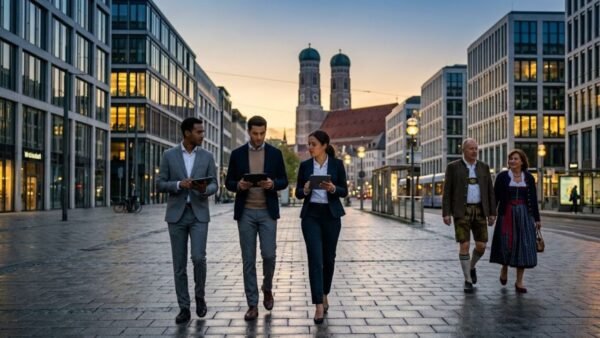
Young Bavarians are navigating global citizenship and local tradition with considerable creativity. Bairisch dialect is finding new audiences on TikTok among young people who might have abandoned it in previous generations. Dirndl fashion has moved from Trachtenverein performances into Munich Fashion Week. The Almabtrieb is documented on Instagram with a care and aesthetic sophistication that serves the tradition’s continuation rather than commodifying it into irrelevance. Oktoberfest is experienced by young Bavarians simultaneously as a genuine cultural inheritance, a commercial spectacle they approach with some ambivalence, and a context in which their own Tracht — authentic, fitted, carefully chosen from quality makers — distinguishes them visibly from the tourist-market costume versions that surround them. The tension between old and new is not a crisis for Bavarian identity. It is the condition in which that identity has always grown.
Conclusion: Mia San Mia
Return to the dinner table in Munich. The Bavarian who corrected you — gently, factually, with the confidence of someone stating something they consider obvious — was not being nationalistic or provincial or difficult. They were describing their actual experience of themselves. An experience shaped by 1,400 years of political sovereignty followed by 154 years of negotiated integration into a German state that was built on Prussian values Bavaria never shared. An experience organized around a Catholic calendar that structures time differently, a dialect that encodes identity in every vowel, a food culture that insists on eating together properly, a festival tradition that creates community through shared ritual, and a political culture that has consistently preferred its own party, its own policies, and its own pace.
Bavaria is Germany. It is also something older, prouder, and more specifically itself than that designation fully captures — a civilization that happened to be absorbed into a country rather than a region that happened to develop some local color. The history is real, the language is real, the religion is real, the food is real, the political difference is real, and the identity is real. Mia san mia is not a boast. It is a description. And understanding what it describes — the complete picture this guide has tried to provide — is the beginning of understanding Bavaria rather than merely visiting it. For those who want to engage with Bavarian culture through its most expressive tradition, the complete collections of Bavarian Dirndl dresses, men’s Lederhosen, Bavarian Trachten shirts, and the full range of German Oktoberfest attire are available at GermanAttire, alongside the complete cultural blog that explores Bavarian and German tradition in the depth it deserves.
Frequently Asked Questions
Are Bavarians considered German?
Yes — Bavarians are German citizens — but many consider themselves Bavarian first and German second. Bavaria was an independent kingdom until 1871, only 154 years ago, and maintains its own dominant political party, its own dialect, its own Catholic holiday calendar, and a regional identity that runs deeper and more consistently than any other German state’s sense of distinctiveness.
Do Bavarians speak a different language than Germans?
Bavarians speak Bairisch — an Upper German dialect group linguistically distinct from standard German in grammar, vocabulary, and phonology. In deep rural dialect, northern Germans genuinely struggle to follow Bavarian speech. Most Bavarians code-switch between dialect and Hochdeutsch depending on context. Bairisch is not merely a regional accent — it has distinct structural features that mark it as a separate dialect system within the German language family.
Why do Bavarians say Grüß Gott instead of Hallo?
Grüß Gott — “God’s greeting to you” — is the Catholic greeting traditional in Bavaria and Austria, reflecting the Catholic religious framework that structures Bavarian social life. It has no currency in the secular north, where Hallo or regional alternatives like Moin are standard. The greeting you use reveals your cultural and geographic origin as precisely as your dialect. Using Grüß Gott in Hamburg would feel theatrical; using Hallo with a Bavarian shopkeeper feels abrupt and vaguely cold.
What is the difference between Bavarian and German food?
Bavarian food is hearty, pork-forward, ceremonial, and communal — centered on Weißwurst, Schweinshaxe, Obatzda, Knödel, and the Brotzeit cold-meal tradition. Northern German food is simpler, more fish-forward in coastal areas, and more functional in its relationship to the meal as a fueling event. Bavarian food is inseparable from the social ritual of eating together — with beer, at long tables, without rushing. The philosophies behind the meals are as different as the dishes themselves.
Why is Bavaria so Catholic compared to northern Germany?
Bavaria remained emphatically Catholic during the Protestant Reformation while northern and central Germany adopted Lutheranism extensively. The Wittelsbach dynasty was a pillar of the Counter-Reformation. This single historical difference ripples into holidays, social organization, work culture, community structure, art, and architecture — making Catholic Bavaria and Protestant northern Germany fundamentally different cultural environments that have been sharing a passport for only 154 years.
What does Mia san mia mean?
Mia san mia is Bavarian dialect for “We are who we are” — the four-word summation of Bavarian identity and self-assurance. It is the unofficial Bavarian motto, the psychological foundation of the regional identity, and the philosophy of a culture that has consistently declined to define itself by external expectations. It is also the name of FC Bayern Munich’s championship philosophy. No other German regional identity has a phrase that functions with equivalent weight and universality.
What is the CSU and why does it only exist in Bavaria?
The Christlich-Soziale Union is the only major German political party operating in a single state. It exists only in Bavaria, contests only Bavarian elections, and represents Bavarian interests nationally through a formal alliance with the CDU. Bayern has returned the CSU to power with remarkable consistency since 1957. Its Catholic-social conservatism, aggressive regional identity politics, and Bavarian exceptionalism philosophy reflect its electorate’s character with considerable accuracy.
Is Bavaria the richest state in Germany?
Yes. Bavaria transformed from Germany’s poorest state in 1945 to its wealthiest by GDP, home to BMW, Siemens, Allianz, Adidas, and MAN among other major international corporations. This economic miracle is a major source of Bavarian pride and the basis for the state’s vocal resentment of the Länderfinanzausgleich — the fiscal equalization system through which Bavaria now pays among the largest transfers to poorer states in Germany.
What is a Stammtisch?
A Stammtisch is a reserved regular table at a Gasthaus, restaurant, or Biergarten where the same group — farmers, craftsmen, professionals, friends — gathers on the same evening each week. It is the social glue of Bavarian community life, a forum for conversation, local opinion, and informal community governance. Bavaria has a higher density of Stammtisch culture than any other German region, reflecting the Catholic tradition of communal social life that distinguishes the south from the more individualistic urban north.
What is the Reinheitsgebot?
The Reinheitsgebot — the Beer Purity Law of 1516 — is the oldest food safety regulation in the world still in active use. Enacted by Duke Wilhelm IV of Bavaria, it specified that beer could only be brewed using water, barley, and hops. It was a Bavarian law before there was a Germany and remains the foundational document of Bavarian beer identity, defining the standards to which Bavarian breweries hold themselves and their resistance to the global craft beer movement’s experimental tendencies.
Why do Bavarians call northern Germans Saupreiss?
Saupreiss — literally “Prussian pig” — is Bavarian slang for northern Germans reflecting genuine historical conflict. Bavaria fought against Prussia in the Austro-Prussian War of 1866, lost, and was absorbed into a Germany built on Prussian values it never shared. In contemporary usage it is deployed with more humor than hostility — Bavarian bemusement at northern seriousness and inability to relax — but the historical resentment beneath the humor is real and structurally grounded.
Is Franconia really part of Bavaria?
Administratively yes — Franconia is part of the state of Bavaria. Culturally the relationship is contested. Franconia is largely Protestant, wine-drinking rather than beer-drinking, has its own distinct dialect, and a significant proportion of its population identifies as Franconian first and Bavarian reluctantly second. The Franconian identity debate is a miniature version of the Bavaria-versus-Germany argument played out one level down in the regional hierarchy — the same dynamic of a historically distinct culture sharing an administrative category it did not fully choose.
What is the Almabtrieb?
The Almabtrieb is the autumn cattle drive in which livestock are brought down from summer Alpine pastures to winter valley barns. It is both a genuine working agricultural tradition and a celebrated community festival — the lead cow is traditionally decorated with elaborate flower and herb arrangements. It marks the transition from summer abundance to winter preparation and is one of Bavaria’s most authentically rooted seasonal traditions, with no equivalent in northern German cultural life.
What is Bavarian Tracht?
Tracht is Bavarian traditional dress — Dirndl for women, Lederhosen for men — worn as living daily clothing rather than as a costume or folkloric artifact. Each Alpine valley historically developed its own distinct Tracht style encoding regional identity in specific embroidery, colors, and cut. Trachtenvereine preserve these regional traditions with considerable seriousness. Modern Bavarians wear Tracht at festivals, Sunday Mass, community events, and restaurant dinners as a natural expression of cultural identity, not as a deliberate statement.
What does Servus mean in Bavarian?
Servus derives from the Latin for “servant” and functions in Bavarian and Austrian usage as both a hello and a goodbye — a dual-purpose flexibility that makes it particularly useful in casual settings. It is used throughout Bavaria and Austria and nowhere in northern Germany, making it an immediate cultural identity marker. Using or hearing Servus signals membership in the Bavarian-Austrian cultural sphere as precisely as any dialect feature or greeting tradition.

Anna Bauer is a seasoned Bavarian fashion expert, cultural consultant, and heritage stylist with over a decade of hands-on experience in traditional German clothing. Born in Munich, the heart of Bavaria, Anna grew up surrounded by the rich traditions of Trachten fashion. Her passion for cultural attire led her to pursue a degree in Fashion and Textile Design at the prestigious University of the Arts Berlin, where she specialized in European folkwear.
Over the past 12+ years, Anna has collaborated with renowned Trachten designers, styled outfits for Oktoberfest events across Germany, and contributed articles to top fashion and culture magazines across Europe. Her work focuses on preserving the authenticity of Lederhosen and Dirndl wear while helping modern audiences style them with confidence and flair.
As the lead content contributor for German Attire, Anna combines her academic background, professional styling experience, and deep cultural roots to provide readers with valuable insights into traditional German fashion. Her blog posts cover everything from historical origins and styling guides to care tips and festival outfit planning—making her a trusted voice for anyone looking to embrace Bavarian heritage in a stylish, modern way.